The Wilderness, The First Union Offensive Led By Ulysses S. Grant
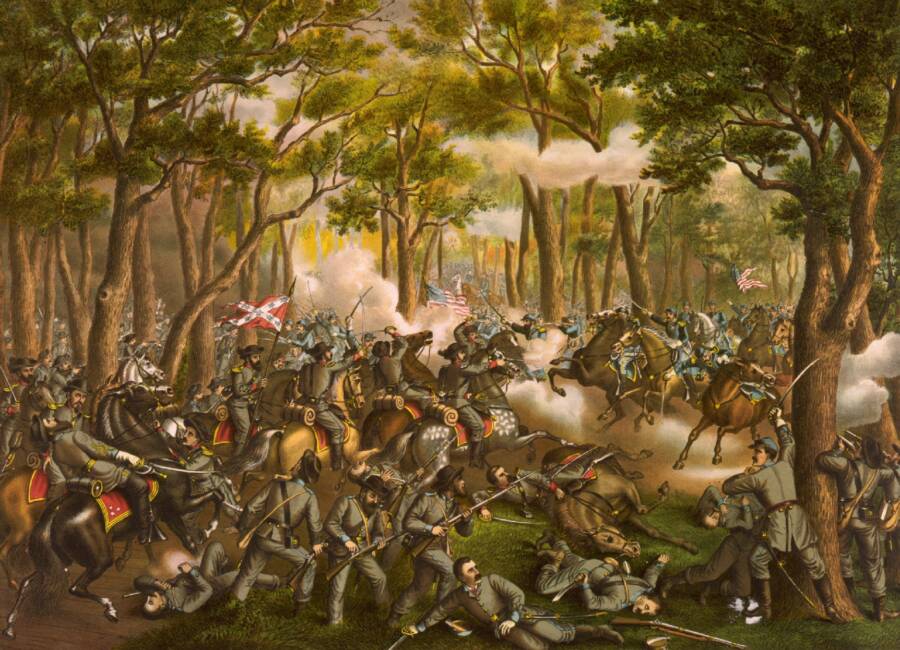
Library of CongressThe Battle of the Wilderness took place in the thick Virginia woods.
Just before the Battle of Spotsylvania was the Battle of the Wilderness. Abraham Lincoln had recently appointed Ulysses S. Grant as general-in-chief of all Union armies, and Grant had promised the president that he would not retreat. Grant proved true to his word.
In May 1864, Grant planned an offensive attack toward the Confederate capital of Richmond. He wanted to pursue Lee, forcing Lee to defend Richmond, while General William T. Sherman marched unmolested toward Georgia. But while Grant planned to move his troops quickly through an expanse of Virginia forest known as the Wilderness before confronting Lee, Lee decided to meet Grant in the Wilderness, which his troops knew better.
Thus, on May 5, 1864, 101,895 Union troops met 61,025 Confederate soldiers in the dense woods. One called the ensuing firefight “bushwhacking on a grand scale” as the two sides attempted to navigate the thick undergrowth and the gunsmoke that soon settled like fog amid the low branches.
After 48 hours, neither side had hardly moved an inch. But they’d each suffered terrible losses. Grant had thrown wave after wave of men at the Confederates, resulting in Union casualties of 17,666, including 2,246 deaths. Lee had fared better, but only slightly, with 11,033 casualties (with 1,477 killed), for a total of 28,699 dead, injured, captured, or missing.
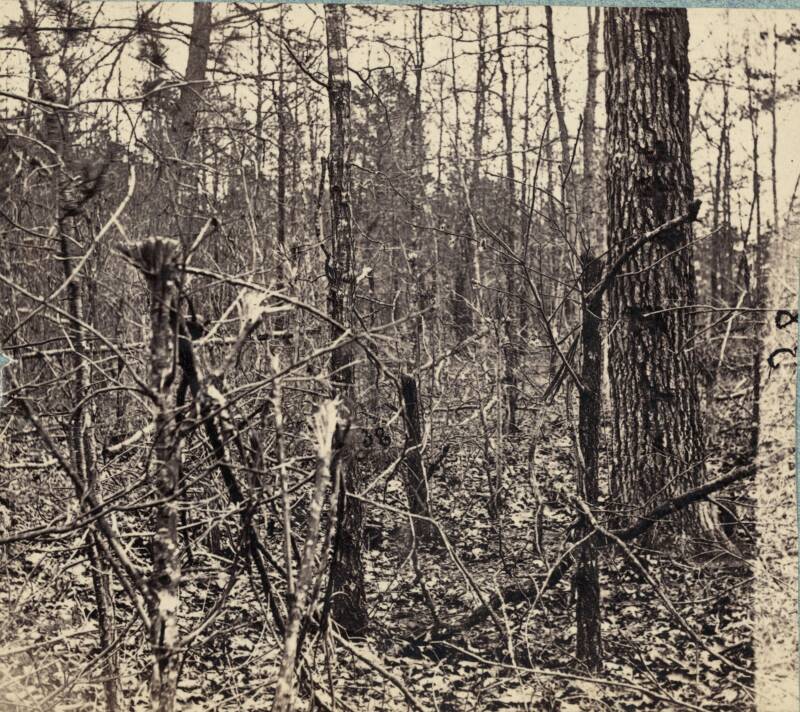
Library of CongressThe thick woods of the “Wilderness.”
Meanwhile, some of Grant’s men began to express doubt in his strategy, urging him to think about what Lee would do next. According to Grant by Ron Chernow, Grant responded to the criticism: “Oh, I am heartily tired of hearing about what Lee is going to do. Some of you always seem to think he is suddenly going to turn a double somersault, and land in our rear and on both of our flanks at the same time. Go back to your command, and try to think what we are going to do ourselves, instead of what Lee is going to do.”
And though the Battle of the Wilderness ended without a victor, Ulysses S. Grant had kept his word to Lincoln. He had not retreated. And to the cheering of his men, he pressed onward — into the South.