‘The Devil’s Own Day’ At The Battle of Shiloh
Public DomainThe Battle of Shiloh shocked the country with its high casualty count.
Some of the other Civil War battles listed here had higher casualties than the Battle of Shiloh, which took place in Tennessee in April 1862. But this Civil War battle was among the first to show the sheer, shocking scale of the conflict.
The battle began on April 6, when Confederate forces led by General Albert Sidney Johnston attacked Union men under the command of Ulysses S. Grant near Shiloh Church in Hardin County, Tennessee. The Union soldiers were caught off guard, and Johnston’s men were able to push them back into defensive positions. But the Confederate drive came at great cost. Johnston, an important general and a friend to Confederate President Jefferson Davis, was shot in the knee and bled to death.
He was replaced by General Pierre G. T. Beauregard, who swiftly claimed victory. Writing to Richmond, Beauregard assured the Confederates that they “had gained complete victory, driving the enemy from every position.”
But Grant wasn’t ready to give up. According to Chernow, Sherman found the general resolutely chewing on a cigar as the day’s battle came to an end. “Well, Grant, we’ve had the devil’s own day, haven’t we?” Sherman said. “Yes,” Grant replied, and then added: “Lick ’em tomorrow, though.”
And he did. Bolstered by reinforcements that arrived in the night, swelling the Union forces from 40,000 to 54,000 men, Grant renewed the attack in the morning. Beauregard, with 34,000 men, suddenly found himself on the defensive. Faced with the terrifying possibility that his own forces might collapse under the onslaught, Beauregard ordered his men to retreat.

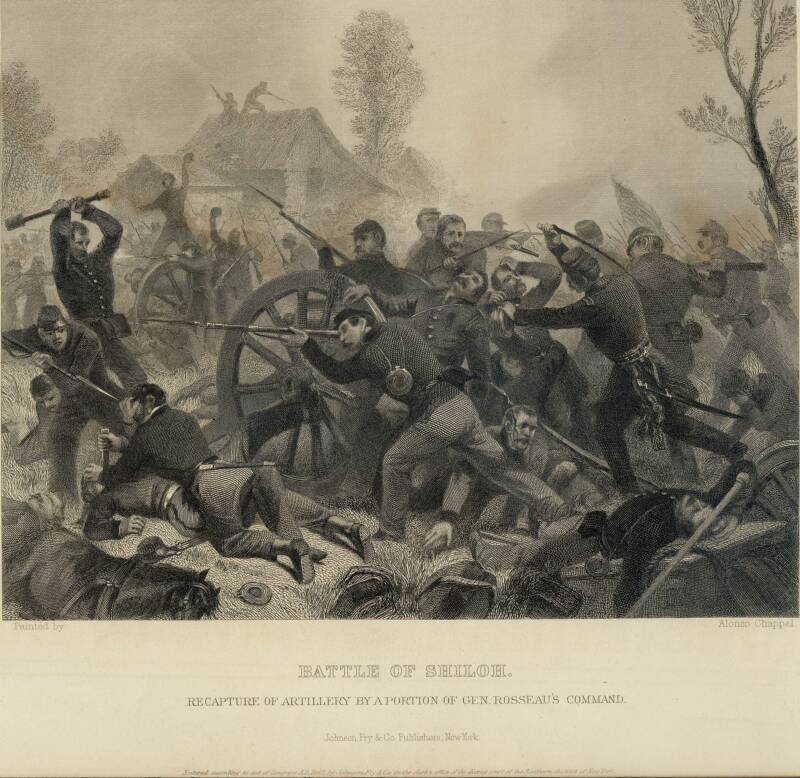
Public DomainA depiction of the Battle of Shiloh, also known as the Battle of Pittsburg Landing.
Thus, the Battle of Shiloh was a Union victory. But it came at great cost. There were 13,047 Union casualties (including 1,754 dead) and 10,669 Confederate casualties (with 1,728 killed), for a total of 23,746. It was a number as shocking to civilians as to the soldiers who’d experienced it. “I saw an open field,” Grant later wrote, “so covered with dead that it would have been possible to walk across the clearing, in any direction, stepping on dead bodies, without a foot touching the ground.”
Grant also faced criticism for how the battle had begun. But Lincoln defended the general, whom he’d come to admire. “I can’t spare this man,” the president purportedly stated. “He fights.”