Antietam, The Bloodiest Single-Day Battle Of The American Civil War
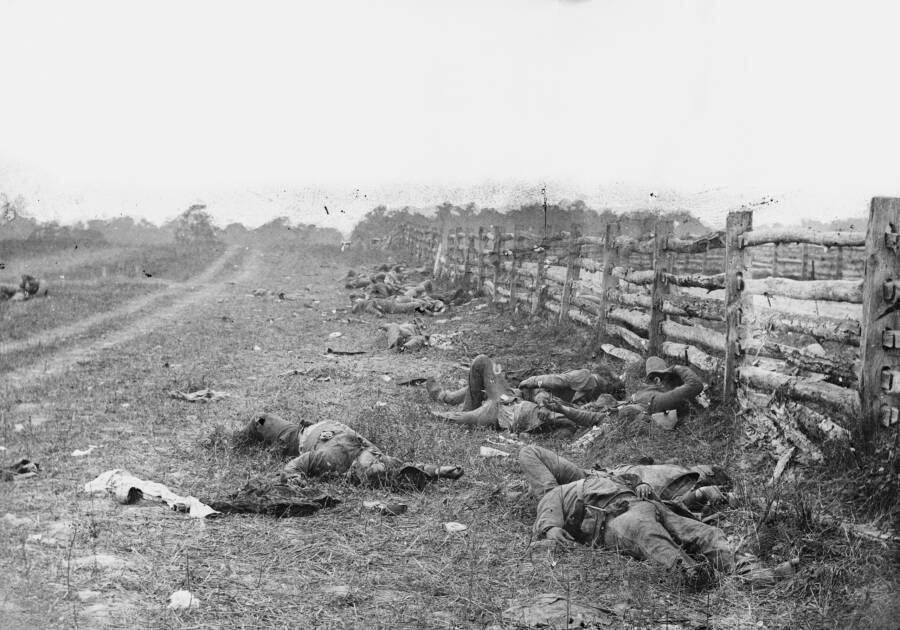
Library of CongressDead soldiers at Antietam, the bloodiest day in American history.
Though other Civil War battles, including the Second Battle of Bull Run and Stones River, had high casualty counts, the Battle of Antietam stands out. The Civil War battle in September 1862 lasted only one day, but it stands as the bloodiest single day in American history.
For Lee, Antietam represented the final push of his campaign to strike in Union territory. After a Confederate victory at the Battle of Harpers Ferry, Lee hoped to push into the North, capture Washington, D.C., and change the course of the conflict. Meanwhile, Abraham Lincoln charged Major General George B. McClellan with defending Washington, D.C. from the Confederate army. Lincoln also hoped for a Union victory to keep Republican control in Congress and to give him a chance to issue the Emancipation Proclamation.
Between Sept. 15 and Sept. 16, Union and Confederate forces gathered near Sharpsburg, Maryland, along a tiny creek called Antietam. And on Sept. 17, the battle began in earnest. Each side launched vicious attacks and counterattacks until the gunfire filled the air and the rifles became hot in the soldiers’ hands.
Watching scores of his men fall to a Confederate attack, Union Major General Joseph Hooker later wrote, “…the slain lay in rows precisely as they had stood in their ranks a few moments before.”
The battle lasted just one day but resulted in jaw-dropping casualties. The Confederate forces had suffered 10,316 casualties (with 1,546 dead); the Union forces had 12,401 (including 2,108 killed), for a total of 22,717. Much of the carnage was also captured by Civil War photographers like Alexander Gardner, giving American civilians a never-before-seen look at Civil War dead.
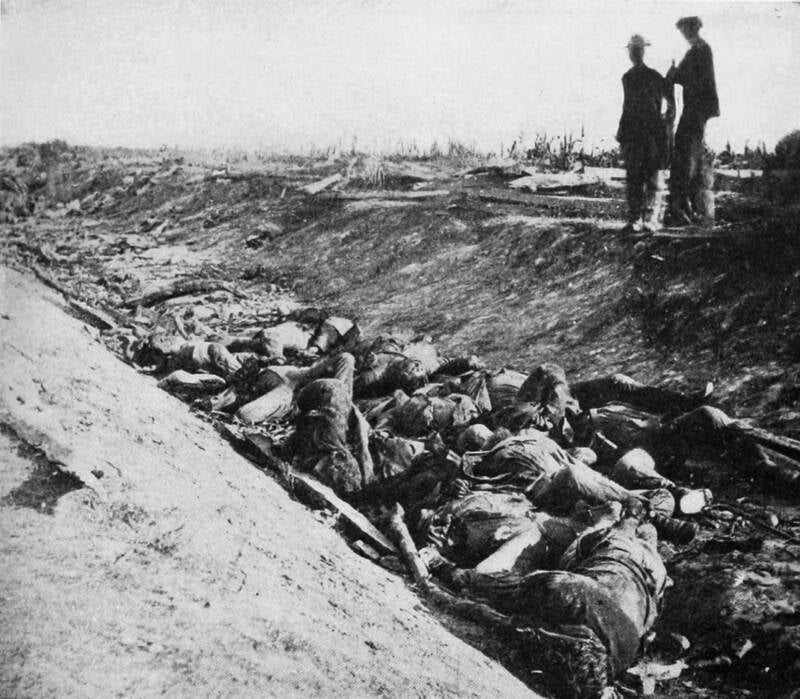
Public DomainConfederate dead at Antietam, as photographed by Alexander Gardner.
Though the battle was technically a draw, the Union was able to claim victory because Lee abandoned his plans to attack the North. Lincoln thus took the opportunity to announce the Emancipation Proclamation — forever changing the course of American history — in which he declared that enslaved people in Confederate territory “shall be then, thenceforward, and forever free.”
In the end, these Civil War battles are just a small part of the larger conflict, which endured from 1861 until 1865, and resulted in at least 600,000 deaths.
After reading about the bloodiest battles of the Civil War, discover the strange story of Wilmer McLean, the man who saw the Civil War begin in his front yard — and watched it end in his parlor. Or, learn the heroic stories of Black soldiers who served in the American Civil War.