Around 620,000 men died during the Civil War — roughly two percent of the United States' population at the time.
After the battle of Cold Harbor in the spring of 1864, Ulysses S. Grant was called a “butcher.” The Union general had sent wave after wave of Union soldiers against entrenched Confederates near Mechanicsville, Virginia, and at one particularly bloody point in the fighting, some 7,000 men were killed or wounded in just 30 minutes. But Cold Harbor was far from the bloodiest Civil War battle to take place during the course of the conflict.
During the war, which lasted from 1861 to 1865, hundreds of thousands of Americans lost their lives. The horrors of Spotsylvania and Shiloh left fields of dead, and Chickamauga and Chancellorsville resulted in tens of thousands of casualties. At Shiloh, the carnage was such that General William T. Sherman remarked that it could “have cured anybody of war.”
These are the harrowing stories of seven of the bloodiest battles of the Civil War, from Gettysburg to the Wilderness to Antietam.
Gettysburg, The Bloodiest Battle Of The Civil War
On June 3, 1865, Confederate soldiers marched north toward Pennsylvania. They were ebullient. The war was going well for the South, so well that Confederate General Robert E. Lee expected that a decisive victory in Union territory could force peace talks. Instead, the Battle of Gettysburg, which broke out a month later on July 1, would become one of the bloodiest battles of the Civil War. And it would end in a resounding Union victory.
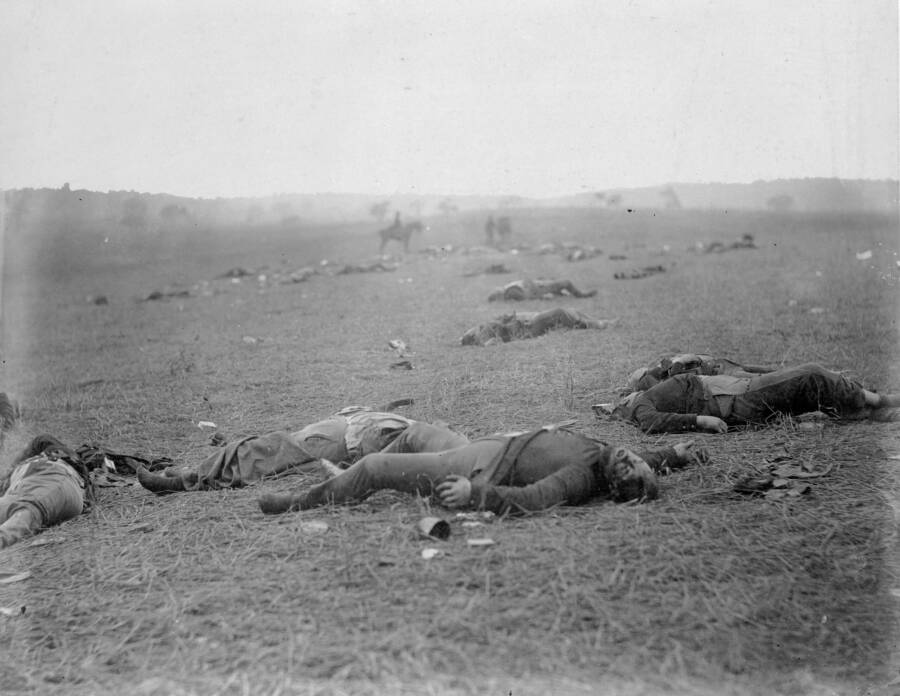
Public DomainOver 7,000 Confederate and Union soldiers lost their lives during the Battle of Gettysburg, which raged for three days in the summer of 1863.
On the first day of July 1863, 93,000 Union troops met 71,000 Confederate soldiers in the tiny Pennsylvanian hamlet of Gettysburg. Though the Confederates were initially able to overwhelm the Union soldiers, the tide began to shift on the second day of battle. Then, Union forces held their ground. Lieutenant Colonel Joshua Chamberlain and the 20th Maine Infantry were even able to repel Confederate forces at Little Round Top by running straight at the enemy with nothing but their bayonets.
Then, during fierce fighting on the third and final day of the Battle of Gettysburg, Lee focused his assault on the center of the Union line. That afternoon, three divisions of around 12,500 Confederate men flung themselves at Union forces stationed along Cemetery Ridge. But the attack — dubbed Pickett’s Charge after General George E. Pickett, who was, in fact, just one of three generals involved — was a massive failure.
The Union troops stood their ground. And over the course of just an hour, the Confederates suffered 6,555 casualties. The failed assault up the ridge became known as the “High-Water Mark of the Confederacy,” and, indeed, it would spell the beginning of the end for the Confederacy itself.
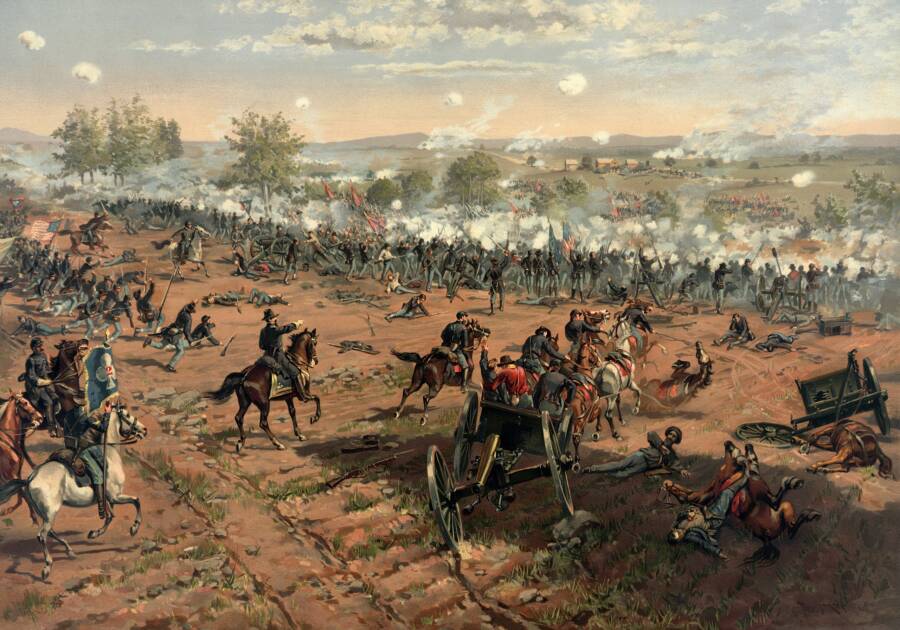
Library of CongressA depiction of Pickett’s Charge, which also became known as the “High-Water Mark of the Confederacy.”
By the time the Battle of Gettysburg ended on July 3, 1863, both sides had suffered unthinkable losses. The Union had an estimated 23,049 casualties; the Confederates 28,063, for a total of 51,112. It was a Union victory, but Gettysburg was also the bloodiest battle of the Civil War, one of the deadliest days in American history, and a sharp reminder of the stakes of the conflict.
Speaking at the site on Nov. 19, President Abraham Lincoln famously promised: “…that these dead shall not have died in vain — that this nation, under God, shall have a new birth of freedom — and that government of the people, by the people, for the people, shall not perish from the Earth.”