The Costa Concordia capsized on the night of January 13, 2012, and the ship’s captain was later found guilty of manslaughter and other charges.
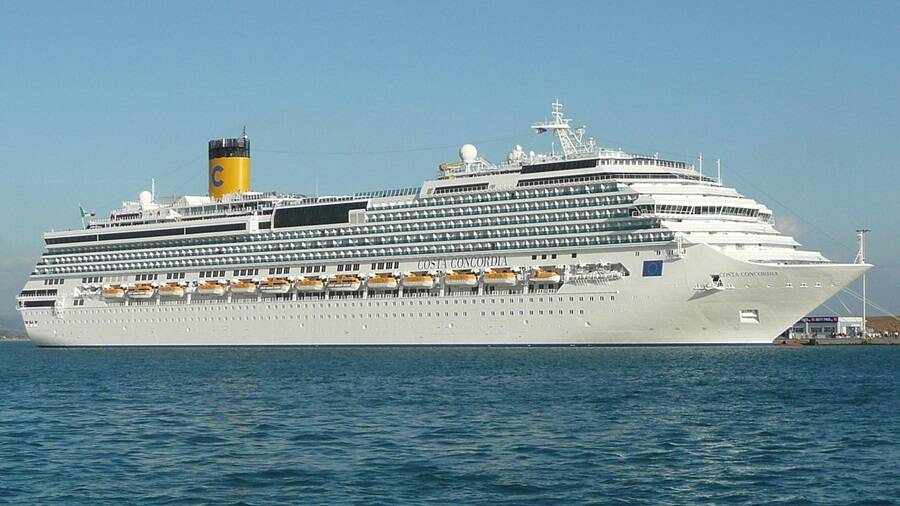
Robert Lender/Wikimedia CommonsThe Costa Concordia, a 114,000-ton cruise ship, was among the largest cruise ships built in Italy.
On Jan. 13, 2012, the Italian cruise ship Costa Concordia set out on what should have been a routine Mediterranean voyage. Thousands of people — families, couples, and retirees — boarded the massive vessel expecting a week of luxury at sea. Instead, the first day of the ship’s journey ended in a tragedy that no one could have imagined.
By the next morning, 32 people were dead, and thousands were stranded on a tiny Italian island. One of the largest cruise ships ever built lay on its side just offshore, slowly sinking into the water.
What had happened to the ship? The Costa Concordia disaster was ultimately a tale of poor decision making by its crew, which sadly cost dozens of human lives.
A Luxurious City At Sea
When the Costa Concordia entered service in 2006, it was one of the largest cruise ships ever constructed. The massive vessel stretched 952 feet long, weighed more than 114,000 tons, and could carry over 3,700 passengers alongside 1,100 crew members. It was thus far larger than the Titanic.
And the ship was not only large — it was luxurious. Inside, every imaginable comfort awaited guests, including swimming pools, a movie theater, bars and nightclubs, a casino, and a luxury spa. The ship felt like a city at sea.
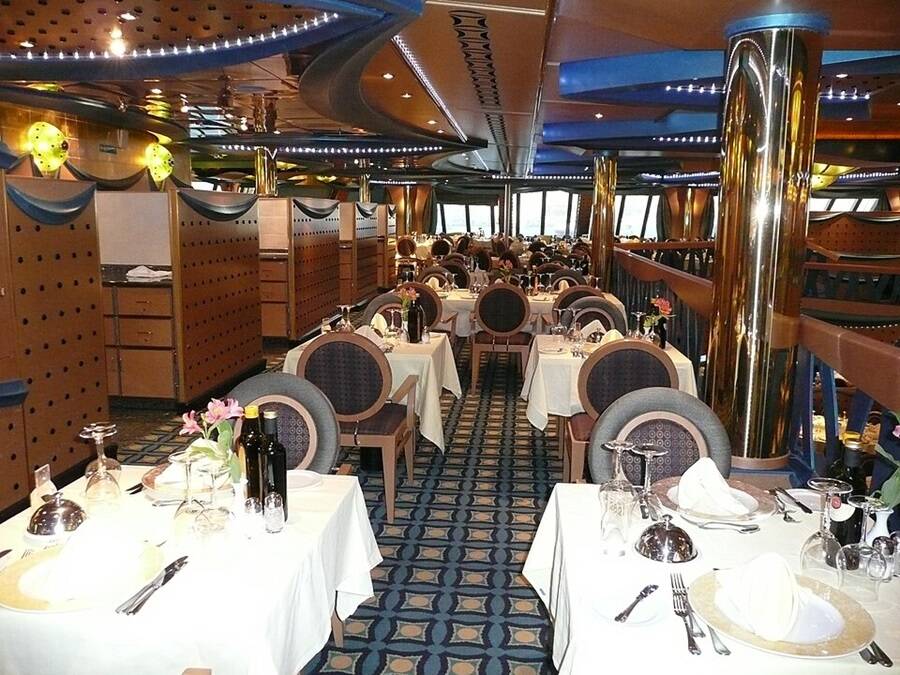
Robert Lender/Wikimedia CommonsInside the Costa Concordia’s dining room, where many passengers were eating dinner when the ship lost power and began listing.
The first five years of its service passed largely without incident — aside from when high winds pushed the ship against a dock in Palermo, Italy, in 2008, damaging its bow. As such, the Costa Concordia’s planned cruise in January 2012 was expected to proceed as normal.
The voyage was intended to be a seven-day Mediterranean cruise, leaving from Rome’s port of Civitavecchia, with stops in Italy, France, and Spain. For the 3,206 passengers onboard, the first night of the cruise was supposed to be the beginning of a carefree vacation.
But it would end up being one of the worst nights of their lives.
How The Costa Concordia Disaster Began
Just after 7:00 p.m., the Costa Concordia left Civitavecchia. A few hours later, it sailed toward Giglio Island, a small rocky outcrop off the Tuscan coast. Instead of staying on its planned course, the ship moved closer to shore.
The ship’s captain, Francesco Schettino, had ordered a sail-by salute, a tradition meant to impress locals by passing near land. He had performed similar salutes before without incident, although Schettino would later be accused of ordering this particular salute in order to impress his girlfriend.
At 9:40 p.m., Schettino called his former mentor, Senior Captain Mario Palombo, who lived on Giglio. He told Palombo the ship would sound its horn as a tribute while passing by. Palombo said he wasn’t on the island that night, and according to Vanity Fair, advised Schettino to only quickly honk his horn and to stay far from the shore. Moments later, disaster struck.
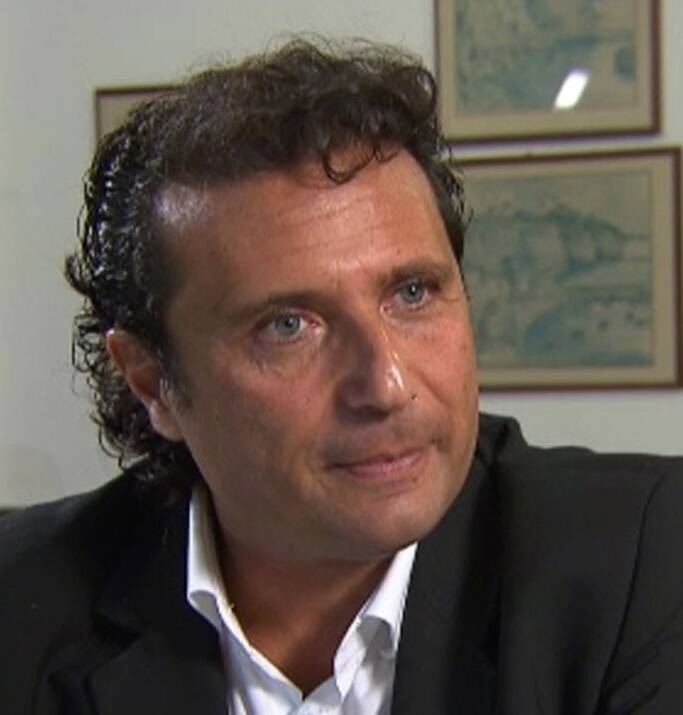
YouTubeFrancesco Schettino, the captain of the Costa Concordia.
At 9:45 p.m., the Costa Concordia struck a reef known as the Scole Rocks. The collision tore a huge gash along the port side, measuring 115 to 174 feet, flooding the engine rooms and cutting power to the ship.
Inside, the lights went dark. Passengers heard banging noises and the sound of the ship groaning, but not everyone immediately realized that something was wrong. According to CNN, when the ship’s lights went out during a magic show, some passengers thought it was just part of the act. But then the ship began to list sharply to the starboard side. In the dining areas, dishes, tables, and people tumbled down. Elsewhere, in an ironic twist, the the Oscar-winning song “My Heart Will Go On,” from the film Titanic played.
Fifteen minutes after the initial collision, Schettino called Roberto Ferrarini, the ship’s crisis coordinator. He initially downplayed the damage to the ship, saying that just one compartment was flooded. Over two subsequent conversations with Ferrarina, Schettino admitted that two compartments were flooded (in fact five were flooded).
“I have made a mess and practically the whole ship is flooding,” Schettino told Ferrarini. “What should I say to the media?… To the port authorities I have said that we had… a blackout.”
Panic On The Costa Concordia As The Ship Sank
Schettino had called Ferrarini, but the first calls to the Italian Search and Rescue Authority did not come from the ship, but from the shore — a passenger’s mother had called the police after learning that the passengers were putting on life jackets. Search and Rescue then called Schettino.
But the captain didn’t initially reveal the full truth of the Costa Concordia disaster. It wasn’t until 10:22 p.m. that he admitted that the ship had had a “failure” and needed help. And at 10:33 p.m., passengers were ordered to make their way to muster stations and await instructions.
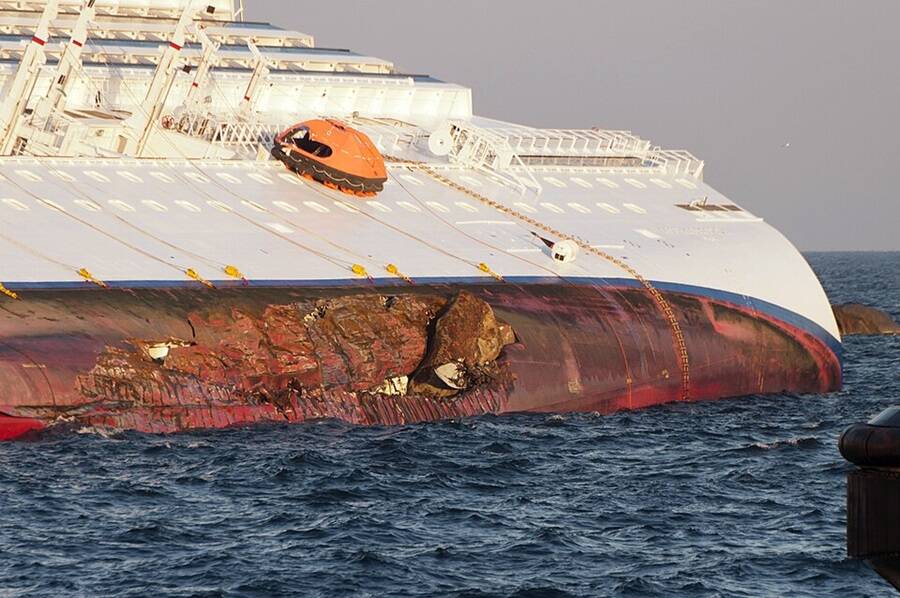
YouTube The port side of the Costa Concordia after capsizing.
However, by this point, that was easier said than done. The ship had tilted more than 30 degrees, making navigating its labyrinth of corridors extremely difficult. What’s more, some passengers claimed that they never heard the instructions to proceed to the lifeboats though, at 10:54 p.m., Schettino had given the order to abandon ship.
As the Costa Concordia tilted more steeply, passengers were forced to climb slanted corridors to reach lifeboats. Some jumped into the cold water and attempted to swim toward shore, more than 300 feet away. Those who waited to get onto a lifeboat found themselves facing utter chaos as the passengers elbowed each other to escape the ship.
Meanwhile, by 11:19 p.m., Schettino had abandoned the vessel.
He later claimed that he had fallen into a lifeboat because of the listing of the ship, but a coast guard member who encountered him angrily told the captain: “Vada a bordo, cazzo!” — “Get back on board!”
Meanwhile, Giglio Island’s deputy mayor, Mario Pellegrini, had raced toward the scene from shore to help. To his shock, he couldn’t find any senior officers on board — just one “young, a second-class officer,” as he later told the BBC. The two worked together to navigate passengers toward the lifeboats and, by 12:15 a.m., almost everyone from the Costa Concordia’s starboard side had escaped the vessel. But then the ship began to roll.
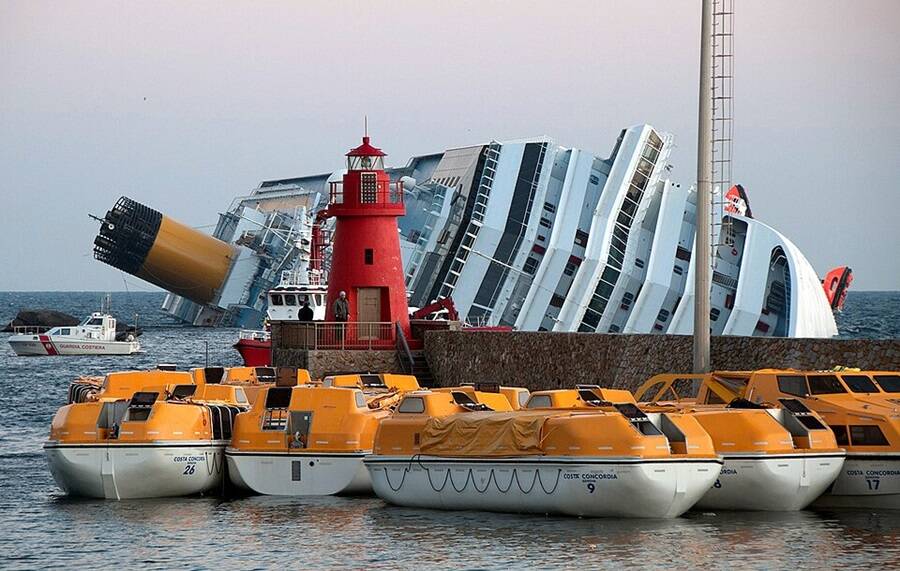
Rvongher/Wikimedia CommonsThe Costa Concordia rests on its side near Giglio Island after running aground on January 13, 2012.
“I couldn’t understand what was going on, the movement was so violent,” Pellegrini told Vanity Fair. “Suddenly it was difficult to stand. It was very disorienting. If you took a step forward, you fell. You couldn’t tell which way was up or down. You couldn’t walk… That’s when the panic hit, and the electricity went out as well. Lights winking out all over.”
The movement of the ship caused seawater to surge down new corridors, trapping passengers throughout the ship. Hundreds of people were still onboard, and Pellegrini and the second-class officer worked until dawn to rescue who they could.
But not everyone could be saved. Thirty-two people lost their lives in the Costa Concordia disaster, both on the ship and in the cold water surrounding it. The last victim’s body was not recovered until November 2014.
The Legal Aftermath Of The Maritime Disaster
In the aftermath of the Costa Concordia disaster, many of the ship’s crew were convicted for their role in the sinking, and several were sentenced to time in prison. Captain Francesco Schettino was found guilty of manslaughter, causing a shipwreck, abandoning ship before passengers and crew were evacuated, and lying to authorities about the disaster. In 2015, he was sentenced to 16 years in prison.
Meanwhile, the wreck of the Costa Concordia sat in the shallow water off the coast of Giglio Island for more than two years. In September 2013, the ship was righted during a massive 19-hour operation.
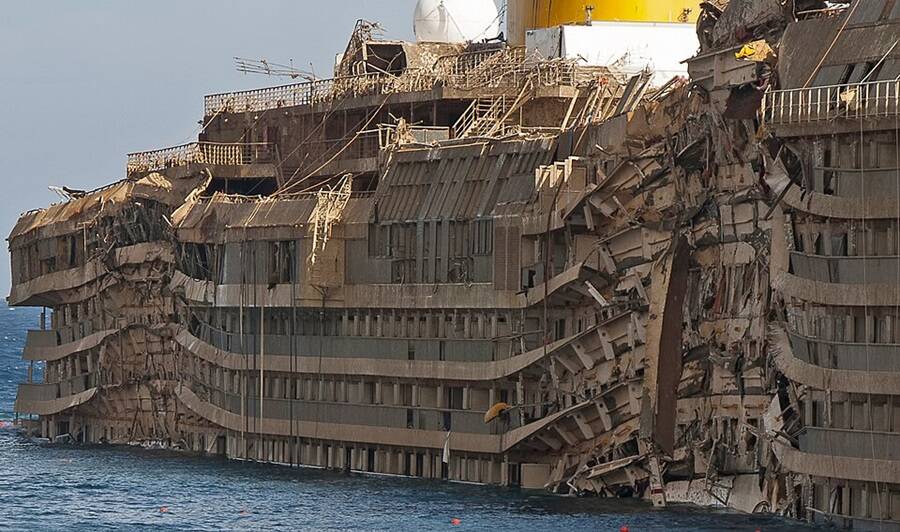
Rvongher/Wikimedia CommonsThe decaying Costa Concordia at Genoa after the disaster that killed 32 people.
By July 2014, the wreck was towed to Genoa for dismantling, and scraping of the ship was completed in 2017. The operation cost nearly $2 billion — more than three times the ship’s original construction price.
But the Costa Concordia disaster cost far more than that. Thirty-two people lost their lives, and thousands were traumatized. Most tragic of all, the Costa Concordia did not sink because of rough conditions at sea, but because of the poor decisions made on its bridge that night.
Crew member Roberto Bosio, who helped dozens of women and children into lifeboats and is believed to have helped coordinate much of the rescue effort throughout the night, said of Captain Schettino: “Only a disgraceful man would have left all those passengers on board. It was the most horrible experience of my life. A tragedy, a heartache that I will carry with me forever.”
Now that you’ve read about the Costa Concordia, read about how researchers found the USS Nevada after 72 years. Then, learn the story of the SS Cotopaxi, the ship that vanished from the Bermuda Triangle in 1925.