Born Charles de Batz de Castelmore, d'Artagnan led France's Musketeers of the Guard from 1644 until his death in battle in 1673.
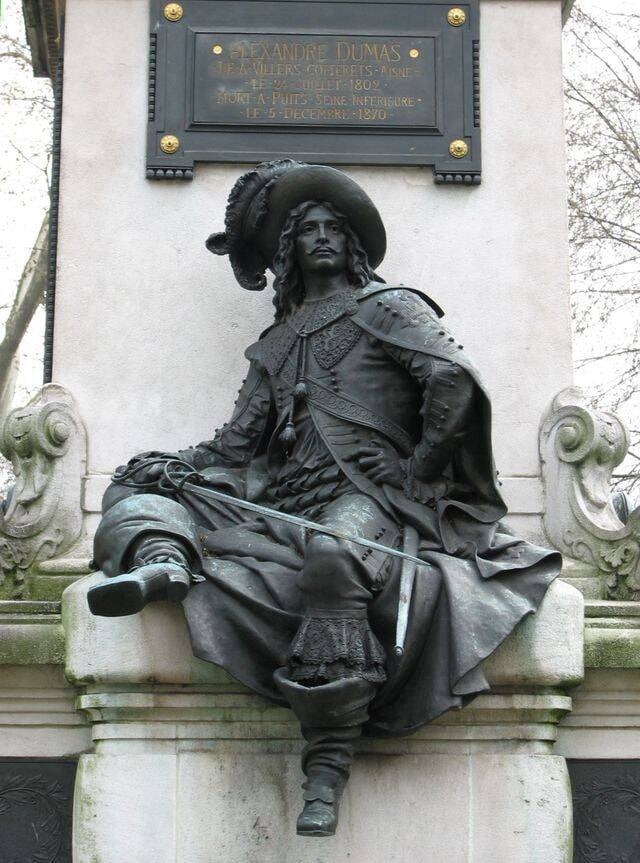
Marimarina/Wikimedia CommonsA statue of d’Artagnan in Paris.
The 19th-century novel The Three Musketeers by Alexandre Dumas is one of the most beloved books of all time. It follows the adventures of a young man named d’Artagnan and his friends, the musketeers Athos, Porthos, and Aramis. But while Dumas took many creative liberties with his story — which he based on a fictional memoir called Mémoires de Monsieur d’Artagnan — d’Artagnan was a real figure who lived in 17th-century France.
His actual name was Charles de Batz de Castelmore, and like the d’Artagnan of Dumas’ story, he lived a colorful, adventurous life. He was a soldier and later a musketeer who served under King Louis XIV.
But though The Three Musketeers has a tidy ending, with d’Artagnan given a prestigious promotion, the real-life d’Artagnan had a more tragic fate.
The Early Life Of Charles De Batz De Castelmore
Though scholars disagree on the exact year of his birth, Charles de Batz de Castelmore was born in the 1610s at the Château de Castelmore near Lupiac, France. He came from a noble but poor family, and he likely had a quiet childhood defined by hunting for pleasure, simple meals like salted pork and gruel, and limited educational instruction.
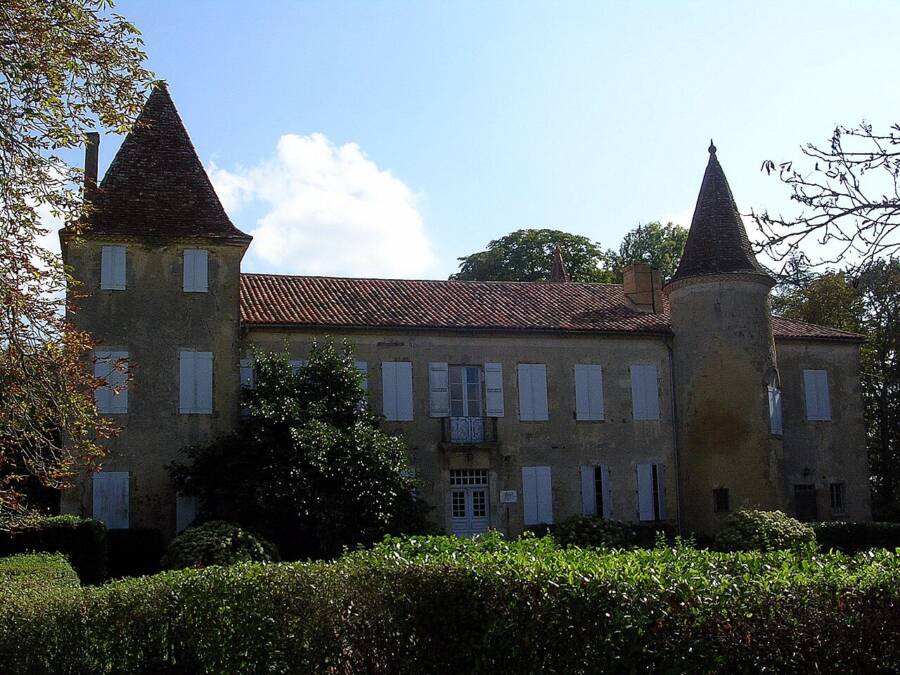
Jibi44/Wikimedia CommonsChâteau de Castelmore, where Charles de Batz de Castelmore was born between 1611 and 1615.
Though he may not have spent much time in school, it seems that young Charles was instructed on how to fight. He would have also likely been regaled with stories of his relatives’ military prowess, and after his older brother left home to become a soldier, Charles soon followed.
When he arrived in Paris in the 1630s, Charles de Batz de Castelmore started using his mother’s family name, d’Artagnan, likely because it had more influence. He first joined the French Guards, an infantry regiment. But he had his eye on the Musketeers of the Guard, the elite fighting company of France’s royal household.
This renowned group was formed in 1622 by King Louis XIII, who served as the commander. The Musketeers drew young, brave men — and d’Artagnan wanted to be one of them.
The Many Adventures Of The Famous Musketeer
In 1644, d’Artagnan got his wish. He joined the Musketeers under the new king, Louis XIV, who was still a child at the time. Over the next decade, the regiment would be disbanded and then reformed, but d’Artagnan remained an important asset to the crown. A seasoned soldier, he spent much of the 1640s serving Cardinal Mazarin, the chief minister.
On the orders of Mazarin, d’Artagnan was sent on a number of important secret missions, such as transporting sensitive intelligence across the country, relaying messages, and using his own judgment to assess strangers and situations. He traveled between the French court and distant battlefields, gathering intelligence, monitoring troop movements, and carrying orders to various armies.
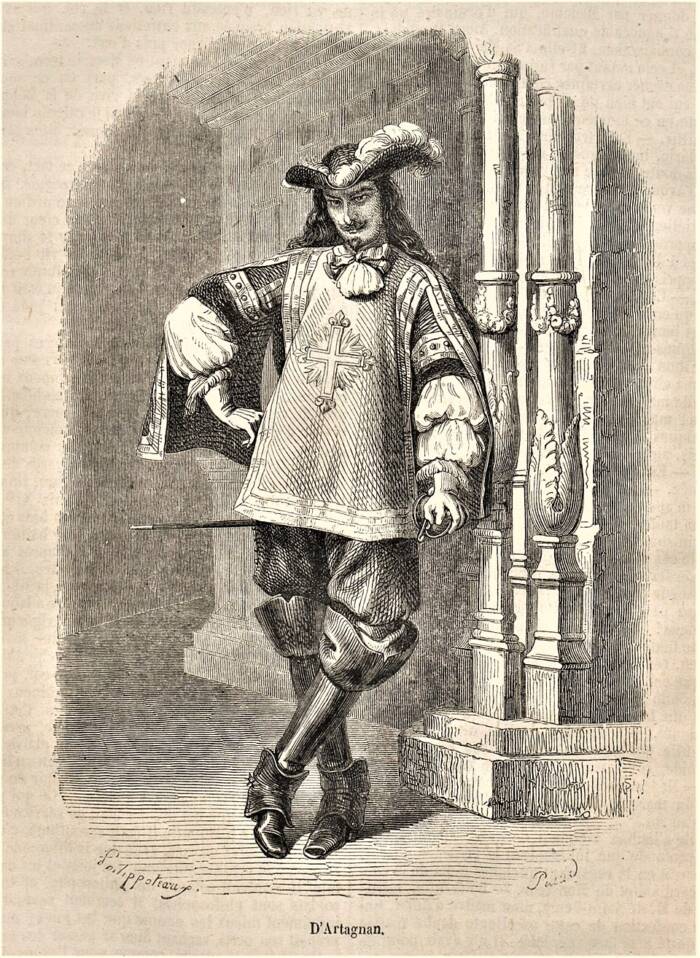
Public DomainA depiction of d’Artagnan in The Viscount of Bragelonne, one of Alexandre Dumas’ sequels to The Three Musketeers.
He earned the trust of Mazarin, especially because of his steadfast loyalty as the minister’s popularity ebbed and flowed. This, in turn, earned d’Artagnan the trust of Louis XIV. In 1661, the Musketeer was tasked with arresting Nicolas Fouquet.
Fouquet, the king’s superintendent of finances, had sparked the monarch’s suspicion by throwing a lavish party to celebrate the construction of his new château. Louis believed that Fouquet could only have afforded the grand feast by stealing from the royal treasury and ordered his arrest.
D’Artagnan took him into custody and spent the next four years guarding his cell, as the king knew his loyal Musketeer couldn’t be bribed to help Fouquet escape. Fouquet was ultimately sentenced to life in prison and died behind bars in 1680.
In 1667, d’Artagnan was promoted to captain-lieutenant of the Musketeers. While Louis XIV officially held the title of commander, d’Artagnan was essentially the leader of the company. Sadly, his fulfilled dream wouldn’t last long.
How D’Artagnan Died During The Siege Of Maastricht
For a brief period in 1672, d’Artagnan was appointed to serve as the governor of Lille, a city the French had seized from the Spanish Habsburgs. He was unhappy in the position and longed to return to battle. He got his wish once more in 1673, but it would prove lethal.
D’Artagnan was sent to fight in the Franco-Dutch War (1672 to 1678). On June 25, 1673, he came under heavy musket fire during the Siege of Maastricht. Some accounts say he was shot in the chest, while others claim a musket ball ripped through his throat. Regardless of his exact injuries, d’Artagnan died on the battlefield that day.
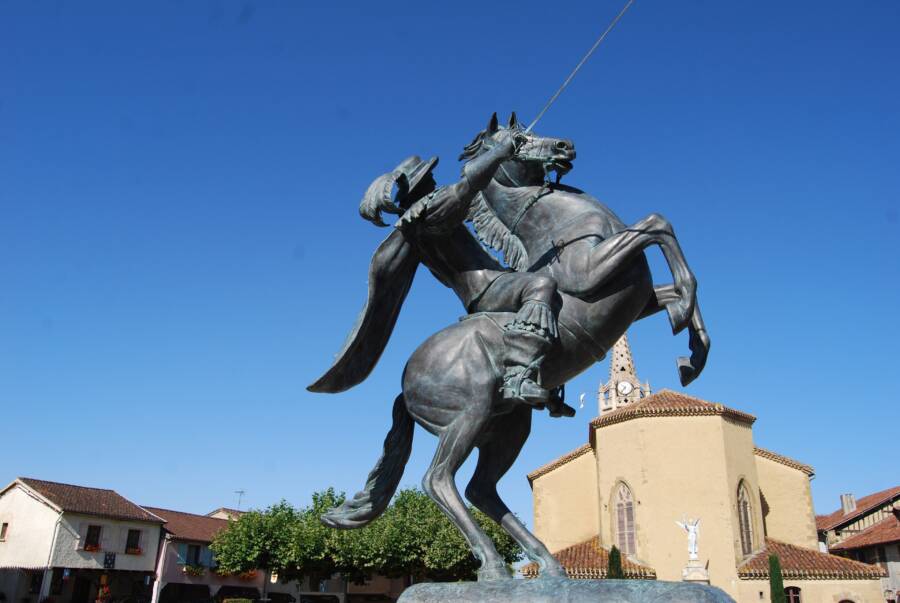
OT de Lupiac/Wikimedia CommonsA statue of d’Artagnan near his birthplace in Lupiac, France.
He was mourned widely, by both his fellow Musketeers and King Louis XIV, who wrote to his wife, “Madame, I have lost d’Artagnan, in whom I had the utmost confidence and who merited it in all occasions,” according to France Mémoire.
D’Artagnan’s death is not described in The Three Musketeers, which ends with his promotion. But Dumas did write about it in The Viscount of Bragelonne, a sequel that takes place decades later.
“D’Artagnan endeavored to raise himself,” Dumas wrote. “It was thought he had been knocked down without being wounded. A terrible cry broke from the group of his terrified officers; [d’Artagnan] was covered with blood; the paleness of death ascended slowly to his noble countenance.”
In the confusion that followed, d’Artagnan was buried in “consecrated ground” in Maastricht. But the exact location of his body was lost to time. Some historians suspected that the Musketeer had been buried beneath the city’s St. Peter and Paul Church in Maastricht, but it wasn’t until 2026 that evidence emerged to support this theory.
During restorative work of the church’s floor, workers came across human remains. Though the skull had been shattered, the neck and vertebrae were in perfect condition, and there were a number of positive signs that the skeleton belonged to d’Artagnan.
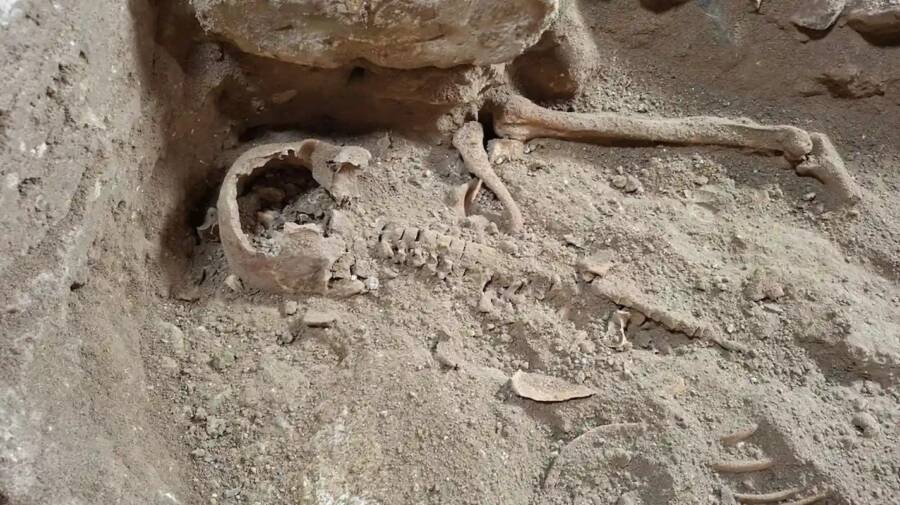
Stichting 6213 HLThe skeleton found at St. Peter and Paul Church in 2026 that may belong to d’Artagnan.
“There was a French coin from that time in the grave,” Jos Valke, the church’s deacon, told Dutch media. “And the bullet that killed him lay at chest level. Exactly as described in the history books. The evidence is very strong.”
Though more tests are needed to confirm the identity of the skeleton, the discovery of d’Artagnan’s remains would be hugely significant. Since his death in 1673, he has faded almost into myth; thanks to Alexandre Dumas and The Three Musketeers, his fictional life is far better known than his actual accomplishments.
But while some parts of d’Artagnan’s biography are lost to time, the story of his rise from a poor nobleman’s son to the most beloved Musketeer in French history remains as compelling as ever.
After reading about d’Artagnan, known during his life as Charles de Batz de Castelmore, discover the wild story of the Storming of the Bastille, the violent protest that helped lead to the French Revolution. Or, go inside the strange and terrifying legend of the Beast of Gévaudan, the mysterious monster that terrorized the countryside of 18th-century France.