Ever since the Grateful Dead debuted in the 1960s, they've counted a massive following of enthusiastic fans, the most devoted of which are known as Deadheads.
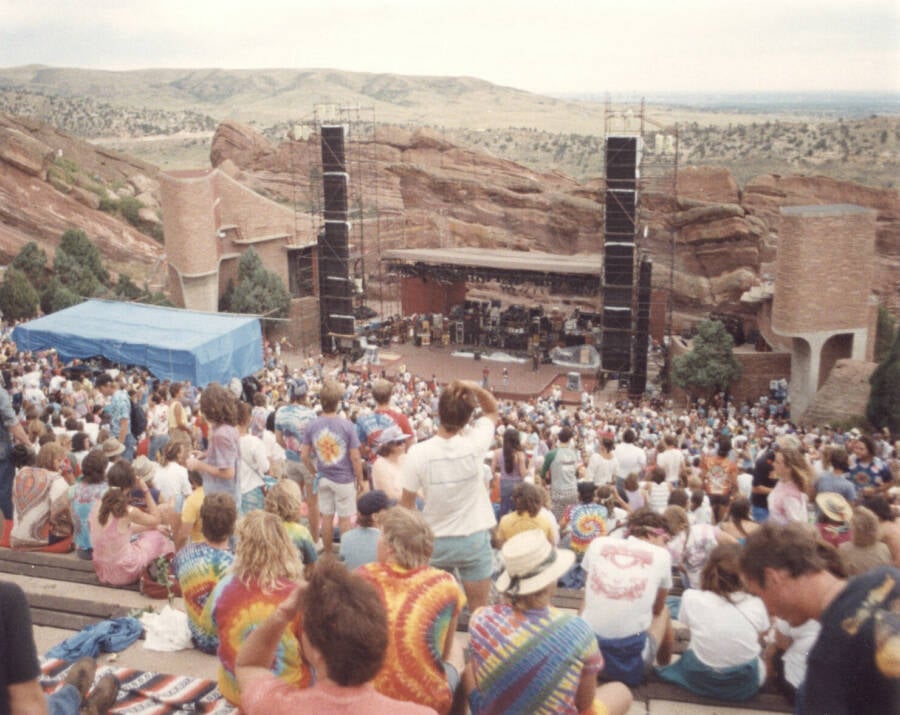
Wikimedia CommonsGrateful Dead fans often referred to themselves as Deadheads — and their dedication could be incredibly intense.
As any fan would say, there was nothing like a Grateful Dead concert. For decades, legions of fans called the Deadheads embraced this statement like gospel, following the band from venue to venue, and creating one of rock music’s most devoted subcultures. Ultimately, that devotion sometimes proved to be a double-edged sword for the band.
While the Grateful Dead’s relationship with their fans began as something rather revolutionary, it gradually evolved into something almost cult-like. Many fans were unwaveringly dedicated to the Dead, and for the band members, this sometimes removed accountability.
After all, when every performance is greeted with ecstatic approval, when fans will follow you regardless of your artistic growth or creative risk-taking, what incentive remains to challenge yourself? The context of the Grateful Dead’s music could sometimes be lost, and the performances could sometimes become more like rituals, with a series of repeated motions. It’s unsurprising that all this had a big impact on the Grateful Dead — particularly on Jerry Garcia, who reportedly felt “deified” by his fans.
Today, the legacy of the Deadheads is complex. On one hand, their steadfast loyalty had allowed the band to achieve remarkable success; on the other hand, it may have brought about the end of the music they loved so much.
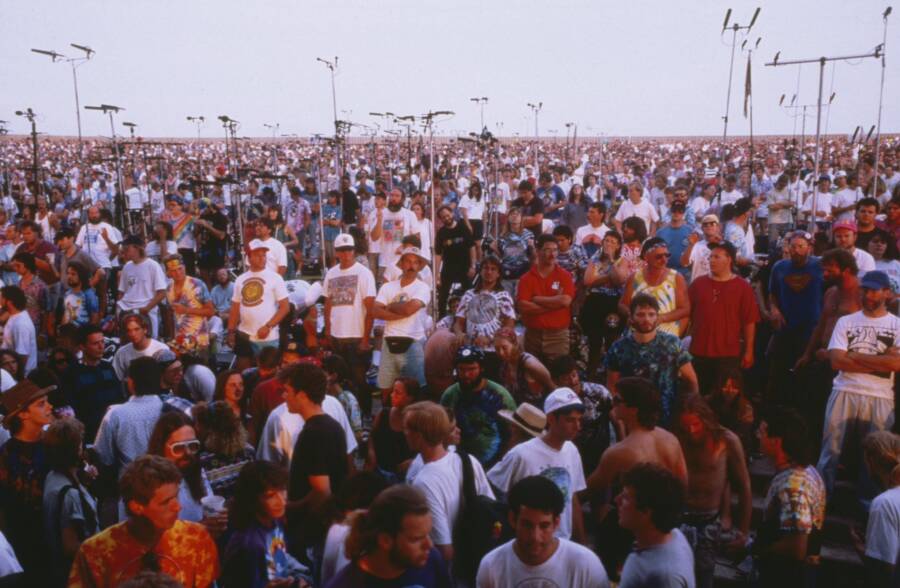
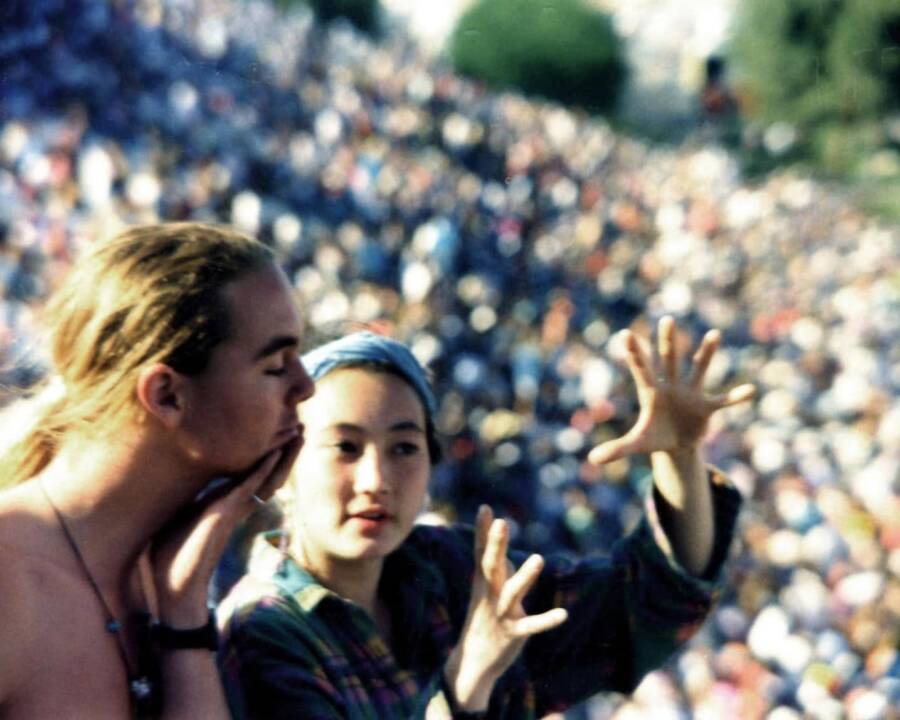
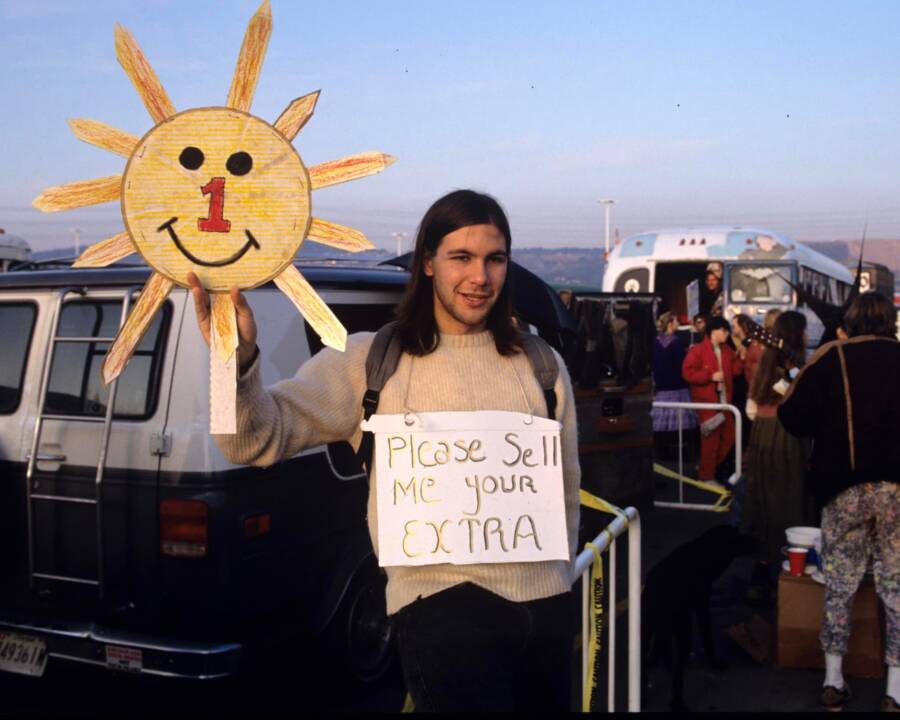
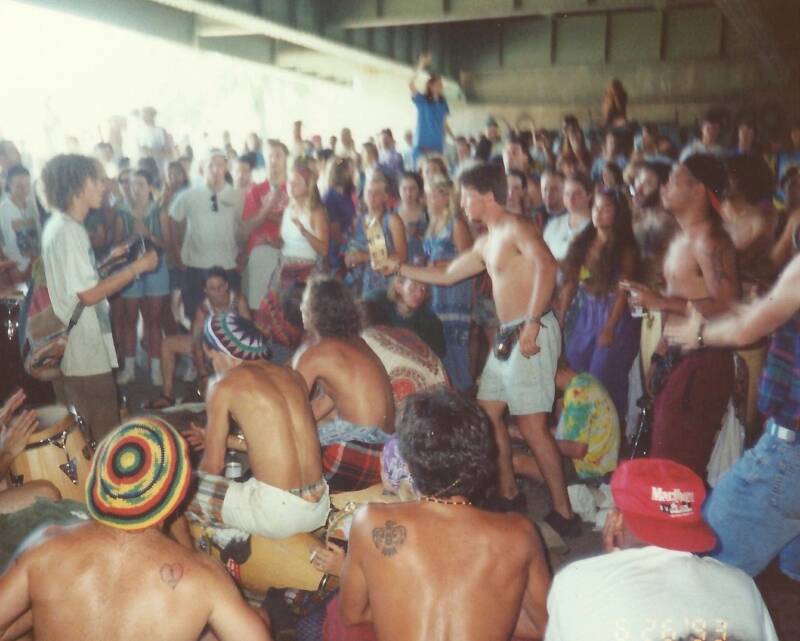
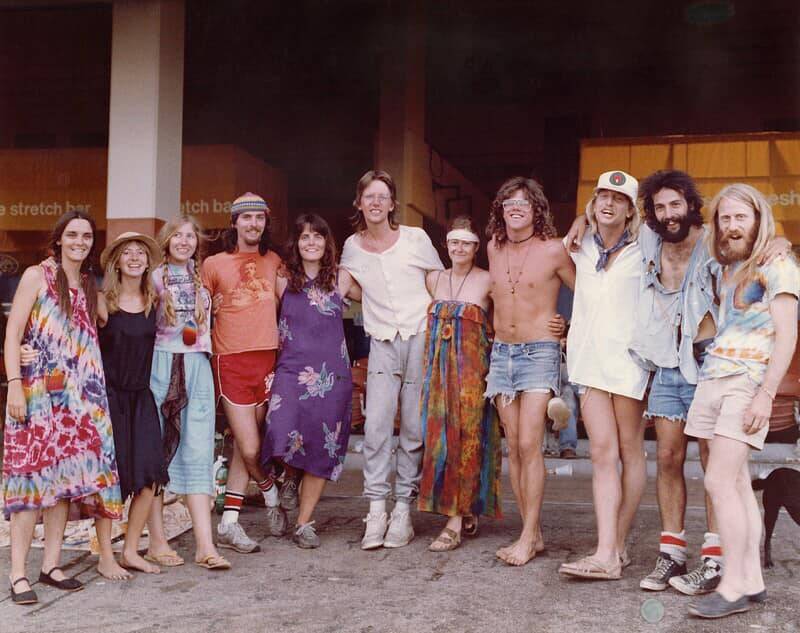
See some vintage photos of the wild world of Deadheads below.


And if you liked this post, be sure to check out these popular posts:
Grateful Dead publicist Dennis McNally later recounted, “For Phil especially, it was one of the truly spectacular experiences of a lifetime, as though for an hour or two he lived inside a Seurat or a Cezanne.” Grateful Dead/Facebook


The Rise Of Deadheads And The "Vibe" That Accompanied It
Emerging from San Francisco in the mid-1960s, the Grateful Dead had always rejected traditional showbiz hierarchies. They didn't want to be distant "rock gods." Instead, they sought what their publicist Dennis McNally described in his book, A Long Strange Trip, as a "partnership of equals."
The Dead and their fans were meant to be "companions in an odyssey," not gods and worshippers. At least, that was how it began.
It was a concept that resonated deeply with countercultural youth at a time when a communal experience felt like rebellion against an increasingly fragmented society. It probably helped that the Grateful Dead, even at first glance, wasn't a typical rock band. Their music was full of impressive improvisations and indulged heavily in blues-inspired and jazz-inspired sounds that were often memorably paired with the haze of a marijuana high.

Grateful Dead/FacebookA girl dancing at a Grateful Dead show at New York's Tompkins Square Park in 1967.
They embodied the hippie lifestyle in a way no other band did. Of course, the Dead had their critics as well — and they were far from perfect performers.
"They could be sloppy, unrehearsed," Nick Paumgarten wrote for The New Yorker. "They forgot lyrics, sang out of key, delivered rank harmonies, missed notes, blew takeoffs and landings, and laid down clams by the dozen... They resisted irony. They were apolitical. They bombed at the big gigs."
Despite this, they amassed a highly devoted fan base who referred to themselves as Deadheads. To these fans, the band's flaws were part of the appeal, a sign of true authenticity. In the music, they had also found a sense of community. Unfortunately, a few bad apples spoiled the bunch, and those outside the fandom began to link all Deadheads to obnoxious stereotypes.
"Many came by the stereotypes honestly: airheads and druggies, smelling of patchouli and pot, hairy, hypocritical, pious, ingenuous, and uncritical in the extreme," Paumgarten wrote. "They bought into the idea, which grew flimsier each year, that following a rock band from football stadium to football stadium, fairground to fairground, constituted adventure of the Kerouac kind."
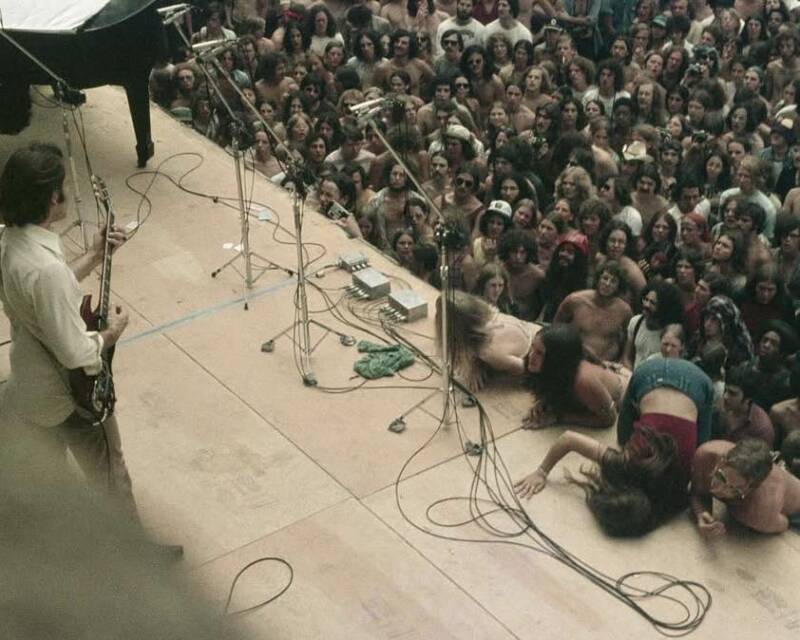
Grateful Dead/FacebookDeadheads climbing onto the stage at RFK Stadium in Washington, D.C. in 1973.
For many Deadheads, attending the shows wasn't just for entertainment — it was a lifestyle, an identity, and sometimes even a spiritual practice.
Meanwhile, as the countercultural era fizzled out, some iconic figures of the period tragically died, like Janis Joplin and Jimi Hendrix, and other figures were eager to reinvent themselves. But the Grateful Dead seemed to maintain the same eclectic spirit they always had, and so many hippies and other free spirits looked to the band to keep the movement alive.
The Dead had initially tried to avoid being treated like gods, but they ultimately failed in the long run. And the attention often took a toll on the band. Bob Weir said he believes it may have even killed his bandmate Jerry Garcia, who struggled for decades with substance abuse.
"The deification that those folks made of Jerry is basically what killed him," Weir told The Washington Post in 2022. "It disgusted him, and rightly so."
The Complicated Legacy Of The Deadheads
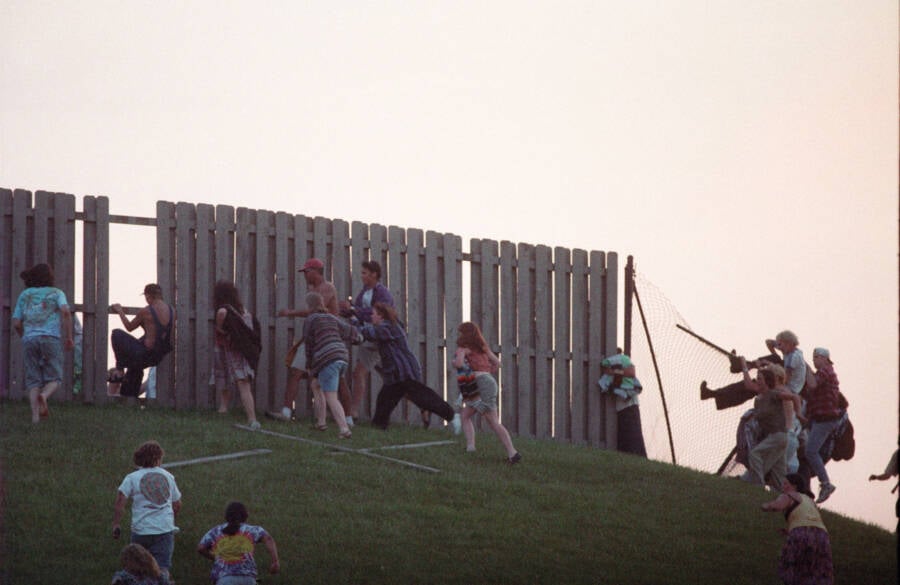
Jeremy Hogan/Alamy Stock PhotoDeadheads jumping a fence to see the band perform in Deercreek, Indiana. 1995.
No one doubted that when the Grateful Dead band members were sober, or at least coherent, they were some of the most talented musicians of their time. Even their critics had to admit that. But as the band, and Jerry Garcia in particular, fell into bad habits, their fans only continued to cheer. That doubtless faith would prove to sometimes be almost as harmful as the substances that contributed to the band's well-documented struggles.
"The Dead's reputation and press coverage have always fixated on the culture that sprouted up around the band," Paumgarten explained, "and that then began to choke it, like a weed."
The attitudes of some Deadheads did little to help this. Outwardly, they were supposedly enlightened music enthusiasts, yet they would often ignore adventurous opening acts at the shows. Many fans wore similar tie-dye styles, danced the same wiggle dance, and maintained their long-lasting assumptions that every show was magical.
The "vibe" often became more habitual, rather than blissful.
The Deadheads would applaud no matter what the band produced, so why should they have tried to grow artistically? If no one held them accountable for their less-than-stellar performances, why bother to improve them?

Everett Collection Historical/Alamy Stock PhotoThe Grateful Dead: Jerry Garcia, Bob Weir, Phil Lesh, Brent Mydland, Bill Kreutzmann, and Mickey Hart.
Garcia could play a show half-asleep, drooling on his microphone, and swaying as he missed parts of songs he had written, while Deadheads would cheerfully shout the lyrics he wrote back at him. Sometimes, they would ignore the lyrical context completely. One that reportedly frustrated Garcia in particular was the line "when it seems like the night will last forever" from the melancholy ballad "Black Muddy River," which fans cheered on in a way that completely missed the song's darker implications.
This unending devotion also created something of a comfortable bubble that stifled the band's growth. Safe within Deadhead-land, they could coast through lackluster performances, knowing their audience would always stand by them. With nothing to strive for and no musical goals demanding achievements, the Grateful Dead lapsed into what some critics described as a creative torpor during the final years of their career.
McNally's biography, despite its authorized status, couldn't entirely airbrush away this trajectory. The book sometimes reads as a cautionary tale or even a tragedy — the development of a cult following so strong that it helped shape the band's music, but also likely helped bring it to an end.
The Grateful Dead wanted to bridge the gap between performer and audience, but perhaps they bridged it too well, creating a relationship where honest and necessary critiques became nearly impossible to make.
Even today, this relationship raises uncomfortable questions about fandoms in general. At what point does devotion become destructive? When does a community of support transform into a harmful echo chamber?
Art is meant to be challenging and to be challenged. Deadheads had created something genuine — a countercultural space, a traveling chosen family, and a shared experience that gave meaning to countless people. But the most loyal fans were often also the most dangerous enablers, and it's possible that they may have ultimately loved the Grateful Dead to death.
After this look back at the colorful and complicated history of Deadheads, check out our gallery of vintage photos from when goth culture shocked the world. Or, check out these photos of the Beatles in their early days.