On November 10, 1975, the 29 crew members aboard the SS Edmund Fitzgerald died when the freighter sank to the bottom of Lake Superior during a storm that produced 35-foot waves and wind gusts over 80 miles per hour.
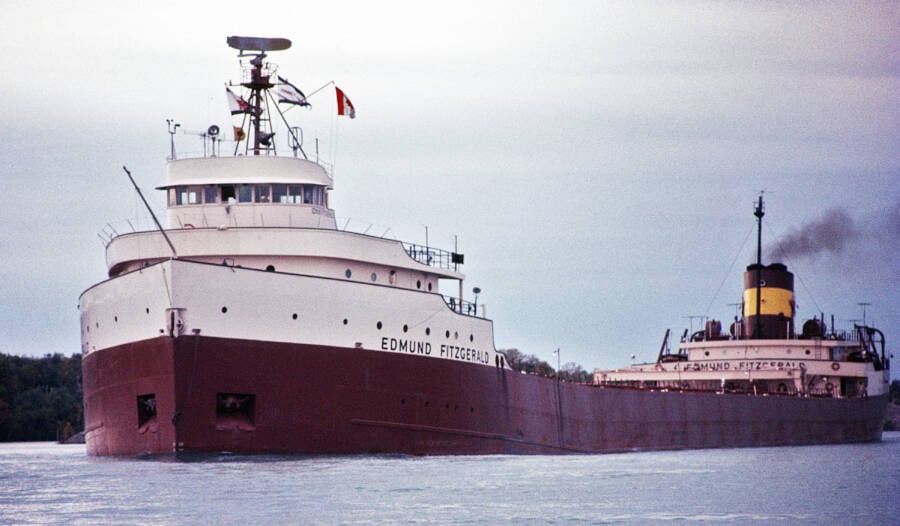
Greenmars/Wikimedia CommonsThe SS Edmund Fitzgerald was the largest ship to ever sink in Lake Superior.
“Superior, they said, never gives up her dead when the gales of November come early,” Canadian singer-songwriter Gordon Lightfoot wrote in the aftermath of the 1975 sinking of the SS Edmund Fitzgerald.
On Nov. 10, 1975, the 729-foot-long freighter went down in Lake Superior during a vicious storm, resulting in the loss of the entire crew of 29 men. The vessel remains the largest ship to have ever sunk in the Great Lakes.
In the days after the wreck, aircraft detected a magnetic anomaly under the lake’s surface around 17 miles off the coast of Michigan. And in May 1976, an underwater recovery vehicle was deployed to the site and photographed the Edmund Fitzgerald beneath more than 500 feet of water. The ship had split in two, earning it the nickname the “Titanic of the Great Lakes.”
The story of the vessel’s final voyage was immortalized by Gordon Lightfoot’s song “The Wreck of the Edmund Fitzgerald,” which was released in 1976. As the lyrics go, “All that remains is the faces and the names of the wives and the sons and the daughters.”
The Story Of The SS Edmund Fitzgerald
When the SS Edmund Fitzgerald was launched in June 1958, it was the largest ship on the Great Lakes. Its 729-foot-long hull earned the vessel the nickname the “Queen of the Lakes” until the 730-foot SS Murray Bay came along the following year. It was named after the president and chairman of the board of the Northwestern Mutual Life Insurance Company, the company that invested in the construction of the ship.
An estimated 15,000 people gathered to watch the massive vessel enter the water for the first time — but the event was marked by a series of bad omens. The champagne bottle that was smashed over the bow didn’t break until the third attempt, the crew of the shipyard struggled to get the freighter into the lake, and one attendee died from a heart attack. Still, once the Edmund Fitzgerald was in service, it quickly became a legend.
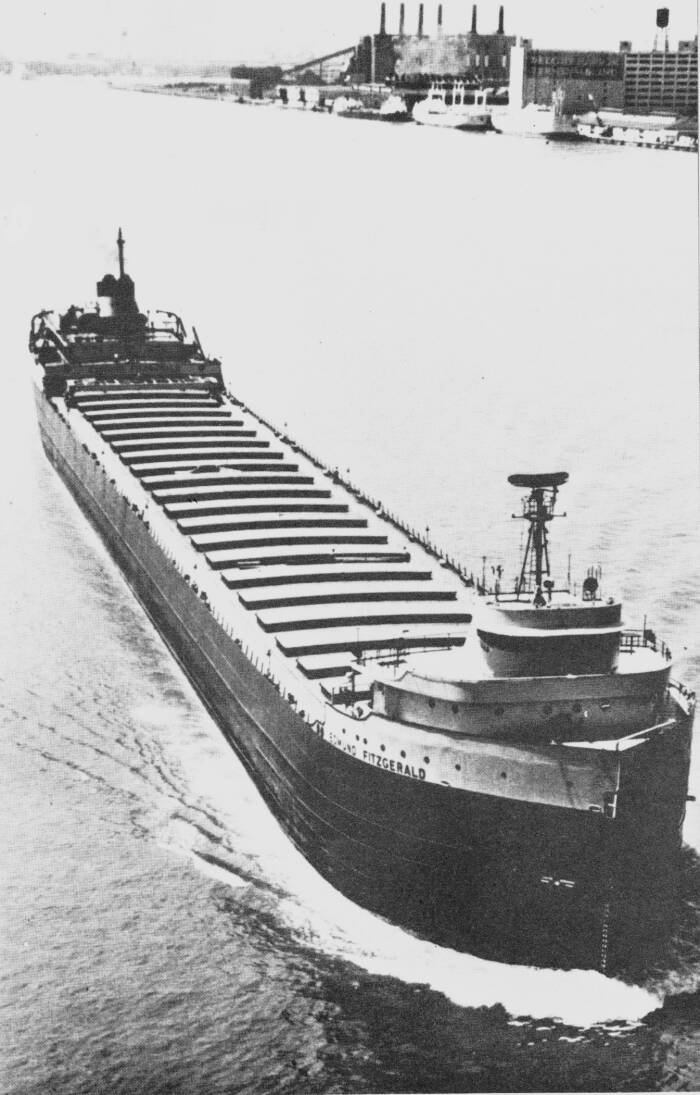
Public DomainThe Edmund Fitzgerald without cargo, on its way to collect a shipment. Date unknown.
The Fitz, as the freighter came to be known, carried iron ore from mines in Minnesota to foundries in Detroit, Toledo, and other Midwestern port cities. In addition to being one of the largest ships on the Great Lakes, the SS Edmund Fitzgerald was also one of the most efficient. It set seasonal hauling records multiple times, and it became so famous that onlookers would gather along its route to watch it float by.
At the time, the Great Lakes were known to be dangerous for ships. Between 1875 and 1975, an average of one vessel was lost in the region every week. But the Fitz was so large that it seemed untouchable. Then, on Nov. 10, 1975, a violent snow storm struck.
The Fitz Meets Its Fate On Lake Superior
The final voyage of the SS Edmund Fitzgerald began on the afternoon of Nov. 9, 1975. There were 29 crew members onboard, including Captain Ernest McSorley. The ship departed from Superior, Wisconsin, carrying nearly 30,000 tons of taconite, a type of iron ore. The Fitz was heading toward a steel mill on Zug Island near Detroit, a journey of nearly 750 miles.
That evening, the National Weather Service (NWS) issued a gale warning for all of Lake Superior. The U.S. Coast Guard Marine Board of Investigation reported in the aftermath of the sinking that the NWS was predicting wind speeds of up to 60 miles per hour and 16-foot waves for the morning and afternoon of Nov. 10. However, conditions were seemingly much worse than that.
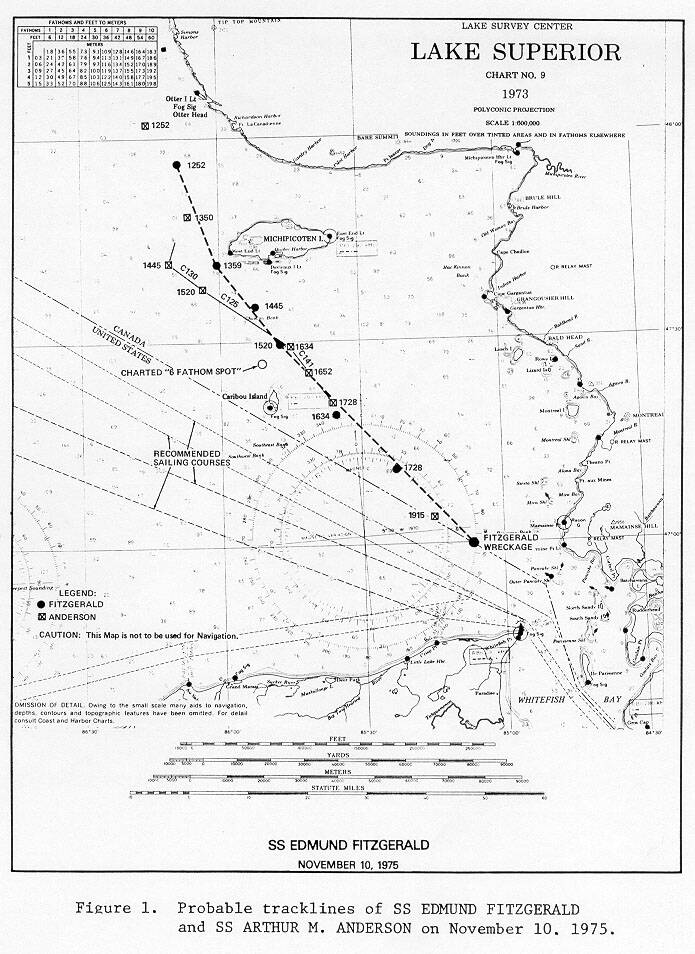
Public DomainThe route likely taken by the Fitz on its final voyage.
The Edmund Fitzgerald was traveling slightly ahead of another freighter, the Arthur M. Anderson, which was captained by Bernie Cooper. Around 2:45 p.m. on Nov. 10, it started snowing heavily, and the Anderson lost sight of the Fitz. Less than an hour later, Captain McSorley radioed Captain Cooper to let him know that the Edmund Fitzgerald was taking on water.
“Anderson, this is the Fitzgerald,” said McSorley, as reported by the SS Edmund Fitzgerald Online. “I have sustained some topside damage. I have a fence rail laid down, two vents lost or damaged, and a list. I’m checking down. Will you stay by me ’til I get to Whitefish?”
The two freighters began to make their way to Whitefish Bay on the coast of Michigan’s Upper Peninsula, hoping for some reprieve from the harsh storm. McSorley’s last communication from Fitz to the Anderson came at around 7 p.m. Cooper had asked McSorley, “Fitzgerald, how are you making out with your problem?”
“We are holding our own,” McSorley responded.
This was the last and final message of the SS Edmund Fitzgerald. Shortly after, the ship vanished from the radar.
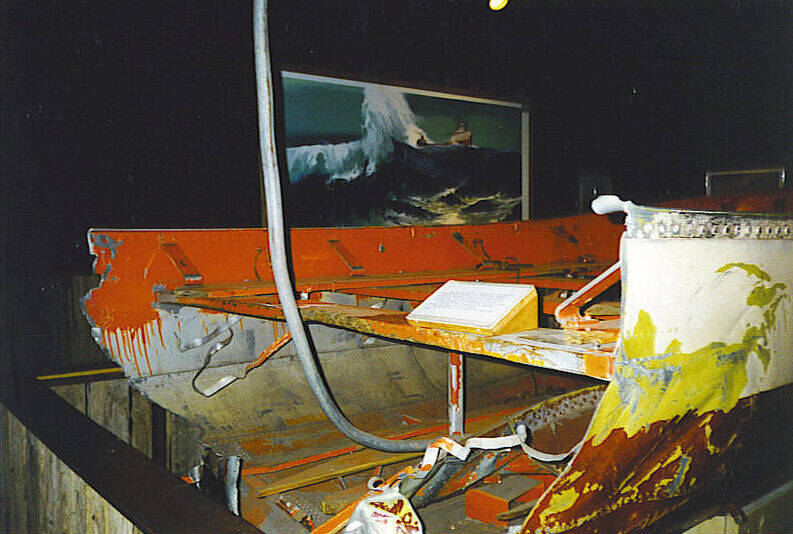
James Lefevre/Wikimedia CommonsA lifeboat salvaged from the Edmund Fitzgerald on display at the Museum Ship Valley Camp in Michigan.
According to a 2005 issue of Telescope, the magazine of the Great Lakes Maritime Institute, Captain Cooper radioed the Coast Guard not long after the Fitz disappeared saying, “I am very concerned with the welfare of the steamer Edmund Fitzgerald. He was right in front of us, experiencing a little difficulty. He was taking on a small amount of water and none of the upbound ships have passed him. I can see no lights as before, and don’t have him on radar. I just hope he didn’t take a nose dive.”
Tragically, Cooper’s words proved prophetic. The Fitz seemingly sank so quickly that McSorley didn’t even have time to make a mayday call.
So, what exactly happened to the Edmund Fitzgerald?
The Mystery Surrounding The Sinking Of The SS Edmund Fitzgerald
While it’s clear that the violent storm caused the Fitz to sink, theories differ on why exactly the vessel went down. The low visibility caused by the snow may have caused the ship to accidentally pass through shallow water, leading to structural damage. Another theory posits that the Edmund Fitzgerald was taken down by a group of rogue waves reported in the area at the time.
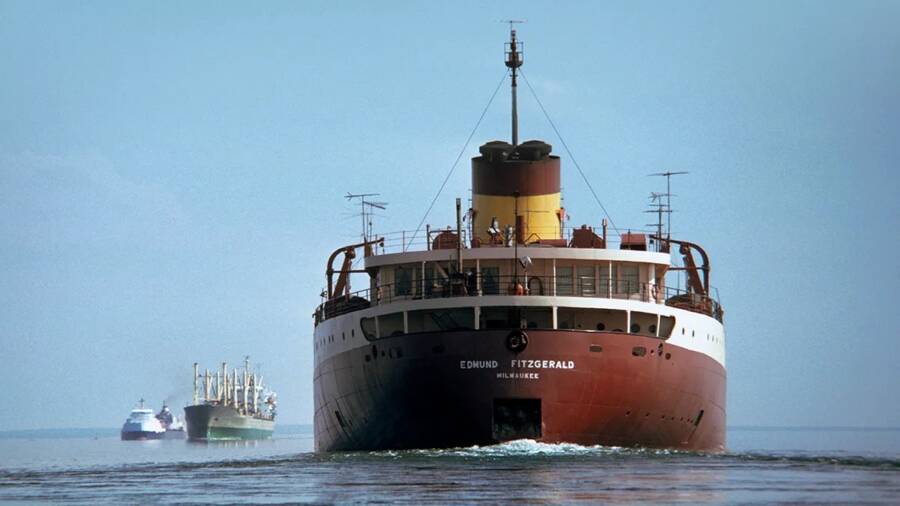
Great Lakes Shipwreck Historical SocietyFor a time, the Edmund Fitzgerald was the longest ship on the Great Lakes.
However, when the National Transportation Safety Board (NTSB) published their investigation in 1978, they noted that “the probable cause of this accident was the sudden massive flooding of the cargo hold due to the collapse of one or more hatch covers.”
A few days after the Edmund Fitzgerald sank, a U.S. Navy plane flew above Lake Superior scanning for magnetic anomalies and detected an inconsistency around 17 miles from Whitefish Point, Michigan. Several months later, a remotely operated underwater vehicle captured striking photos of a shipwreck at that very spot. The name Edmund Fitzgerald was clearly visible on the hull of the vessel.
The wreckage was located 530 feet beneath Lake Superior. The Fitz had been torn in half, with its bow sitting upright and its stern resting upside down on the floor of the lake. However, there was no sign of the 29 crew members, who all perished. Two decades later, in 1994, the remains of one man were found nearby, but he was left undisturbed in his watery grave.
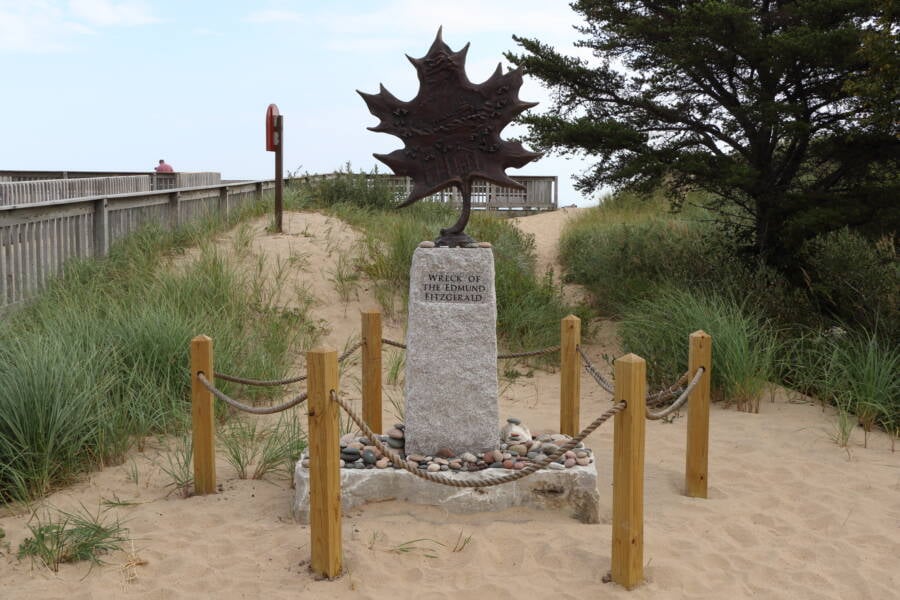
Rklawton/Wikimedia CommonsA memorial to the wreck of the Edmund Fitzgerald at Whitefish Point.
The SS Edmund Fitzgerald was the largest ship to ever sink in the Great Lakes, joining thousands of other vessels that have gone down in the region over the centuries. The SS Arlington sank in Lake Superior in 1940, and the SS Western Reserve wrecked in a storm in 1892. Divers are still discovering other ships beneath the surface, too, such as the SS James Carruthers, which sank in Lake Huron during a blizzard in 1913, and the Frank D. Barker, which sat beneath Lake Michigan for 134 years before it was found in 2025.
Still, the Fitz remains perhaps the most famous of all the ships lost in the Great Lakes. This is partly due to Gordon Lightfoot’s song, “The Wreck of the Edmund Fitzgerald,” which he wrote after reading news reports in the immediate aftermath of the sinking: “In a musty old hall in Detroit, they prayed in the Maritime Sailors’ Cathedral. The church bell chimed ’til it rang 29 times for each man on the Edmund Fitzgerald.”
After reading about the wreck of the SS Edmund Fitzgerald, discover the stories behind nine other famous shipwrecks. Then, look through 33 photographs of the Titanic.