Experts have now determined that the Ketton mosaic depicts a rare version of the Trojan War's climax from Phrygians, a play by the famous Greek dramatist Aeschylus that has since been lost to history.
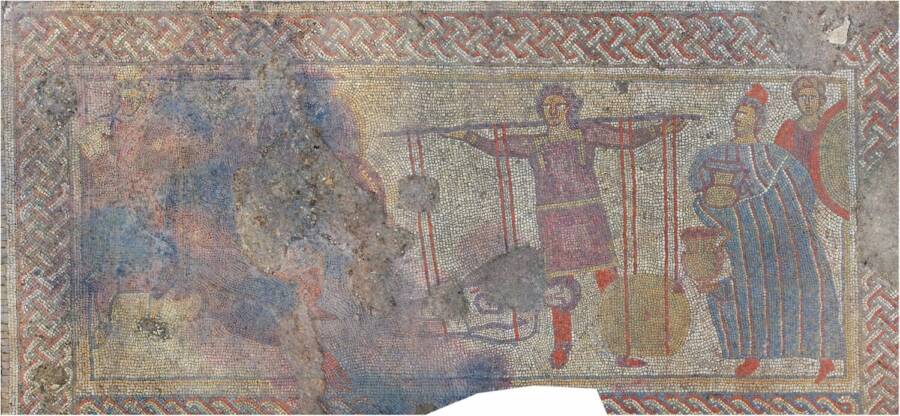
University of Leicester Archaeological ServicesThis panel from the Ketton mosaic depicts the ransom of Prince Hector’s body.
Archaeologists have determined that the celebrated Roman mosaic discovered in Rutland, England in 2020 depicts a “long-lost” version of the Trojan War myth.
This stunning piece, known as the Ketton mosaic, has been described as one of the most remarkable discoveries in the country over the last century. But when it was first uncovered, archaeologists believed that its scenes of the Trojan War were taken from Homer’s Iliad. This famous Greek poem written circa the 8th century B.C.E. has long since become the most well-known telling of the Trojan War legend.
However, researchers have recently discovered that the Ketton mosaic features a forgotten alternate telling of this epic tale of war by the Greek playwright Aeschylus that was popular in antiquity before becoming lost to history. This revelation also suggests that Roman Britain was more in touch with the wider world of the ancient Mediterranean than experts previously thought.
The Discovery Of An Alternate Trojan War Narrative In The Ketton Mosaic
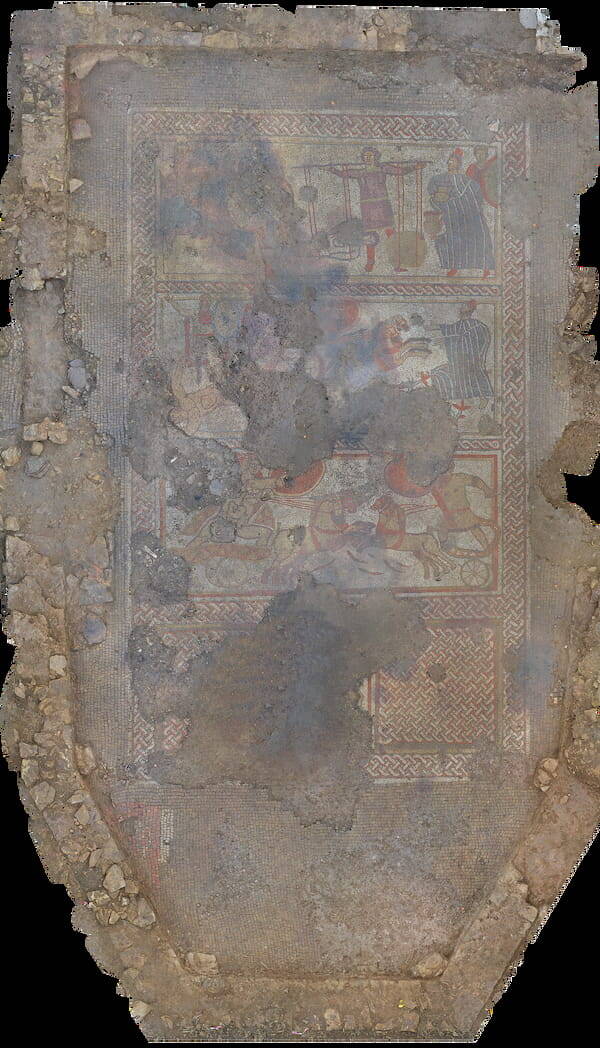
University of Leicester Archaeological ServicesThe complete Ketton mosaic, found in Rutland in 2020.
The Ketton mosaic was first uncovered in 2020 during the COVID-19 lockdown by Jim Irvine, a local resident. The English farmer happened upon the mosaic while on a walk through one of his fields. The discovery then led to major excavations by the University of Leicester Archaeological Services.
Archaeologists determined that the mosaic dated back about 1,800 years. Its three panels tell a portion of the Trojan War story. The first panel depicts the Greek hero Achilles battling Hector, the prince of Troy.
The second panel shows Achilles triumph in their duel, as he drags Hector’s body behind his chariot while Hector’s father, King Priam, pleads for mercy. Finally, the third panel shows Hector’s body being weighed alongside a mound of gold, the ransom that Priam will pay to Achilles in exchange for the return of the corpse.
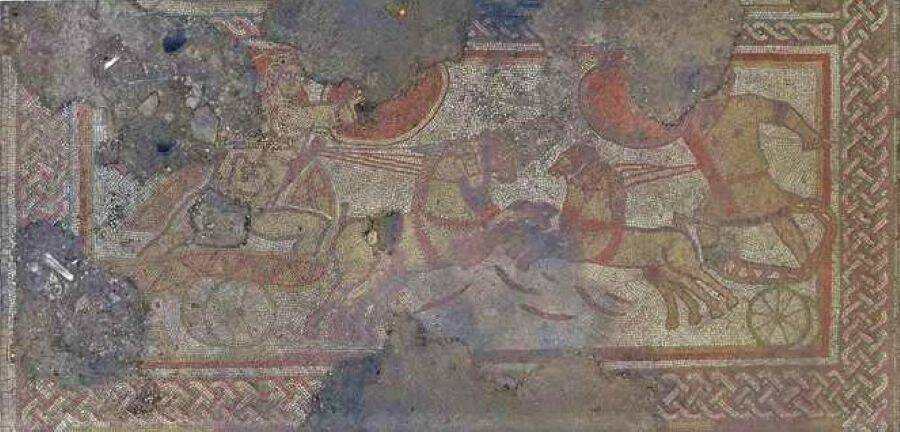
Peterborough ArchaeologyThe first panel of the Ketton mosaic, depicting the battle between Achilles and Prince Hector.
Initially, archaeologists concluded that the panels drew from Homer’s Iliad, the most famous telling of the Trojan War today. However, a new study published in the journal Brittania determined that the mosaic actually features scenes from the Aeschylus play Phrygians, which features an alternate telling of the Trojan War myth.
While that play has long since been lost to history, the ancient Romans certainly would’ve been familiar with it. In fact, the Rutland villa’s elite owner would have relished having a relatively rare depiction of the Trojan War in their home.
In this version, when Priam visits Achilles to retrieve the body of Hector, the king uses a massive scale to give Achilles a mound of gold equal to the weight of his son in exchange for the corpse. In Homer’s version, on the other hand, a ransom is still exchanged for Hector’s body, but it’s not a portion of gold the same weight as the corpse.
What’s more, Phrygians is likely not the only source material for the Ketton mosaic. Experts believe that the first panel may have come from the design on a Greek pot from the time of Aeschylus.
“Once I’d noticed the use of standard patterns in one panel, I found other parts of the mosaic were based on designs that we can see in much older silverware, coins and pottery, from Greece, Turkey, and Gaul,” lead author of the study, Jane Masséglia, said in a statement from the University of Leicester.
The Connection Between Roman Britain And The Ancient Mediterranean
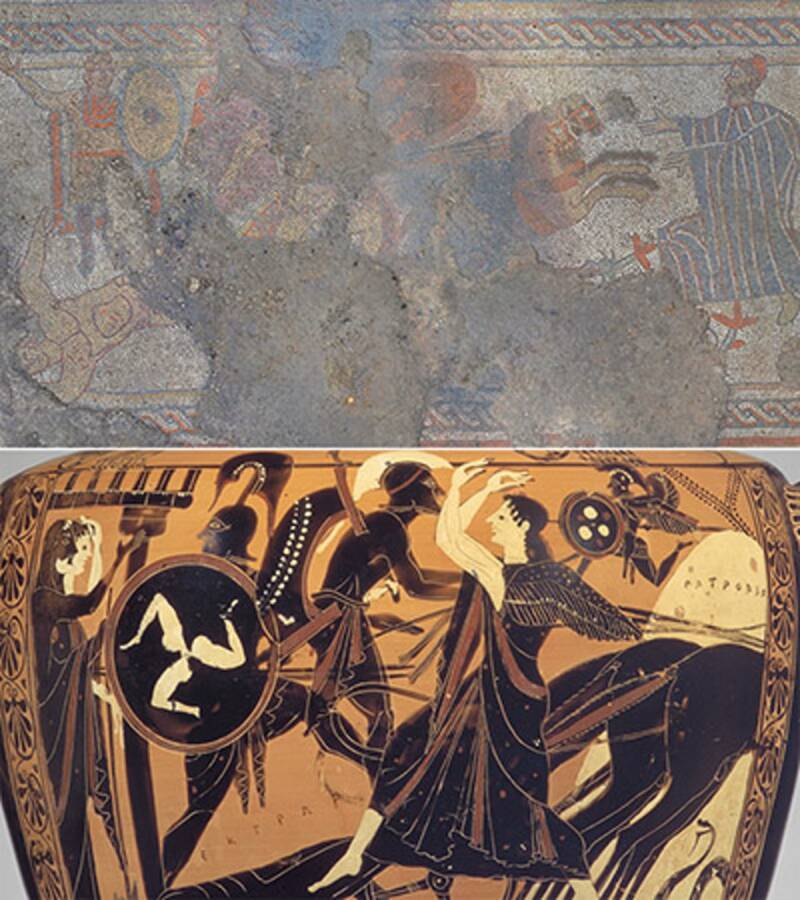
University of Leicester Archaeological ServicesThe second panel of the mosaic, rendering the dragging of Hector’s body by Achilles, takes its design from a Greek pot.
Aeschylus’ play popularized this alternative telling of the Trojan War throughout the Greek world. Moreover, the use of imagery from this play, as well as designs taken from other Mediterranean countries, show that a diverse mix of classical culture spread even to the far reaches of the Roman world in Britain.
“Romano-British craftspeople weren’t isolated from the rest of the ancient world, but were part of this wider network of trades passing their pattern catalogues down the generations,” Masséglia explained. “At Ketton, we’ve got Roman British craftsmanship but a Mediterranean heritage of design.”
The mosaic panels, which once made up the floor of the Rutland villa’s dining room, were inspired by art and myth from across the ancient Mediterranean. As Jim Irvine put it, the new research “reveals a level of cultural integration across the Roman world that we’re only just beginning to appreciate.”
Now, there’s only more to discover at the Ketton mosaic site. Post-Excavation Coordinator Rachel Cubitt said that the new research “brings an added dimension” to the other projects being conducted at the site.
“This fascinating new research offers a more nuanced picture of the interests and influences of those who may have lived there, and of people living across Roman Britain at this time,” Cubitt said.
After reading about the Ketton mosaic, dive into the historical debate surrounding the Trojan horse. Then, learn about the Greek gods and goddesses of ancient mythology.