The Bombing Of Pearl Harbor By Michael Bay
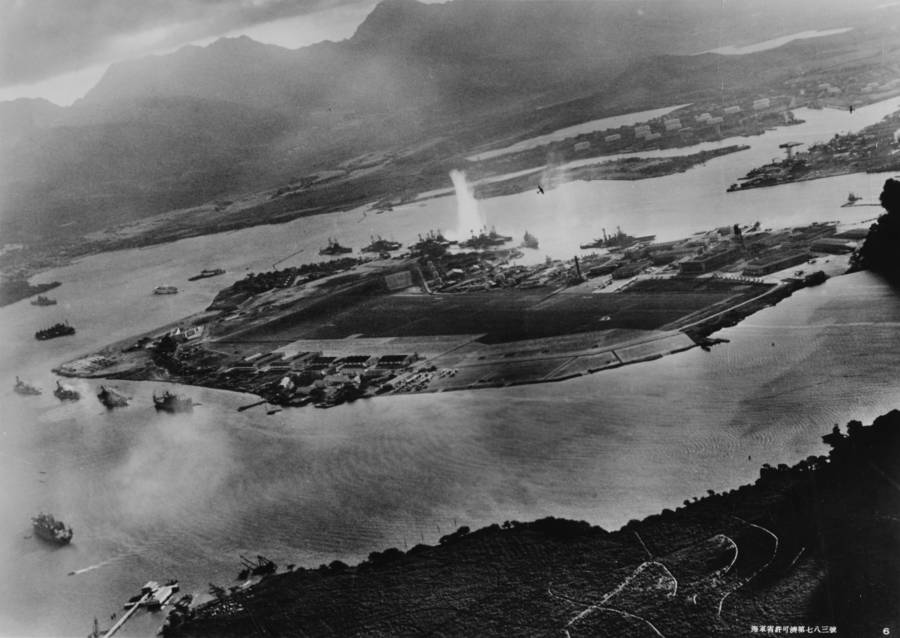
U.S. Navy/National ArchivesPhotograph taken from a Japanese plane. A torpedo strikes ships moored on both sides of Ford Island during the Pearl Harbor attack.
Michael Bay’s films have never been known for their realism and so it was with great trepidation that audiences awaited his first movie based on a true story: the 2001 release of Pearl Harbor.
According to PearlHarbor.org, it was then the most expensive film of all time. While audiences largely enjoyed the proficient action filmmaking Bay is known for, it received terrible reviews — most notably from veterans who lived through the actual event in 1941.
Pilot Kenneth Taylor, who is portrayed in the film, allegedly called the movie “a piece of trash; over-sensationalized and completely distorted.”
Author of the lauded War In The Pacific: From Pearl Harbor To Tokyo Bay, Harry Gailey, couldn’t believe that a film this expensive would skimp on accuracy. “They spent 150 million on this thing,” he told SF Gate. “They should have been able to afford two or three dollars for a historian.”
What exactly did Bay and screenwriter Randall Wallace get so egregiously wrong? Unfortunately, almost everything.
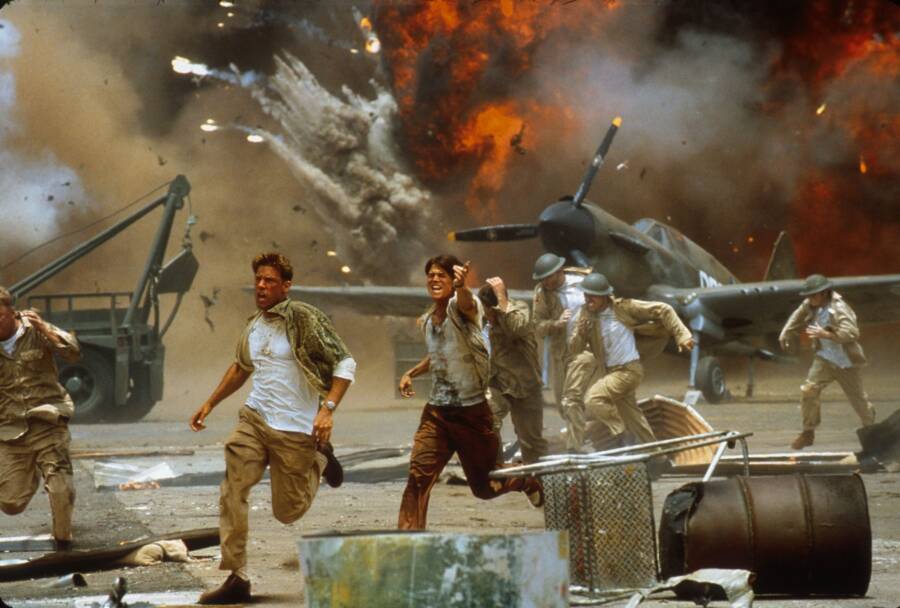
Touchstone PicturesMichael Bay’s 2001 war drama is arguably the most factually inaccurate film on our list.
Inaccuracies begin with the first shot. The opener features a crop duster flying above two boys in 1923 — even though such a plane wasn’t commercially available until the late 1930s.
“They have Japanese torpedo bombers attacking the American airfields,” complained Gailey. “What are they going to torpedo on an airfield?”
Some might generously dismiss these kinds of filmmaking mistakes as negligible, but Pearl Harbor deviated even further for the sake of a convenient narrative.
For instance, characters Rafe McCawley (Ben Affleck) and Danny Walker (Josh Hartnett) are able to speak to each other from within their respective planes, but this kind of technology didn’t even exist during World War II.
In a later scene, a woman in Hawaii can distinctly overhear the communication between pilots and officials in a control tower via her own radio.
“The idea that she can hear in-plane radios while sitting back in Hawaii is nonsense,” said Bruce Reynolds, a nationally renowned military historian. “Planes did not have radios like that. And the control-tower scene is ludicrous. These things are pure Hollywood and have no relation to reality.”
Bay also films the Arizona Memorial, which wasn’t built until 1962, he uses jet catapults and angled flight decks, which were not employed until the 1950s, and he paints Japanese Zero planes green when they were silver. The litany of ahistorical elements in the film is too lengthy to list.
To be fair, this kind of precision was never Bay’s forté, nor does the bombastic filmmaker seem to care about the element of historical realism. For him, it’s all about the ride.
“When you see the movie, you don’t get a sense of the first or second wave,” argued Bay. “You get a sense of the attack. That’s what’s important. And you need to see this through the eyes of people whom the audience connects with.”
Too bad that ethic wasn’t quite enough to win over audiences who would have much preferred a more realistic interpretation.
Do Not Forget Your Dying King: Oliver Stone’s JFK
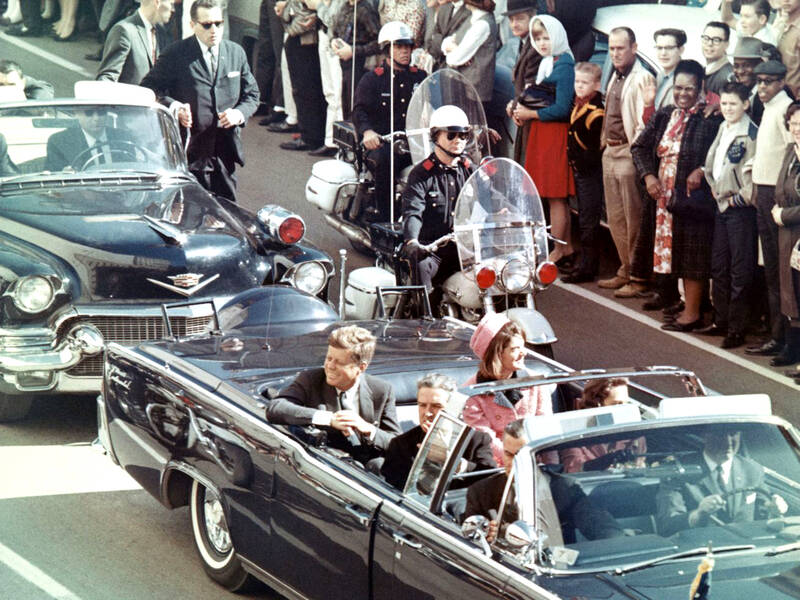
Wikimedia CommonsJohn F. Kennedy, Jacquelin Onassis, and John Connally in the Lincoln limousine motorcade moments before the President’s assassination. Nov. 22, 1963. Dallas, Texas.
Making a film about the assassination of President John F. Kennedy is no easy task. To be sure, any film on the matter is arguably the most difficult to criticize for its accuracy. Not only have key players died, but acquiring the truth from the CIA or those actually involved is virtually impossible.
On the other hand, it isn’t too hard to critique Oliver Stone’s 1991 epic JFK for its inaccuracies.
The film essentially argues that shadowy figures within the government were not only aware but may have contributed to, and certainly benefitted from, the murder of the 35th President of the United States.
“It is not a true story per se,” he told The New York Times shortly before its release. “It explores all the possible scenarios of why Kennedy was killed, who killed him and why.”
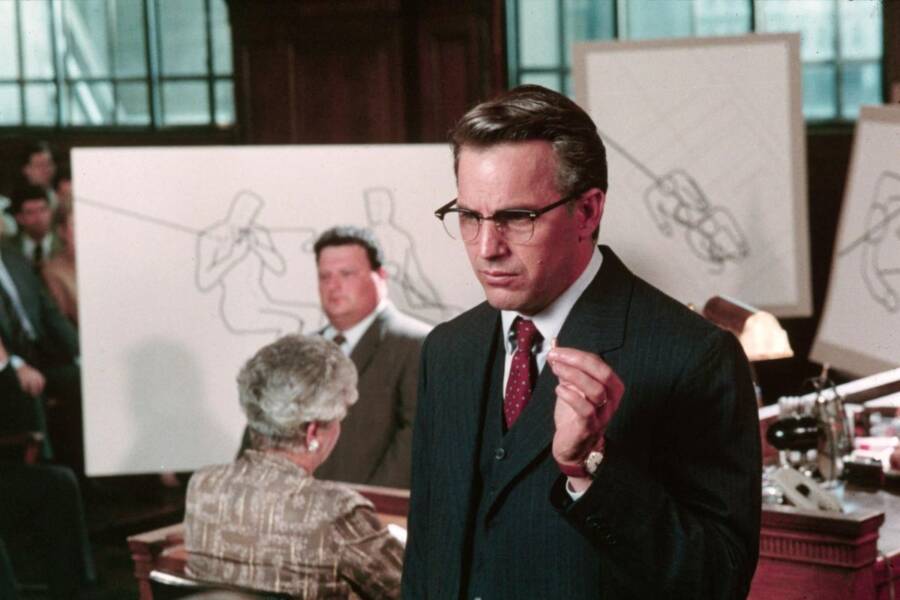
Studio CanalOliver Stone’s magnum opus led to a renewed interest in the Warren Commission’s conclusions and the so-called “magic bullet theory.”
According to The Washington Post, a government agency called the Assassination Records Review Board said the film “disturbed” the citizenry and government officials. Surely, that was part of Stone’s mission. Indeed, the director promised a certain level of accuracy. However, some argue that he failed in this effort.
The film depicts New Orleans district attorney Jim Garrison (Kevin Costner) and his late-1960s trial efforts to find out what happened on Nov. 22, 1963. It also shows key witness David Ferrie (Joe Pesci) admitting that he worked for the CIA, but that has never been confirmed in real life. The movie hinges on the idea that a government conspiracy was behind the JFK assassination.
In reality, Garrison hypnotized and gave a suspicious “truth serum” known to make people suggestible to a key witness in order to garner a specific testimony out of him.
In the film, Stone opted to fabricate a neo-Nazi, male prostitute played by Kevin Bacon to explicitly admit to a government conspiracy plot instead. Bacon’s character is a composite of several witnesses Garrison interviewed.
Perhaps most egregious of JFK is its use of a character named X (Donald Sutherland). The composite character was necessary to give large amounts of exposition, but this fabricated figure never existed. Rather, he was numerous people in one.
On the other hand, X provides an undeniable amount of context for skeptics regarding corruption.
In Stone’s defense, the production did include extensive research on governmental documentation. There seemed to be a massive effort made to trounce his movie upon release, which the director tried hard to fight.
“I had never made a movie where I had to defend it six months later in the press,” he said. “The media was very nasty and they’d set me up on shows. At some point, I had quite a bit of research on my side, but I’d have to recall it all [on the spot] and I couldn’t do that.”
Though the Assassination Records Review Board said the film unfairly “popularized a version of President Kennedy’s assassination” that saw several government agencies involved, it also said the government wasn’t doing itself any favors by keeping key facts classified.