How Caligula Exaggerated The Obscene Life Of A Roman Emperor
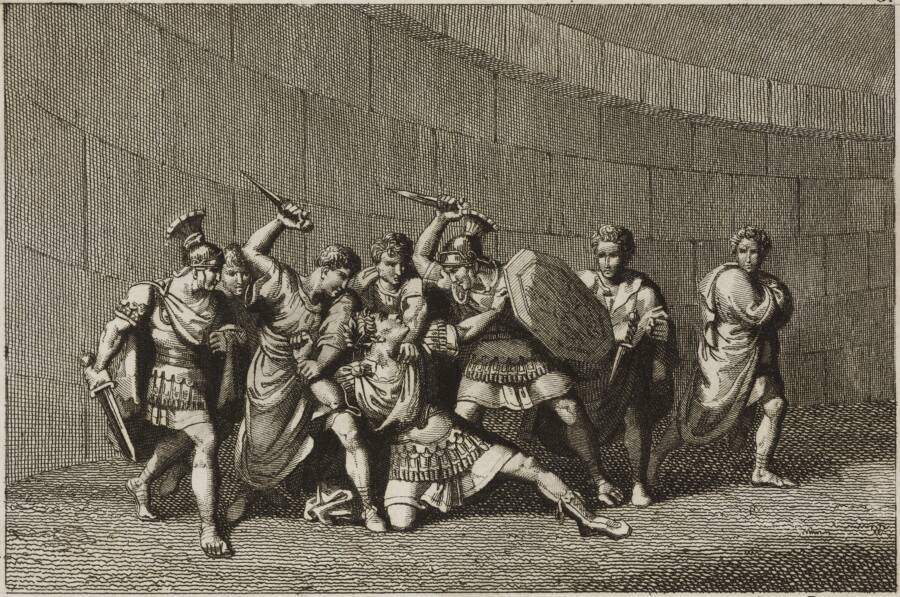
Persichini. Icas94/De Agostini Picture Library via Getty ImagesCaligula is stabbed to death.
The 1979 movie Caligula contained so much sex and violence in a mainstream motion picture that the audience couldn’t believe their eyes.
This movie, based on the Roman emperor who reigned from 37 to 41 A.D., is allegedly as egregiously inaccurate as it is graphic.
The film stars Malcolm McDowell as the eponymous leader and Helen Mirren as his fourth and final wife, Milonia Caesonia.
According to award-winning historical writer and biographer Stephen Dando-Collins, the film certainly portrays the emperor’s penchant for violence accurately, but that’s about all the film covers truthfully.
“The 1979 film was produced and co-written by Penthouse publisher Bob Guccione, who set out with co-writer Gore Vidal to make it as gory and sexually titillating as possible,” he said. “Apart from portraying Caligula as a deranged 20-something emperor of Rome, they got just about everything else wrong.”
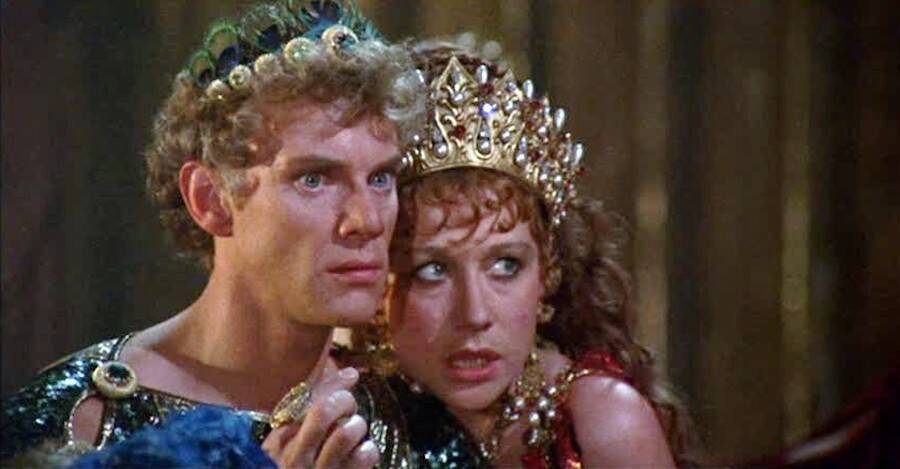
Penthouse FilmsAuthor and historian Stephen Dondo-Collins claimed nearly everything in the film was historically inaccurate. Nonetheless, it became a cult classic for its contributions to the exploitation genre.
The scene in which Caligula cuts the fetus of a child he bore with his sister, Drusilla, out of her body is utter fiction. Dando-Collins said this particular part is “great if you’re a horror film fan,” but not as strong in terms of historical accuracy.
“Drusilla died in a pandemic, and as far as we know wasn’t pregnant at the time,” he said. “Caligula was devastated by her death and had her declared a goddess, but that’s as far as his devotion to her went.”
According to The Harvard Crimson, scenes like this led the film to come under such intense public scrutiny that a Boston Municipal Court deliberated about its potential criminality the year after its release.
“I feel very strongly about First Amendment rights, but I don’t think you’d find me testifying for one of those pictures at North or South Station,” said Harvard’s former associate dean of the faculty for undergraduate education and former professor of Greek and Latin, Glen Bowersock.
Unlike Dando-Collins, Bowersock said he told the court during his three-hour testimony that the film was largely faithful to the truth.
“I’m not arguing that it’s a great movie, but as far as its historical side is concerned, it is exact,” said Bowersock.
Ultimately, just how accurate the film’s rather experimental, avant-garde depiction of Caligula really was is almost beside the point for Bowersock, who claimed historians often dismiss the film due to its explicit nature.
“If there’s one lesson to be learned from this film, it’s that it is not good to ignore a historical period because it is unpleasant,” Bowersock argued. “Sometimes one needs to be reminded of these things.”
Desmond Doss: The Conscientious Objector Of Hacksaw Ridge

Wikimedia CommonsDesmond Doss.
Desmond Doss died in 2006 and never got to see his extraordinary feats of faith and bravery depicted on the silver screen.
The life of the religious veteran who walked into the bloodiest battle of the Pacific Theater of World War 2 with only his devotion to the Seventh Day Adventist church and no weapon was adapted by Mel Gibson and veteran producer Bill Mechanic in 2016 in the film Hacksaw Ridge.
The conscientious objector refused to carry a rifle and enlisted as a medic instead. The true tale was a natural fit for cinematic adaptation and received a standing ovation at its Venice premiere.
“[Mel Gibson and I] were very accurate with Desmond and what happened to him,” said Mechanic.
Nonetheless — as Gibson already understood from his previous work on Braveheart — remaining blindingly faithful to history isn’t always conducive to crafting a cinematic narrative.
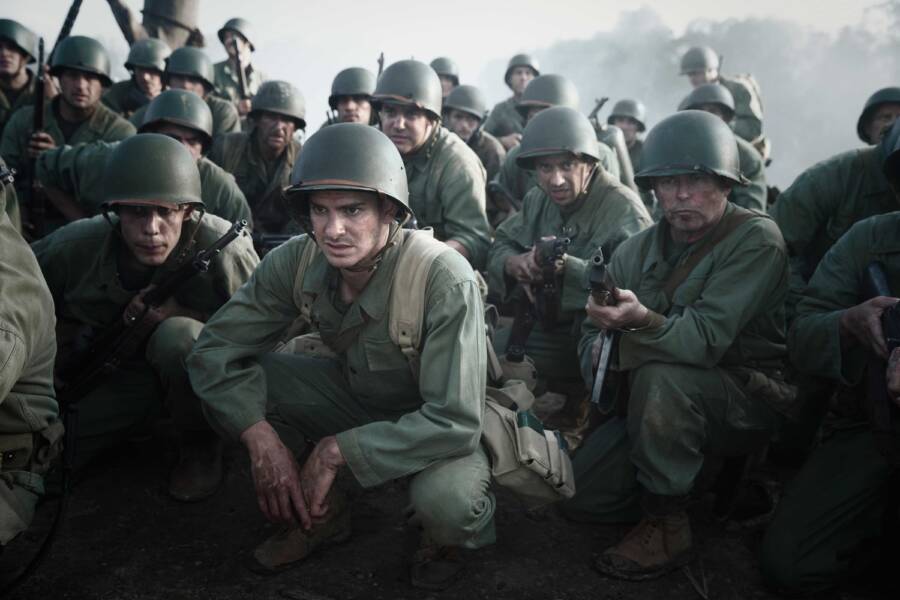
Summit EntertainmentDirector Mel Gibson claimed he intentionally left certain true events out of the film because of how unbelievable they would be to audiences.
Mechanic admitted that the two “were not accurate on some of the details around it,” like the backstory of Doss’ father, for instance. “If you’re a slave to the complete facts, then you’re not making a movie that is compelling,” he argued.
According to filmmaker Terry Benedict, who made The Conscientious Objector about Doss in 2004, the medic’s peers mercilessly mocked him to “man up” and arm himself. This is accurately portrayed in Gibson’s film.
The battle of May 5, 1945, at the Okinawa Maeda Escarpment (which U.S. soldiers called “Hacksaw Ridge”), however, was not. The real-life battle was even more grueling than the movie depicted.
As the Japanese were known to torture their prisoners, Doss made sure to save even those who were terribly injured, to remove them from the top of the ridge. The documentary details Doss’ devout claim that God had spared his life that day.
This could sound preposterous were it not for the fact that even when Japanese soldiers had Doss entirely in their view, their guns jammed several times.
Desmond Doss saved countless lives in a matter of hours that day.
But some of the most impressive details of Doss’s service were left out. For instance, Doss was hit by a sniper and saw all the bones in his left arm shatter and yet he continued to crawl 300 yards to an aid station to seek help for those on the field.
Gibson intentionally excluded this from the film because he simply didn’t think audiences would believe it. As the film stands, one might think Gibson overdid it, but Battle of Okinawa survivors disagree.
“Oh yes, it was graphic,” said Joe Clapper, a 95-year-old Okinawa veteran in 2017. “But when you’ve been there, that’s what it’s like.”
Hacksaw Ridge only came to be because Doss’ only descendant, Desmond Jr., trusted Gibson to faithfully adhere to the truth.
“There was an endless stream of people coming through the door wanting to make a movie, write a book, etc.,” he said. “The reason he declined is that none of them adhered to his one requirement: that it be accurate.”
“And I find it remarkable,” Desmond Jr. concluded, “the level of accuracy in adhering to the principal of the story in this movie.”