Kenneth Taylor, an American pilot portrayed in Michael Bay's Pearl Harbor, called the movie "a piece of trash; over-sensationalized and completely distorted."
To turn a historical event into entertainment is hard enough, but then filmmakers must also consider how to relay the event’s significance accurately and responsibly.
Filmmakers, then, have to ask themselves whether they ought to portray the weight of real-life events or simply try to tell a good story. They have to decide which details can be left out and which must be shown when shaping history into narrative.
It’s not an easy task, so we will assess how these 11 movies based on true stories did in portraying an accurate piece of history.
Movies Based On True Stories: How Mel Gibson Portrayed William Wallace
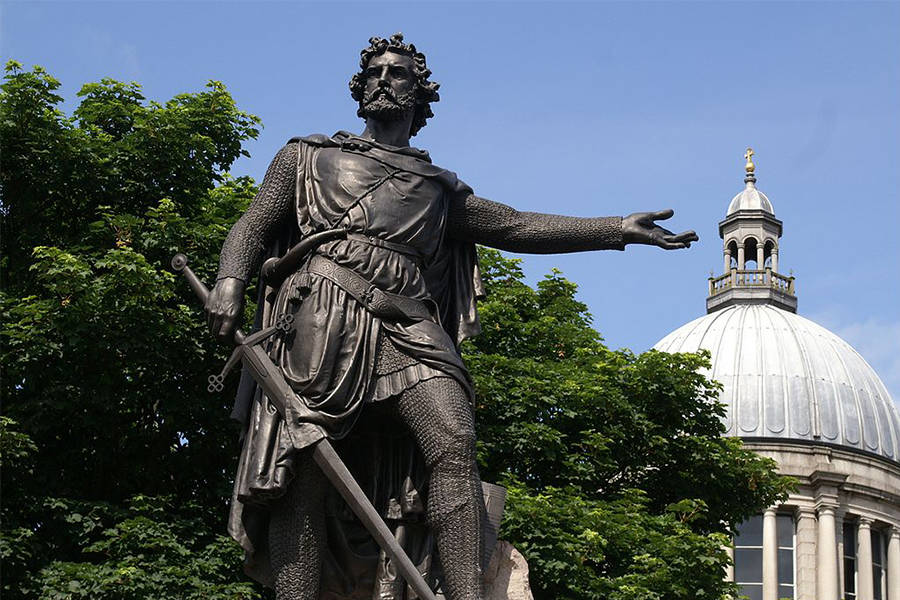
Wikimedia CommonsA statue depicting William Wallace in Scotland.
When Braveheart was first shown in theaters in the spring of 1995, audiences across the United States were stunned by the realistic depictions of real-life Scottish knight William Wallace enmeshed in medieval battle.
It’s a captivating film, but it’s rife with historical discrepancies. It appeared as though Mel Gibson, the director and star of the film, cared more about crafting a character-driven drama than an educational one.
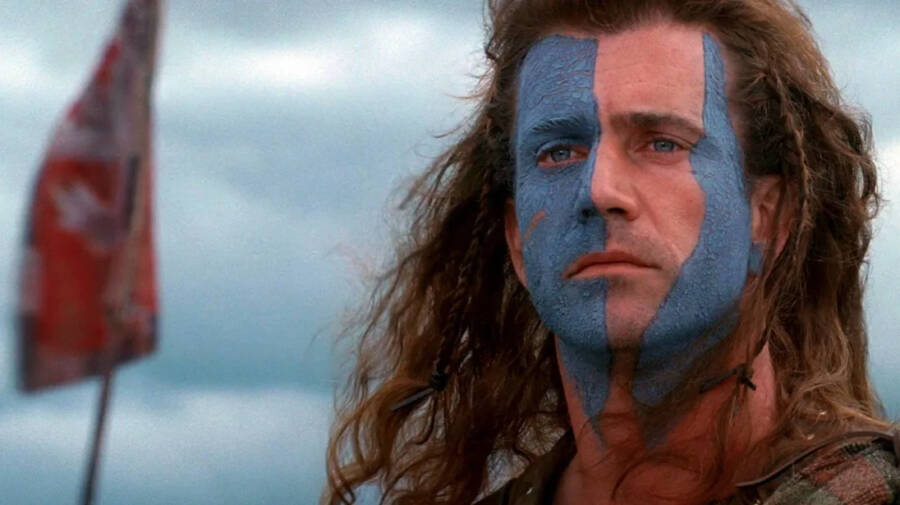
Icon ProductionsMel Gibson did eventually admit that Wallace was more ruthless than portrayed in the film.
Gibson’s Braveheart tells the story of Scottish rebellions against the English across the late 13th and early 14th centuries. Rebellions like these did indeed happen. However, according to Daily History, that’s about where the truth starts and ends in Braveheart.
For instance, the movie gives Wallace an attractive backstory that includes traveling around Europe and learning the ways of the world in his younger years. But little is truly known about the Scotsman’s early life.
The image of a “poor man of the people” that Gibson gave to the Scotsman is empathy-inducing. However, the generally agreed-upon assumption about Wallace’s real background was that he hailed from a noble family and lacked much of the humanity that was depicted in the film.
At least the Oscar-winning director later recognized how historically inaccurate his film was.
“Wallace wasn’t as nice as the character we saw up there, we romanticized him a bit,” Gibson admitted. “Actually, he was a monster. He always smelled of smoke, he was always burning people’s villages down. He was like what the Vikings call a ‘berserker.'”
“We kind of shifted the balance a bit because someone has got to be the good guy against the bad guy; that’s the way that stories are told,” Gibson explained.
Although the film uses the murder of Wallace’s wife by English soldiers as an impetus for his violence, in reality, there are no records besides a poem to prove that the Scotsman had ever been married. Plus, the Scots were already rebelling against England when Wallace joined the fray.
Further, Wallace’s relationship with Isabella of France, Edward II’s wife, was greatly altered. In truth, she was around nine years old at the time the Scotsman was killed and there was no way they could have had a relationship.
The movie returns to partial truth for William Wallace’s execution. It rightly shows his capture and how during his trial he insisted that he had not committed treason because he had never pledged his loyalty to the English crown.
However, the movie fails to mention the many other charges lobbied against him, like raiding and pillaging civilians, which were most likely true.
Ultimately, the film is mired in half-truths and outright falsehoods. But it’s also one of the most cohesively constructed adventure films ever made, with a deeply engaging cast of characters and engrossing arcs. It earned five Academy Awards — including Best Picture.
The Creative Liberties In Gladiator
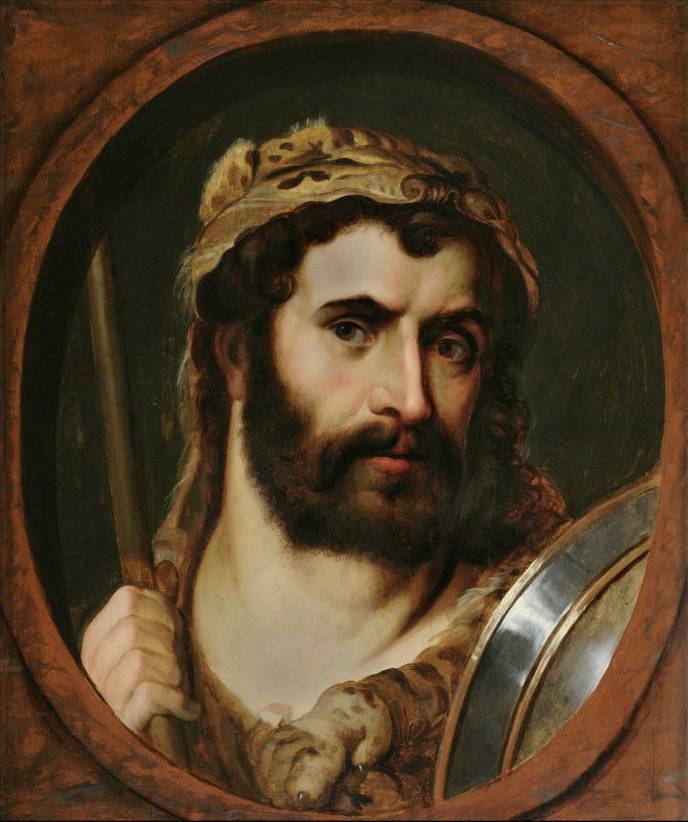
Wikimedia CommonsThe Roman Emperor Commodus, who was portrayed by Joaquin Phoenix in Gladiator.
Ridley Scott’s sword-and-sandals epic was certainly entertaining, but adventure set in ancient Rome was nonetheless historically thin.
The film Gladiator is often compared to Braveheart, even though the movies are set centuries apart in different parts of the globe. According to The Guardian, despite the director’s numerous on-set historians, the script by David Franzoni took tremendous creative liberties.
Marcus Aurelius’ doubt regarding his successor and nefarious son Commodus was true, but his wish of making Rome democratic was pure fantasy.
Commodus was portrayed with pitch-perfect malevolence by Joaquin Phoenix, but even his depiction was more humane than the real-life figure. Indeed, the real Commodus was even more vile, torturous, and barbaric than the movie ever made him out to be.
Commodus herded women, killed rare animals for fun, ate feces, fed his guards poisoned figs, and forced people to beat themselves to death with pinecones. Unfortunately, this kind of cruelty was interpreted as a strength, so Commodus was actually quite popular among his people.
The movie did show correctly that Marcus Aurelius died because of Commodus. Though Commodus himself didn’t kill his father, a friend of his, Cassius Dio, recorded how the emperor’s doctors killed Marcus Aurelius so that Commodus could become emperor.
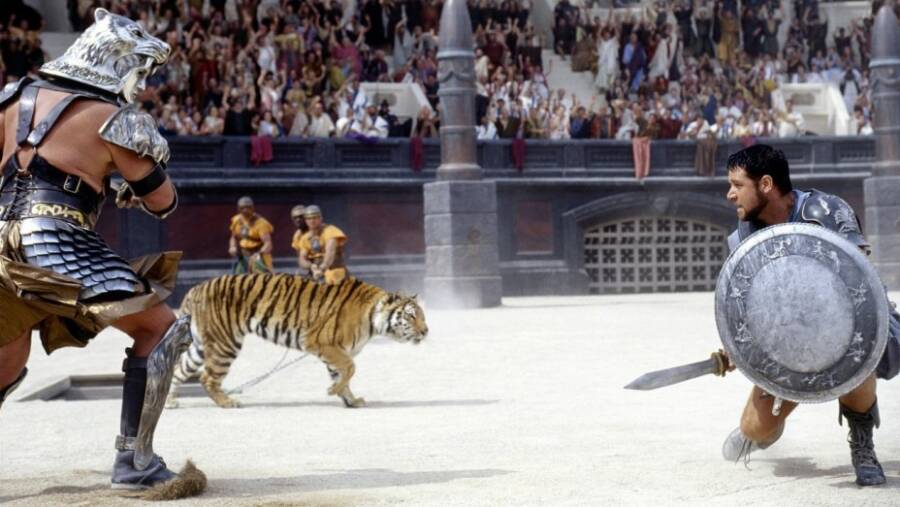
Scott Free ProductionsMaximus (Russell Crowe), confronted by well-armed opposition and ferocious tigers.
In a similar act of narrative leeway to Braveheart, Scott’s film employs plot points that make emotional sense in lieu of historical accuracy.
Mauritanian slave traders didn’t scour rural Hispania for dying men to nurse back to health on the off-chance that they could be sold. This point was pure fiction. The film also conveniently forgets to mention that Commodus fought in hundreds of gladiatorial events — that way it could portray him as more of a coward than he actually was.
But Scott’s masterful direction of the gladiatorial battles and the peripheral landscape of excitement was surely accurate. The fights were indeed gruesome and the audience did enjoy them on a visceral level. As a modern viewer though, it is petrifying to consider that to delight in this kind of violence was once so common.
According to How Stuff Works, the use of catapults in open battlefields like the opening forest battle in Germania was absolute fiction. The whole character of Maximus, himself, was created just for the film as well. But these are debatably minor quibbles when contrasted with other narrative faults of the movie.
Despite the movie squeezing Commodus’ 12-year reign into a seemingly one or two-year period, the depiction of his death is arguably the most egregious deviation from the truth.
In the film, the fictional Maximus valiantly defeats Commodus in battle for all of Rome to see. This plot point may be a neatly tied bow on a well-constructed story, but it’s a far cry from the truth.
In reality, Commodus met his end far less publicly and without much dignity. He was strangled in his bath by a wrestler named Narcissus.