

How the Boston Tea Party of 1773 cost the British a fortune, invigorated the colonists' revolutionary spirit, and hastened the coming of American independence.
On December 17, 1773, John Adams wrote a feverishly excited letter to his friend, James Warren. “The Dye is cast!” he declared. “This is the grandest, Event, which has ever yet happened Since, the Controversy, with Britain, opened! The Sublimity of it, charms me!”
Adams was writing about what would eventually become known as one of the most important moments in early American history: The Boston Tea Party, which had taken place in Boston Harbor the night before.
A group of roughly 100 colonists disguised as Native Americans had descended on three British ships in Boston Harbor. In a matter of hours, they dumped more than 300 chests filled with more than 90,000 pounds of tea into the water, destroying the equivalent of 18 million cups of tea — which were worth more than $1.7 million in today’s currency.
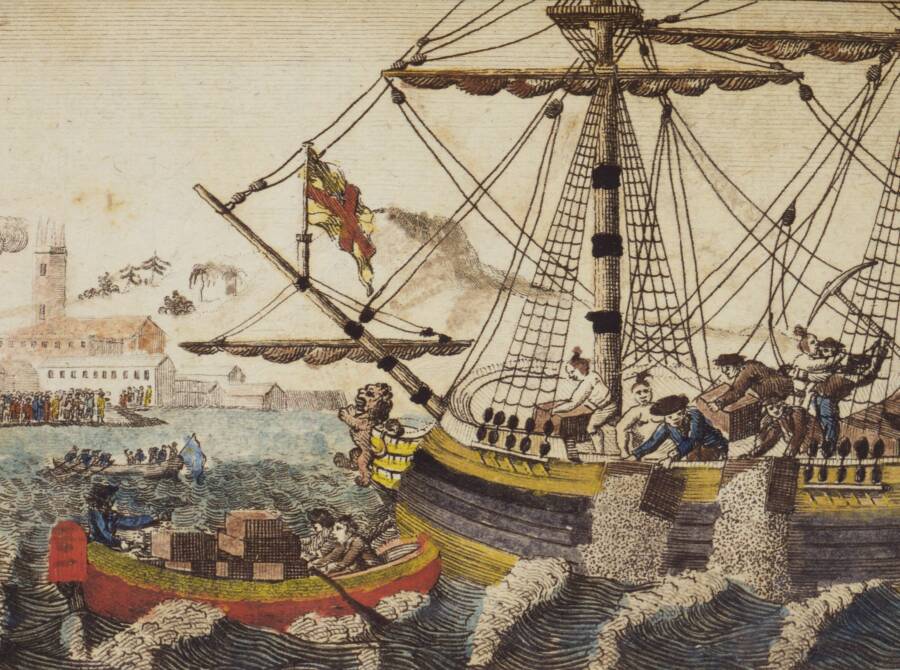
Wikimedia CommonsThousands of onlookers watched and cheered as more than 100 American colonists disguised as Native Americans dumped hundreds of chests of tea into the water during the Boston Tea Party.
As Adams wrote to Warren: “This Destruction of the Tea is so bold, so daring, so firm, intrepid and inflexible, and it must have so important Consequences, and so lasting, that I cant but consider it as an Epocha in History… The Question is whether the Destruction of this Tea was necessary? I apprehend it was absolutely and indispensably so.”
Adams’ words proved prescient. The Boston Tea Party would have enormous aftershocks in the relationship between the American colonists and Great Britain. Tensions between the Americans and the British had been building for years, but the Boston Tea Party brought things to a head. The British responded by cracking down further on Boston, which, in turn, caused even more American colonists to turn against British rule in the other colonies.
George Washington, who had initially thought that the Bostonians were “mad” and that they’d gone too far in their destruction of British tea, changed his mind after the British punished Boston. “[T]he cause of Boston,” Washington declared, “now is and ever will be considered as the cause of America.”
This is the full story of the Boston Tea Party, from how tensions between the British and the American colonists grew, to the actual events of December 16, 1773, to how the Boston Tea Party moved the American colonies closer to the Revolutionary War — and independence.
Learn more about the music used in our podcast. History Uncovered is part of the Airwave Media network. Learn more about your ad choices by visiting megaphone.fm/adchoices.