

Known as OOPArts, out-of-place artifacts are relics that appear to be so advanced or unusual for their supposed time and place that they seem to upend conventional understandings of history.
Over the centuries, archaeologists have come across countless incredible relics that bring humanity’s past to life: King Tut’s tomb, the frozen bodies of Pompeii, intricate silver and gold llama figurines crafted by the Inca. But some of even the most famous artifacts to ever be unearthed simply don’t seem to match the time, place, or context from which they supposedly came.
These out-of-place artifacts, or OOPArts, have thus sparked heated debates. Some conspiracy theorists point to them as proof of ancient extraterrestrial activity on planet Earth, while others say they’re evidence of advanced civilizations that were lost to time, such as Atlantis. These OOPArts have even been used to discredit modern understandings of history, science, and technology altogether.
One of the most incredible examples is the Antikythera mechanism, an ancient analog computer found in a shipwreck off the coast of Greece in 1901. The device was seemingly created in the second century B.C.E., and it could calculate the future positions of celestial bodies and predict eclipses decades in advance. While the ancient Greeks were known for their knowledge of astronomy, the Antikythera mechanism was still centuries ahead of its time.
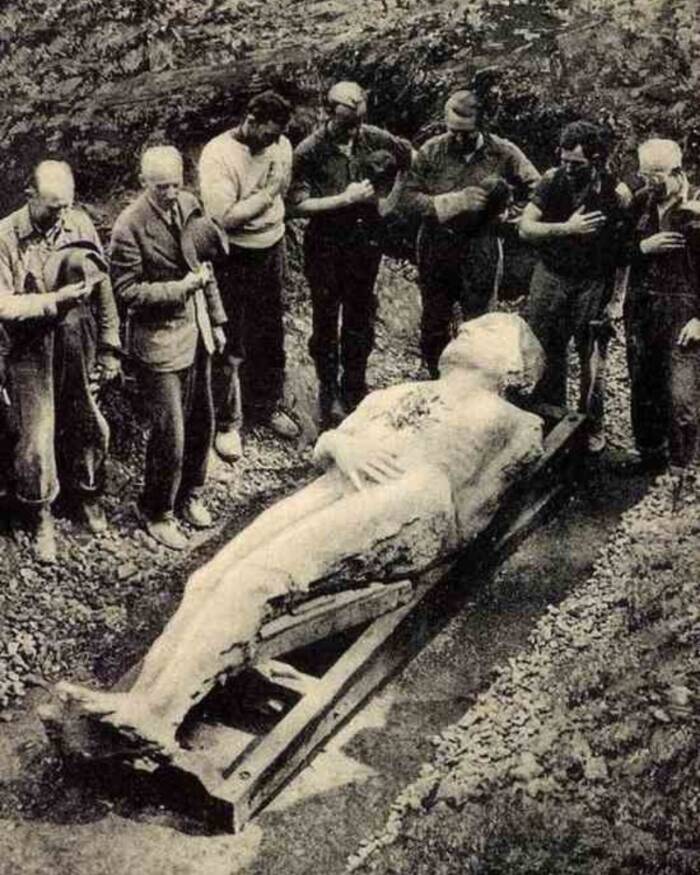
Public DomainThe Cardiff Giant was one of history’s most baffling OOPArts — until it was revealed to be a hoax.
Then, there’s the Maine penny, an 11th-century Norwegian coin found in a Native American shell mound on the coast of Maine. Some historians point to the artifact as proof that the Vikings may have landed in what’s now the United States. Others believe that the coin made its way to Maine from Viking settlements in Labrador or Newfoundland through extensive Native American trading networks.
But not all OOPArts are quite as impressive — at least not upon closer examination. In many cases, these artifacts are simply interpreted incorrectly.
For instance, experts once believed that a tiny figurine unearthed from Sumerian ruins in present-day Iraq depicted a sivathere, a prehistoric giraffe that went extinct more than 8,000 years ago. But the figurine was carved between 3500 B.C.E. and 2800 B.C.E. — thousands of years after the last sivathere walked the Earth.
The artifact ignited debate about whether the sivathere may have survived longer than previously thought. Then, several decades later, small antlers were found in a museum storeroom, and they fit perfectly onto the figurine. It likely wasn’t a sivathere at all, but rather a common deer.
Meanwhile, other OOPArts have been revealed as hoaxes. The most famous example is the Cardiff Giant, the body of a 10-foot-tall “petrified man” that was purportedly found in New York in 1869. Creationists immediately latched onto the artifact as proof of the giants mentioned in the Bible, but the body was quickly exposed as a hoax carried out by a man named George Hull.
While hundreds of these OOPArts have been discovered over the years, very few are actually as out-of-place as they seem. But every so often, a relic comes to light that stumps even the most skeptical of experts.
Learn more about the music used in our podcast. History Uncovered is part of the Airwave Media network. Learn more about your ad choices by visiting megaphone.fm/adchoices.