These bewildering out-of-place artifacts, or OOPArts, often seem too advanced for their time and place, leading to wild theories about advanced ancient civilizations and even aliens.
Out-of-place artifacts, or OOPArts, are objects that appear to contradict our understanding of technological development in ancient civilizations. These historical oddities have captivated public imagination for decades, spawning countless theories about advanced prehistoric technology, ancient aliens, and lost civilizations with sophisticated engineering capabilities.
From the so-called “Baghdad Battery” to ancient figurines that supposedly resemble modern aircraft, these artifacts often serve as focal points for alternative history narratives.
The truth, however, is usually more banal than the headlines suggest. Many OOPArts turn out to be misidentified natural formations, modern objects that have become mineralized more quickly than expected, or legitimate ancient items whose purpose has been misunderstood or sensationalized.
What makes OOPArts particularly resilient to debunking is the appealing narrative they provide: that ancient peoples possessed secret knowledge or technology far beyond what mainstream archaeology acknowledges. While this makes for entertaining content, it often relies on underestimating the ingenuity of our ancestors and overinterpreting ambiguous evidence.
But to truly understand these objects and their appeal also requires some reflection on why people are so eager to accept such wild narratives in the first place.








And if you liked this post, be sure to check out these popular posts:

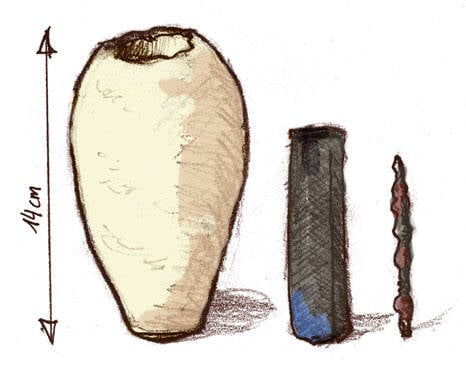
Baghdad Battery
It is frequently cited as an out-of-place artifact (OOPArt) because German archaeologist Wilhelm König suggested in 1938 that it functioned as a galvanic cell (a simple electric battery). If true, it would predate Alessandro Volta’s invention of the modern battery by nearly 2,000 years, suggesting a lost technology. Theories for its use included electroplating, electrotherapy, or perhaps ritualistic magic.
However, its original use as a battery is not the the universally accepted theory by mainstream archaeologists. The more likely theory, scholars say, is that these jars were simply storage vessels for sacred scrolls, possibly wrapped around the iron rod for support. But sadly, the artifact has been missing since the beginning of the Iraq War in 2003.Ironie/Wikimedia Commons
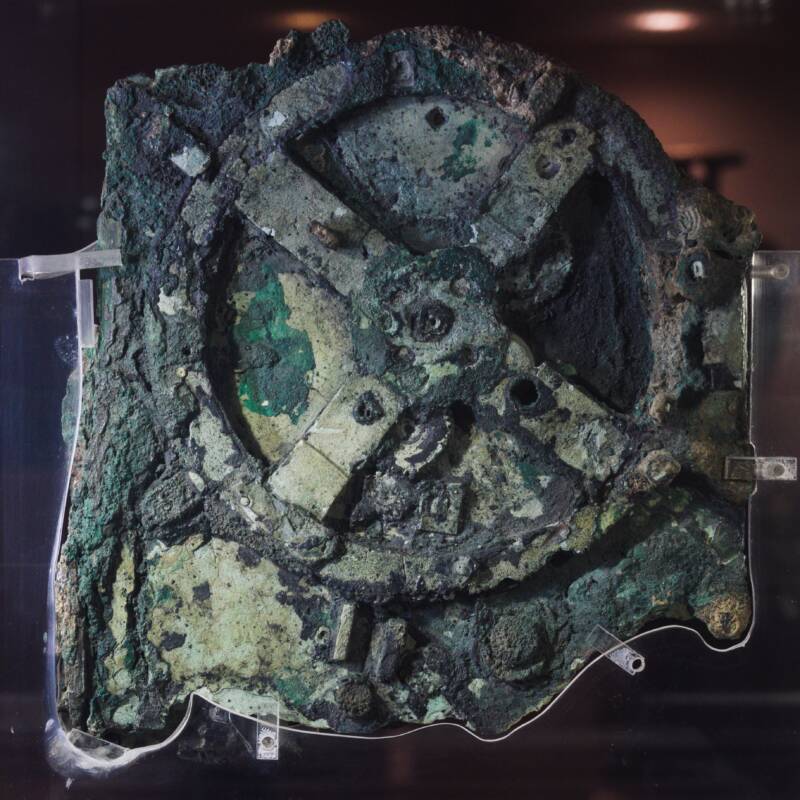
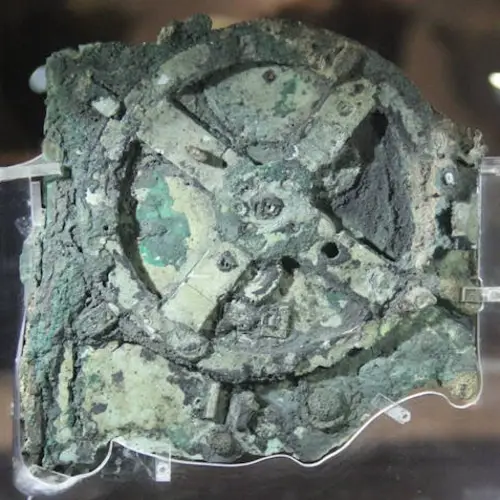
The Antikythera Mechanism
It is often cited as an out-of-place artifact because of its complexity. It includes a system of more than 30 precision bronze gears used to predict astronomical positions and track the four-year Olympic cycle. Machines of comparable complexity didn't appear in Europe until the 14th century, which naturally led to some fringe theories about extraterrestrial life or time travel.
However, the idea that this device was an unexplainable anomaly has been largely debunked. Hellenistic science was already known for advanced astronomy and mathematics, and while the Antikythera Mechanism is certainly a unique device, its uniqueness could be attributed to the failure of similar devices to survive, not a lack of technological capability at the time. Wikimedia Commons
The Lake Winnipesaukee Mystery Stone
Because its carvings and construction don't align with the known skills or culture of the local Abenaki Native American tribes, it is considered an OOPArt, with some theories suggesting it may have been a Native Treaty Stone or Tally Stone, or, more fantastically, a Thunderstone — a mythological object believed to have fallen from the sky during storms.
More modern analysis has challenged the notion that there is any "mystery" to the stone at all. The New Hampshire Historical Society currently houses the stone, and found, via borescope examination of the hole going straight through the stone in 1994, an extreme regularity and scratches inconsistent with ancient Native American methods.
In fact, the hole was more consistent with the sorts made by 19th- or 20th-century power tools, suggesting the artifact may have just been an elaborate hoax or piece of folk art made by an artisan in the mid-to-late 1800s. It may have even been made by its original discoverer, Seneca Ladd. Wikimedia Commons
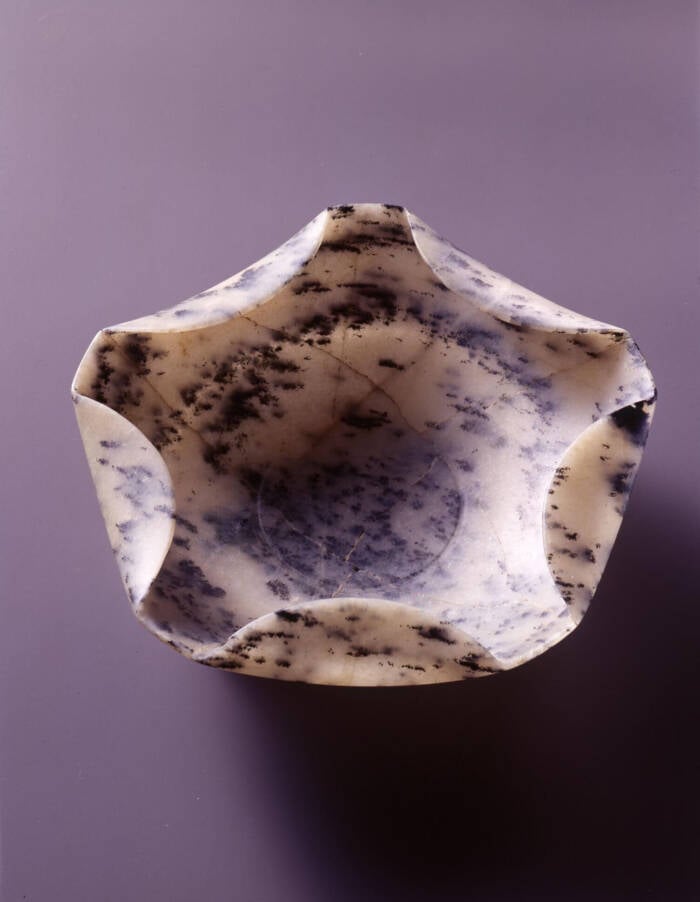
Giza Diorite Bowls
They are considered OOPArts largely because of the sheer difficulty of working with diorite, which is an incredibly hard igneous rock, using only the tools commonly attributed to the Early Dynastic and Old Kingdom periods (3100 to 2181 B.C.E.). This has led to theories about lost advanced technology or machinery, or possibly some pre-Dynastic super-civilization.
While the bowls haven't been as thoroughly debunked as some other OOPArts, there are more grounded explanations, the most likely of which being that these bowls were simply made by incredibly skilled craftspeople using a fixed-point lathe in combination with hard abrasives.Reddit
The Nimrud Lens
It is cited as an OOPArt because its shape gives it optical properties equivalent to a 3X magnifying glass with a focal length of about 4.7 inches — a highly advanced level of optical design for the time.
Theories for its use include a magnifying glass, suggested by its finder Austen Henry Layard, or perhaps a burning glass used to concentrate sunlight and start fires. In 1999, however, Italian scientist Giovanni Pettinato proposed the lens may have been part of an early telescope, suggesting it may explain why the Assyrians had such detailed astronomical knowledge.
These theories have been largely disputed by mainstream archaeology, though. There is a lack of actual evidence to prove the magnifying properties of the stone were an intentional design choice, and in fact, they may have been entirely accidental. More likely, modern archaeologists say, it was a piece of decorative inlay for furniture or jewelry, supported by the fact that it was found buried beneath fragments of blue opaque glass. Its quality would also have been insufficient for any genuine scientific use. Wikimedia Commons
The Sabu Disc
Even at a glance, it should be clear why it is considered an out-of-place artifact. The disc resembles a modern steering wheel or turbine blade, despite being made of a brittle stone that is extremely difficult to carve without breaking. The design is commonly thought to be far beyond the capability of tools from the era, leading to fringe theories about lost ancient machinery or possibly even an entire lost, highly advanced civilization. More grounded theories point to it being a type of oil lamp or possibly a throwing disc.
Modern Egyptologists are still unclear about its exact purpose, but the most accepted theory is that it was a unique ceremonial vessel or a decorative, one-of-a-kind funerary object. Some have also suggested it was a mash rake used to mix grains and hot water in large brewing vats for making beer. Wikimedia Commons
The Wedge Of Aiud
If that dating is to be believed, the artifact would truly be out of place for a specific reason: it is composed of an aluminum alloy, yet aluminum was not isolated and produced in industrial quantities until the mid-19th century. Finding an aluminum alloy in a geological layer potentially thousands, or even hundreds of thousands, of years old would be a genuine anomaly.
Because of this, some have theorized that the wedge was some kind of advanced ancient technology or extraterrestrial in origin. However, skeptics and archaeologists have stated the object is more likely a modern one that was simply misplaced or discarded — probably a tooth from an excavator bucket or other piece of construction equipment.
Being found in river deposits, the object's association with the mastodon bones is likely non-stratigraphic, meaning it was likely discarded upstream and simply tumbled and settled next to the ancient remains, creating a misleading context. The patina layer on the aluminum, often cited as proof of its great age, is also consistent with the rapid oxidation of aluminum, especially in acidic environments, and does not require a prehistoric timeline.RationalWiki
The Iron Pillar Of Delhi
It was long considered an out-of-place artifact because of its resistance to rust for more than 1,600 years, despite its exposure to the elements. Once more, this led to theories about alien technology or lost civilizations.
However, scientific analysis in 2003 revealed that the iron's corrosion resistance is due to the formation of a thin, passive protective layer called misawite — a crystalline iron hydrogen phosphate hydrate. The layer formed because ancient Indian blacksmiths had used a direct reduction process that resulted in an exceptionally high phosphorus content in the iron and a low sulfur content, which combined with Delhi's dry atmospheric conditions, catalyzed the formation of the protective layer.
The Iron Pillar of Delhi is no mystery, just a testament to the skill of ancient Indian metallurgists. Wikimedia Commons
Dendera Lamps
Some have argued that the bas-reliefs depict something akin to modern electrical devices like Crookes tubes or incandescent lightbulbs, indicating the ancient Egyptians had advanced technology.
In truth, Egyptologists say the imagery actually depicts a serpent emerging from a lotus flower, contained within an elongated, bulb-shaped enclosure — a symbolic creation myth about the sun god Horus emerging from a lotus flower within the womb of the sky goddess Nut. Wikimedia Commons
The Stone Spheres Of Costa Rica
They are often considered OOPArts because of their geometric perfection — near-perfect spheres carved from hard igneous rocks like granodiorite and gabbro. Discrediting the Diquís culture's skills, some have claimed the spheres were alien navigational beacons or even relics of Atlantis.
The truth is that while their exact purpose is still debated, archaeological research has confirmed the spheres were indeed crafted by the Diquís people, not beings from outer space. Wikimedia Commons
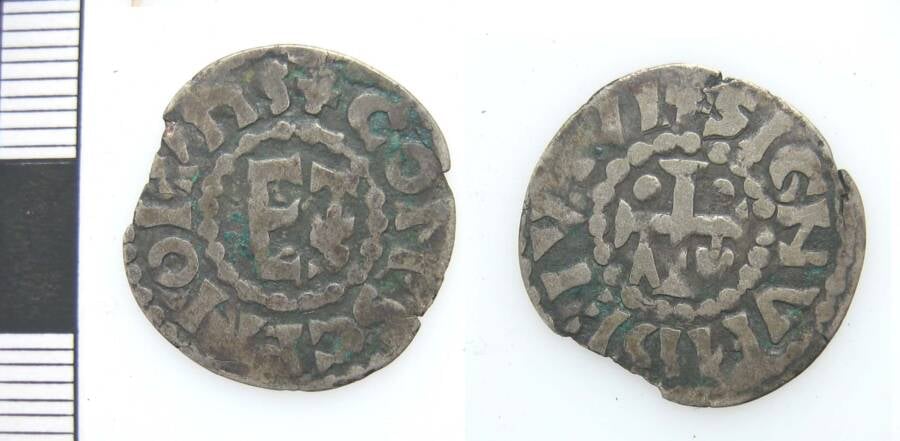
The Maine Penny
It is the only pre-Columbian Norse artifact generally regarded as authentic found in the United States, which is why it is perhaps rightfully considered an out-of-place artifact. Its presence, 200 years before the Goddard site was occupied by Europeans, and far south of the known Viking settlement at L'Anse aux Meadows in Newfoundland, does raise genuine questions about how it arrived.
Some believe it points to Viking exploration further south than commonly believed, or to trade between the Vikings and Native Americans. This latter theory is the more commonly accepted, as the Goddard site was a known trade hub, but there is also the possibility the whole thing was a hoax.
The amateur discoverer, Guy Mellgren, happened to be a coin collector, and such coins were available on the open market in 1957. The circumstances of the find were poorly recorded, which led to some skepticism about the authenticity of Mellgren's claims. In either case, the coin itself is authentic — but doesn't provide evidence of Norse exploration in Maine.Wikimedia Commons
The Nanjing Belt
It is cited as an OOPArt because of its material: the object is made of aluminum, which, like the Wedge of Aiud, was a metal not isolated and produced cheaply until the mid-19th century. As always, theories proposed included advanced ancient technology, extraterrestrial origins, or time travel.
The most plausible and widely accepted explanation is contamination during the excavation process. Despite the tomb being "sealed," it is extremely difficult to guarantee absolute integrity over centuries, especially against modern intrusion or poor excavation controls. A small, lightweight object like a belt buckle could have easily fallen into the tomb rubble from a worker's clothing or a piece of equipment during or before the official opening.
The aluminum is also of a common modern grade, and its style is rather nondescript, aligning with modern styles. Reddit
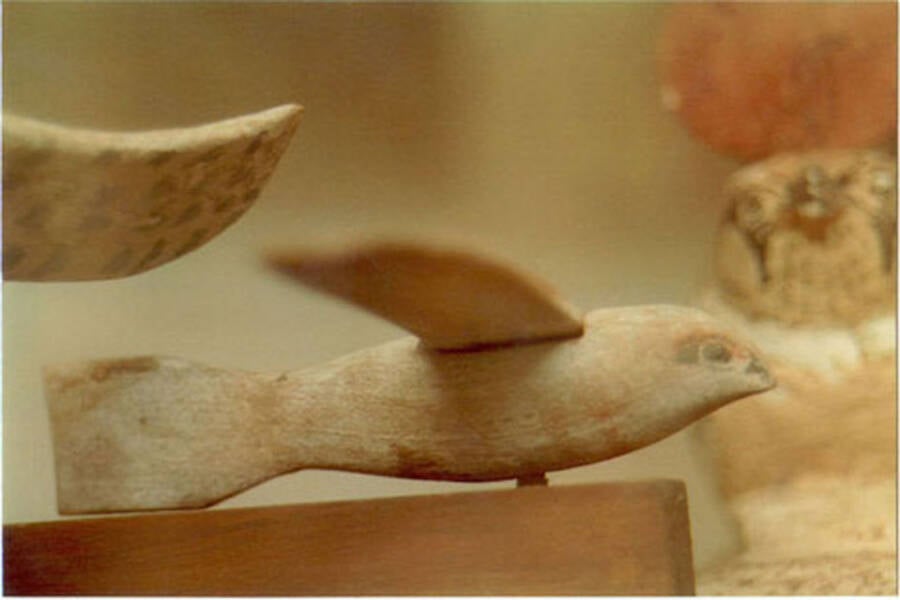
The Saqqara Bird
Unlike typical Egyptian artistic depictions of birds — which show wings flat or curved down — the Saqqara Bird features straight, stiff wings positioned at a slightly upward angle, resembling the dihedral common on modern glider wings. Those who consider it an out-of-place artifact often argue the Saqqara Bird is a fully functional, intentional model of an ancient aircraft or glider.
Egyptologists, on the other hand, largely consider the bird to be an ornament or toy of some kind, possibly even a weather vane topper. While a reconstruction can be flown when a vertical stabilizer like a tail is added, that doesn't necessarily prove the ancient Egyptians knew the secrets to flight — and certainly not on a larger scale capable of transport.Wikimedia Commons
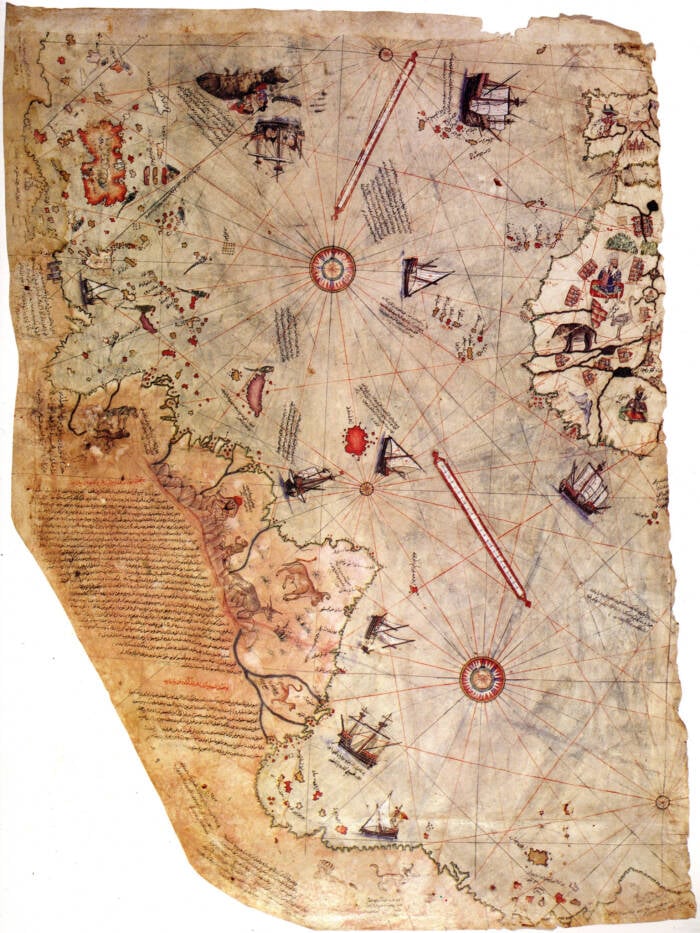
The Piri Reis Map
There are two main reasons it is considered an OOPArt. Firstly, Piri Reis noted that he used 20 source maps, including a now-lost map drawn by Christopher Columbus, making it the only known map to potentially preserve Columbus' early cartography.
Secondly, and most controversially, it features what appears to be a distorted landmass at the bottom of the map, which some claimed to be a depiction of Antarctica's coastline before it was covered by ice, fueling theories of a lost, highly-advanced civilization with global seafaring and cartographic knowledge.
But while the map is a genuine and priceless historical document, the notion that it depicts an ice-free Antarctica is widely refuted. The most accepted explanation is that the landmass is not Antarctica at all, but rather a highly distorted or speculative extension of the South American coast, bent to fit onto the animal-skin parchment. Cartographers of the era also frequently included the purely theoretical southern continent known as Terra Australis Incognita, largely for philosophical balance.
Besides, the geographical record shows that Antarctica has been ice-covered for millions of years, so Piri Reis, had he even known about it — which he didn't, given that Antarctica wasn't discovered until 1820 — certainly wouldn't have seen it ice-free. Wikimedia Commons
The Tecaxic Calixtlahuaca Head
It is considered an out-of-place artifact because classical art experts have stylistically identified it as a Roman artifact dating to the second or third century C.E., placing its origins around 1,200 years before the tomb was sealed and centuries before the first sustained European contact in the 1500s.
There are three leading theories as to how this head wound up in Mexico. The first suggests it may have washed ashore after a Roman, Phoenician, or Berber shipwreck, after which it was preserved and traded by Indigenous people as a curious exotic artifact. Others suggest Viking explorers brought it with them to Mesoamerica, and then traded it.
The third theory is that the whole thing was a hoax or practical joke played on Payón, possibly planted by a student or colleague. Payón's documentation of the find was poor, seemingly lending some credence to this theory.
In 1995, however, a thermoluminescence test confirmed the head dated to between the 9th century B.C.E. and the middle of the 13th century C.E., according to a statement from Ohio State University. While this didn't entirely rule out the hoax theory — someone may have still planted the figurine — it did at least confirm the object's authenticity as a historical artifact. Romeo Hristov/Ohio State University
The Kensington Runestone
It is a famous OOPArt because if authentic, it would prove that European explorers traveled deep into the interior of North America 130 years before Christopher Columbus. The inscription details a journey by "eight Goths [Swedes] and 22 Norwegians" who were on an exploration trip from the west. It also mentions that 10 of their party were killed by Indigenous people and ends with a plea to the Virgin Mary to save them from evil.
Those who believe this to be an authentic artifact argued it was a legitimate, albeit secret, record of a genuine Norse expedition deep into the continent, further claiming that the runic forms and language reflect a dialect of medieval Swedish-Norwegian that only someone intimately familiar with the language of the time could have created.
That said, the runestone's authenticity has always been a matter of contention. The main argument against it is linguistic — the runes used are a mix of different runic systems from different time periods and origins, the vocabulary contains several words that are modern Swedish/Norwegian, and the inscription uses Arabic numerals, which were not commonly used in Scandinavia in 1362.
A lack of any other supporting Norse artifacts, and Olof Ohman's reputation for practical jokes, ultimately caused academics to conclude the Kensington Runestone was nothing more than a hoax. Wikimedia Commons
The London Hammer
It is cited as an OOPArt because the rock formation it was allegedly embedded in is supposedly Cretaceous, dating it back to more than 100 million years old. That would mean this hammer predated human civilization — in which case, some argue, it could have been created by a highly advanced hominid society that existed hundreds of millions of years ago, or, of course, non-human, extraterrestrial origin.
Unfortunately for hopeful believers, the extreme age claims surrounding the London Hammer have been thoroughly debunked. It was not found in a Cretaceous layer, but rather a ferrous concretion, a hard mass formed by mineral precipitation that rapidly hardens around a foreign object, giving the appearance of encasing it in ancient rock.
In truth, the London Hammer is just a low-quality cast iron hammer from the 19th or 20th century, probably lost by a miner. Wikimedia Commons
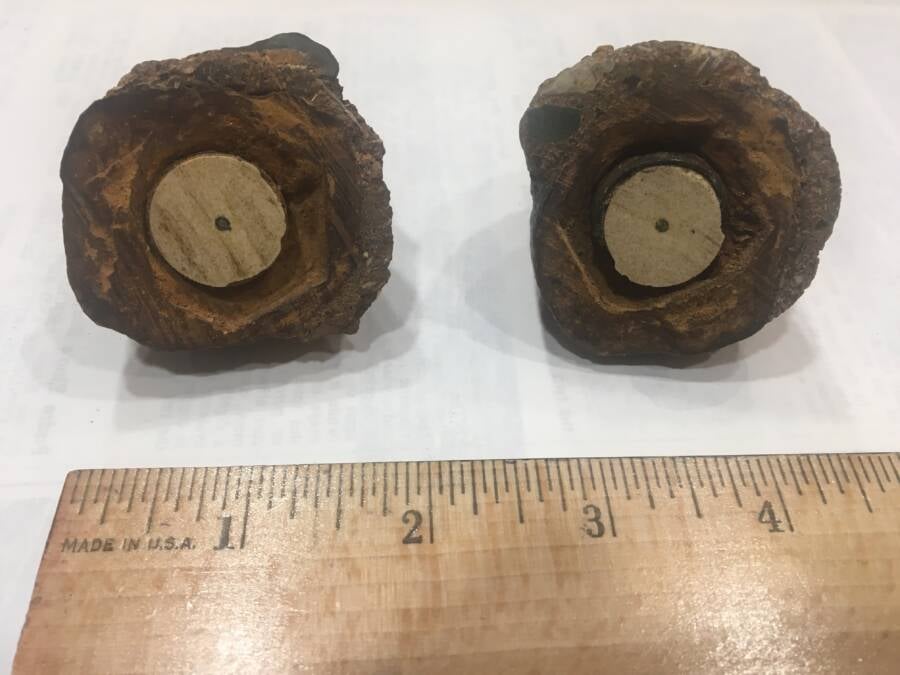
The Coso Artifact
When they cut it open, they were shocked to find what looked like a modern spark plug inside — odd, given that the clay was supposedly anywhere from 10,000 to 500,000 years old. This led to speculation about the artifact being the remnants of a highly advanced pre-human civilization or alien propulsion system.
The truth was much less exciting. It really was just a 1920s-era spark plug, and the "geode" it was found in was yet another ferrous concretion that formed over just a few decades. Like the London Hammer, it was probably just a lost object. Wikimedia Commons
The Dorchester Pot
The object is cited as an extreme OOPArt because the geological formation it was reportedly found in is the Roxbury Conglomerate, which is part of the Precambrian or Early Paleozoic era, making the rock between 570 and 600 million years old. The vessel itself was described as being made of an unknown alloy, decorated with six inlaid silver figures or flowers, a clearly intentional artistic design that would have predated humanity by hundreds of millions of years.
Experts unanimously rejected this conclusion. The Dorchester Pot is considered a legendary artifact with no credible scientific basis. It was likely either a hoax, intentionally planted near the blast zone, or the context was completely misinterpreted — and the fact that it was not preserved makes it impossible to verify any claims. Wikimedia Commons
This carving is cited as an OOPArt because when viewed at a distance, the overlapping symbols appear to depict several recognizable modern vehicles: a helicopter, a submarine, and a type of flying saucer or airship.
In actuality, the interpretation of these carvings as modern vehicles is a misinterpretation caused by pareidolia and a specific process of re-carving that took place during the temple's use.
The visual anomaly is an accidental byproduct of a common ancient Egyptian practice called a palimpsest. The original cartouche of Seti I was plastered over and re-carved with the cartouche of his son, Ramesses II. Over time, the plaster fell away, leaving the original carvings visible, and the overlapping of the older symbols with the new ones accidentally produced the shapes resembling modern vehicles.Hypnôs/Wikimedia Commons
Dropa Stones
The stones became a famous OOPArt specifically because the claims of their origins were so wild. The stones, which looked similar to Chinese bì discs, supposedly had spiral grooves running out from the center. A Chinese professor, Tsum Um Nui, allegedly translated those grooves in 1962, from which he determined they were hieroglyphs that chronicled an alien craft crashing on Earth 12,000 years ago.
Of course, this was debunked. Tsum Um Nui wasn't even verified to be a real person, nor was the archaeologist who supposedly found the stones, Chi Pu Tei. One of the books that popularized this theory, Sungods in Exile was also admitted to be satire by its author David Gamon in an interview with the Fortean Times. Wikimedia Commons
The Shakōkidogū
They are often considered OOPArts due to their highly stylized and non-realistic reatures, particularly the long, oblong eye slits that seem to look like snow goggles, welding goggles, or some other kind of specialized eye protection that would have been far ahead of anything from that era.
Some theories about their origins include non-human intelligence or ancient astronauts, depictions of more advanced specialized gear, or possibly representations of deep sea divers.
The more extreme claims of alien involvement are of course widely rejected by modern Japanese archaeologists. More likely, experts say, these were ceremonial and ritual objects that would have been used in fertility rites, shamanistic healing rituals, or purification ceremonies, their shape simply a highly stylized representation of the female form. Wikimedia Commons
The Quimbaya Airplanes
These objects are cited as an OOPArt because they possess an uncanny resemblance to modern delta-wing aircraft, especially when compared to conventional depictions of birds, fish, or insects from the same region.
Like other examples of "modern technology" in ancient works, archaeologists and historians largely agree that these were nothing more than highly stylized representations of the local fauna, specifically flying fish, insects, or birds. These pendants were funerary objects, likely meant to convey status and spiritual power, associating the deceased with a creature that could aid them in the afterlife. Reddit
Crystal Skulls
These skulls are cited as OOPArts not because of their age, but because of the claims made about their impossible craftsmanship and supernatural powers. Proponents of these theories suggest the quartz, a hard material, was carved using advanced technologies like laser cutting or diamond-tipped drills — technology that was not in existence yet. They also claimed the skulls had powerful psychic energy, healing properties, or hold ancient knowledge connected to Maya prophecies.
These claims have been conclusively debunked, and the vast majority of crystal skulls have been proven to be modern forgeries, often manufactured in 19th-century Europe. Wikimedia Commons
The Nebra Sky Disk
It is cited as an OOPArt because it is the oldest known concrete depiction of cosmic phenomena found anywhere in the world. It predates the astronomical knowledge of the Greeks and Babylonians by more than a thousand years, which some take as a sign of lost, advanced ancient knowledge or non-human origins.
The disk itself is universally accepted as authentic, but the claims that it represents a completely isolated and unparalleled breakthrough in science have been tempered. Scientific analysis has confirmed its astronomical purpose, noting alignments with the spring and autumn equinoxes, and there is evidence the disk was modified several times over its life, suggesting it was evolving tool.Wikimedia Commons


OOPArts, Alternative History, And Why People Believe
In many instances, out-of-place artifacts seem to contradict conventional historical chronology. They are claimed to be too advanced for their time period, or perhaps suggest human presence long before humans are known to have existed. Because of this apparent anomaly, supporters often suggest fringe theories as explanations, pointing to lost civilizations or extraterrestrial influence.
These theories have since given rise to what we would call "alternative history." This is not history as told from a different perspective — say, a recounting of World War II from the perspective of the Nazis — but rather a form of conspiracy theory, arguing that the history we are taught of humanity's slow evolution from cave-dwellers to hunter-gatherers and so forth is false. (Stories about the Tartarian Empire, an alleged empire that was "erased" from history, is a good example of this.)
According to Chapman University's 2018 Survey of American Fears, 41 percent of Americans believed aliens visited Earth in ancient times, and 57 percent believed in Atlantis or other lost, advanced ancient civilizations — up significantly from 27 percent and 40 percent respectively in 2016.
That rising popularity reflected even broader trends in pseudoscientific and pseudoarchaeological beliefs.
Several psychological factors drive this belief. Cognitive biases, for instance, can make certain people more inclined to endorse pseudoscientific beliefs by requiring less evidence for claims that confirm their preconceptions. Confirmation bias plays a particularly crucial role, as people tend to seek out information that supports their existing beliefs while dismissing contradictory evidence.
And pseudoarchaeologists have done a great job capitalizing on scientific dismissals by positioning themselves as rebel outsiders fighting for truth against a close-minded establishment, creating an underdog story for themselves to attract followers. See Alex Jones, for example, or look at Mark Booth's The Secret History of the World.

Wikimedia CommonsConspiracy theorist Alex Jones speaking in Washington, D.C. in 2018.
"This is a history of the world that has been taught down the ages in certain secret organizations," Booth, a.k.a. Johnathan Black, begins. "It may seem quite mad from today's point of view, but an extraordinarily high proportion of the men and women who made history have been believers... Anyone who revealed to outsiders what he had been taught inside [the Mystery schools] was executed."
See how Booth positions himself as the bearer of a secret truth, how he — without naming names — argues that history's greatest figures knew this secret truth, and how in revealing this secret truth to the reader he has put himself in harm's way.
Mark Booth is willing to die to give you this knowledge, so won't you please pay $18.99 for it?
Books like Booth's and shows like Alex Jones' Infowars use manipulative language to make it seem like they are on the side of truth. They cite fake studies, or point to odd circumstances or ancient mysteries, to make their claims seem verifiable. Is that a hieroglyph of a bird, or is it an airplane? It certainly looks like one, and that must be evidence of ancient aliens.
It's a logical fallacy, but when presented in the right way, people, some of them at least, will believe. Even obvious hoaxes can appear truthful.
Take a look at some of the most fascinating out-of-place artifacts in the gallery above.
After taking a look at these out-of-place artifacts, see our list of genuine ancient artifacts that show what life was really like for our ancestors. Or, check out 33 of the world's most disturbing museum artifacts.