Measuring 8.5 feet long and weighing 2,200 pounds, the cannon found at Queen's Garden in Hull is believed to come from either the 17th or 18th century.
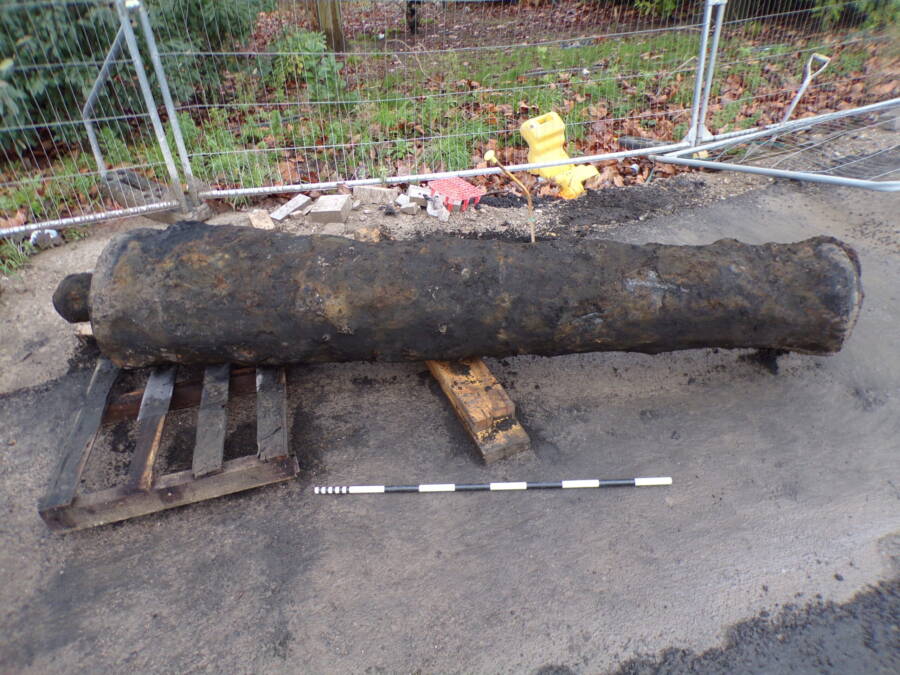
Hull City CouncilThe cannon found in hull was decommissioned and had its nozzle capped long ago.
During recent excavations at Queen’s Garden in Hull, England, contractors stumbled across a large mass deep in the earth. They originally thought it was a World War II bomb, but their discovery, while still a weapon, was actually even older. It soon became clear that the contractors had come across a cannon.
Dating to the 17th or 18th century, this historic cannon had been decommissioned decades ago, with its nozzle plugged up, before it was buried in the early 20th century as backfill along Queen’s Dock.
The Centuries-Old Cannon Discovered At Queen’s Garden In Hull
According to a statement from the Hull City Council, the cannon was discovered entirely by chance. On February 13, contractors were working on construction of an attenuation tank when they ran up against a large mass.
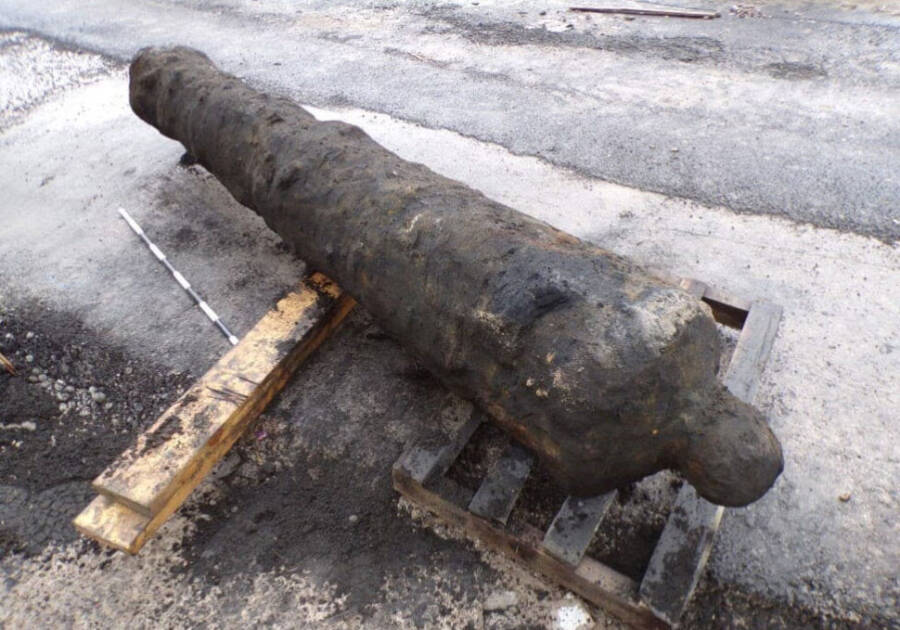
Hull City CouncilThe cannon has probably been buried for roughly a century, ever since backfill was added near the dock in the 1920s and 1930s.
At first, there was some concern that they’d found an ordnance from World War II. However, they soon determined that their find was instead a cannon.
“This is a fascinating discovery that offers a glimpse into Hull’s maritime and military past,” said Peter Connelly, the Archaeology Manager of Humber Field Archaeology. “Our archaeology team is now carrying out detailed assessments and we’ll be able to share more once their work is complete.”
While more study is indeed needed, archaeologists do know a little bit about the cannon as of now. It seemingly dates to the 17th or 18th century, and is thus as many as 400 years old. The weapon is roughly 8.5 feet long and is estimated to weigh more than a ton. And experts can also tell that it had been decommissioned long ago, when it was plugged at the mouth end.
This offers a clue about how the cannon was used — and provides a fascinating look back into Hull’s maritime and military past.
How The Cannon May Have Once Been Used In Hull
As Connelly noted, the cannon probably had a second life after it was decommissioned. Once the muzzle of the cannon was plugged up, it was probably made into a mooring post, a common use for old cannons in the late 19th and early 20th centuries. In fact, Hull still has mooring posts made of decommissioned cannons to this day.
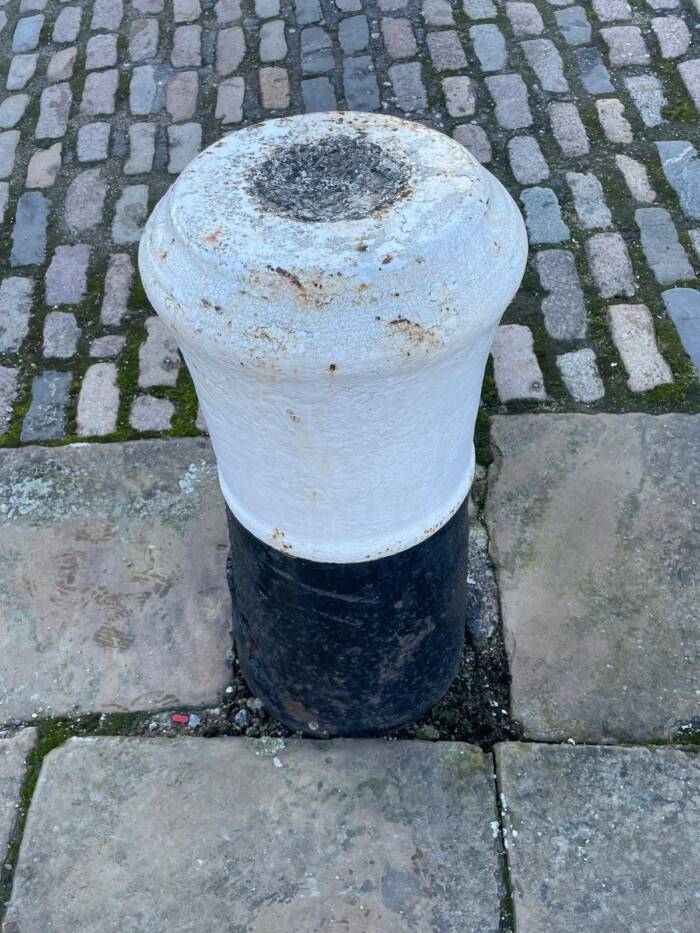
Hull City CouncilA mooring post on Humber Dock Street in Hull, which is made out of a decommissioned cannon similar to the one found in Queen’s Garden.
After becoming a mooring post, the cannon was likely buried in the backfill of the dock area, which took place in the 1920s and 1930s.
So how was the cannon used before it was decommissioned? While it was probably used for defensive purposes, it’s unknown if the weapon was mounted on a ship or on land.
That said, the cannon likely played some role in Hull’s rich history as a port city. Queen’s Garden, where the cannon was found, was actually once the site of the largest dock in the United Kingdom.
Indeed, Hull in the 17th century was a bustling nexus of trade. The city exported grain, cloth, and lead, and “re-exported” coal from Newcastle to other parts of the country. Hull was also a shipbuilding hub, and home to many fishermen. What’s more, the city played an important role in the English Civil War.
In April 1642, King Charles I demanded entry into Hull, a bastion of Parliamentarian sentiment, and was refused by the city’s governor and his supporters. That July, a royalist army laid siege to the city but was ultimately forced to back off. The following autumn, a second siege took place, with the royalists once again forced to back down.
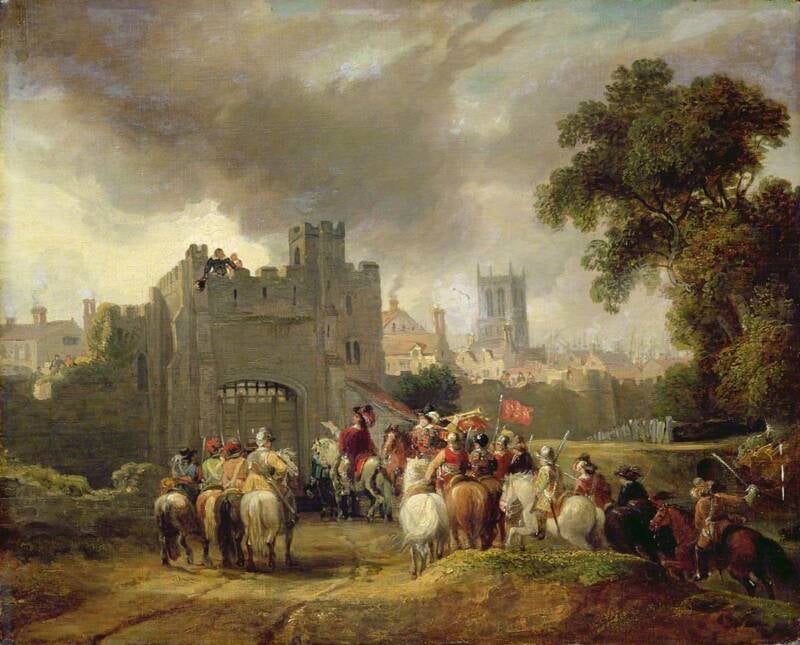
Public DomainA depiction of King Charles I being refused entry to Hull in 1642.
Perhaps the cannon played some role in this dramatic chapter in Hull’s history. But for now, the exact usage of the cannon remains uncertain.
That said, the cannon remains an astounding discovery. As Connelly said, “Finds like this highlight the rich history beneath our city.”
After reading about the cannon from the 17th or 18th century that was unearthed in Hull, England, discover the astounding story of the Schwerer Gustav gun, the German World War II weapon that stands as the largest gun in world history. Then, read about some of the weirdest royal deaths in history, including that of James II of Scotland, who was killed by a backfiring cannon.