In March 1876, raw meat rained down on a Kentucky farm, covering an area the size of a football field and sparking debate about what could have caused the grisly phenomenon.
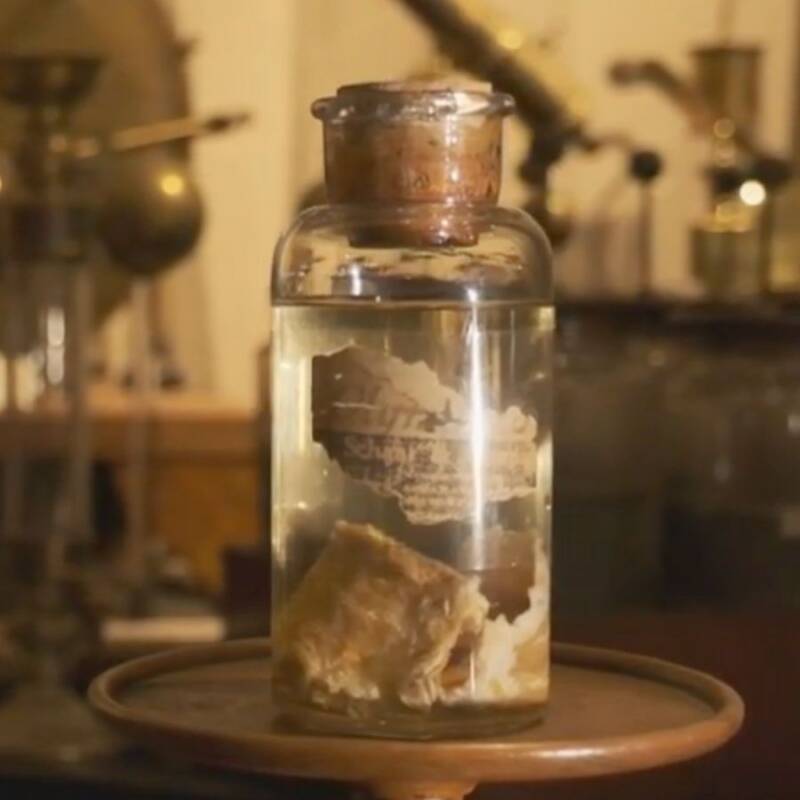
Kentucky Educational Television/YouTubeA sample of the substance that fell from the sky during the Kentucky Meat Shower sits in a museum at Transylvania University today.
March 3, 1876, started as a clear, cool morning in Bath County, Kentucky. Then, one of the most bizarre events in history began: the Kentucky Meat Shower.
Just before noon, chunks of flesh began falling from the sky. The gory storm only lasted a matter of seconds, but it left an area the size of a football field splattered with mystery meat.
In the immediate aftermath, experts from across the country put forth theories about what could have caused the inexplicable incident. Some posited that it was frog spawn that had blown in on the wind; others believed the event was a sign from God.
Today, scientists agree that the Kentucky Meat Shower was most likely caused by a flock of vultures vomiting up a recent meal, but we may never know what actually made flesh rain down over a rural farm on that March day 150 years ago.
The Kentucky Meat Shower, When Flesh Fell From The Sky
On the morning of March 3, 1876, Mrs. Rebecca Crouch was making soap outside of her home in Bath County, Kentucky, about 50 miles east of Lexington. As she told a New York Herald reporter a few weeks later:
“On Friday morning, March 3, between the hours of eleven and twelve o’clock, I was in my yard… The skies were clear and the Sun was shining brightly. There was a light wind coming from a westerly direction. Without any prelude or warning and exactly under these circumstances the shower commenced.”
It wasn’t just any shower. Fresh, bloody meat was falling from the sky. Crouch’s young grandson, who was in the yard with her, shouted, “Why, Grandma, it’s snowing!”
“I then walked around and saw a large piece of it strike the ground right behind me,” said Crouch, “with a snapping like noise when it struck.” Most of the pieces were indeed the size of large snowflakes, but others were much bigger.
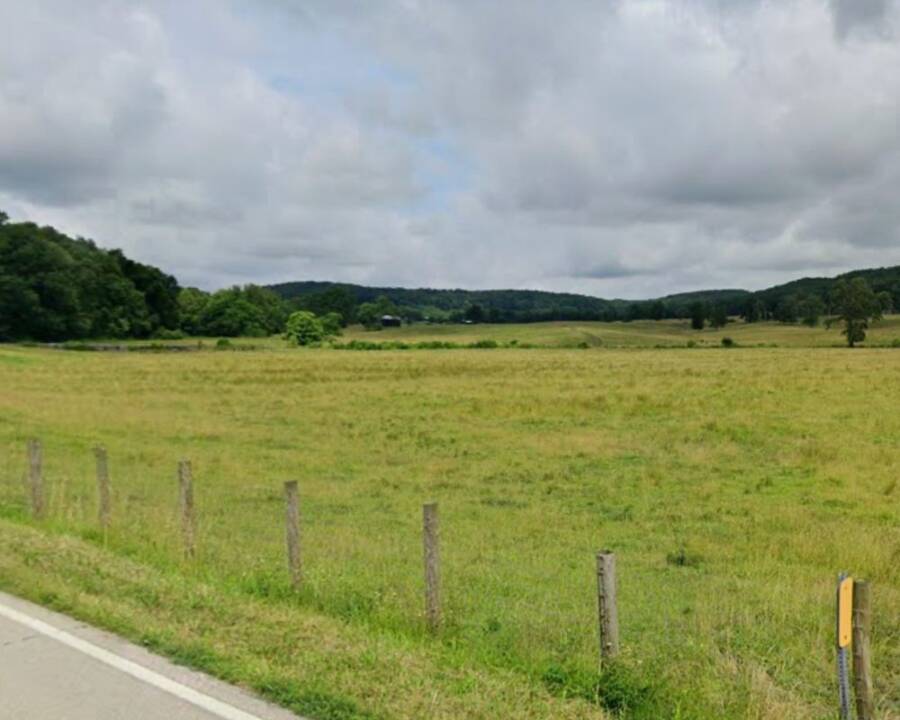
Google MapsThe meat fell over a 100-yard by 50-yard stretch of rural farmland in Bath County, Kentucky.
“The largest piece that I saw was as long as my hand, and about half an inch wide,” Crouch recalled. “It looked gristly, as if it had been torn from the throat of some animal.”
As quickly as the Kentucky Meat Shower had begun, it ended. In less than two minutes, Crouch’s yard had turned into a scene from a horror movie. The flesh stretched across an area about the size of a football field.
When her husband got home, Mrs. Crouch said that he “went out and picked up a great many pieces, and I heard that before that time the bugs, chickens, cat and dog had been eating of it freely, and seemed to like it well.”
What exactly was it, though? This was the very mystery that the community was eager to solve.
Investigating The Grisly ‘Weather’ Event
Word of the incident at the Crouches’ farm quickly spread across rural Kentucky, and friends and neighbors rushed over to see the carnage for themselves.
One local man, B. F. Ellington, immediately claimed that it was bear meat. “I know bar grease when I see it,” he told the New York Herald reporter, “an’ that’s the kind of fluid what come outen that meat at old Allen’s and got all over my hands when I was zamining it. I smelt it, too, and I know that smell as well as I know the smell of licker. Gentlemen, it’s bar meat certain, or else my name is not Benjamin Franklin Ellington.”
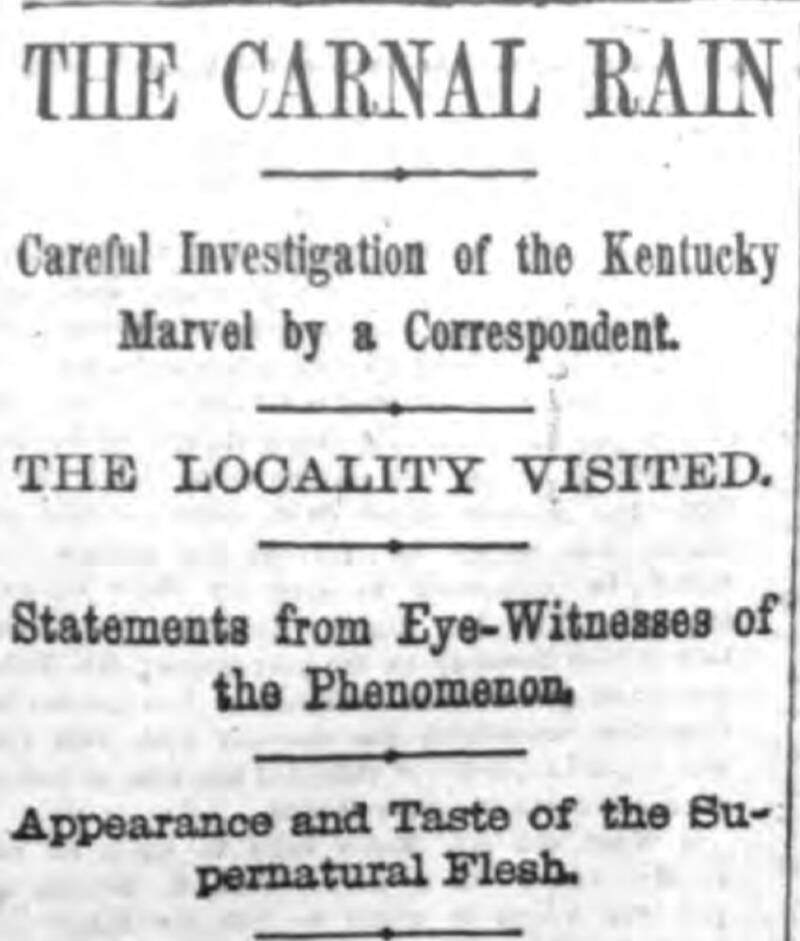
New York HeraldThe 1876 New York Herald headline about the mysterious meat shower in Kentucky.
Butcher L. C. Frisbe also examined the mysterious substance — and even chewed some up before quickly spitting it out. “I have handled all kinds of meat,” he said, “and I never tasted anything exactly like it before. I am not prepared to say for certain that the taste resembled that of either fish, flesh or fowl… It looked more like mutton than anything else that I can compare it to.”
Many who saw the meat agreed that it was mutton, or perhaps venison, but nobody could come to an agreement on what exactly had fallen from the sky.
So, officials bottled up specimens of the meat and sent them off to scientists across the country to get their opinions on the matter.
What Caused The Kentucky Meat Shower?
Experts’ theories about the Kentucky Meat Shower ranged as widely as the locals’ had. In July 1876, Scientific American printed the opinion of scientist Leopold Brandeis, who suggested that the “meat” was actually a substance called Nostoc, a type of gelatinous cyanobacteria.
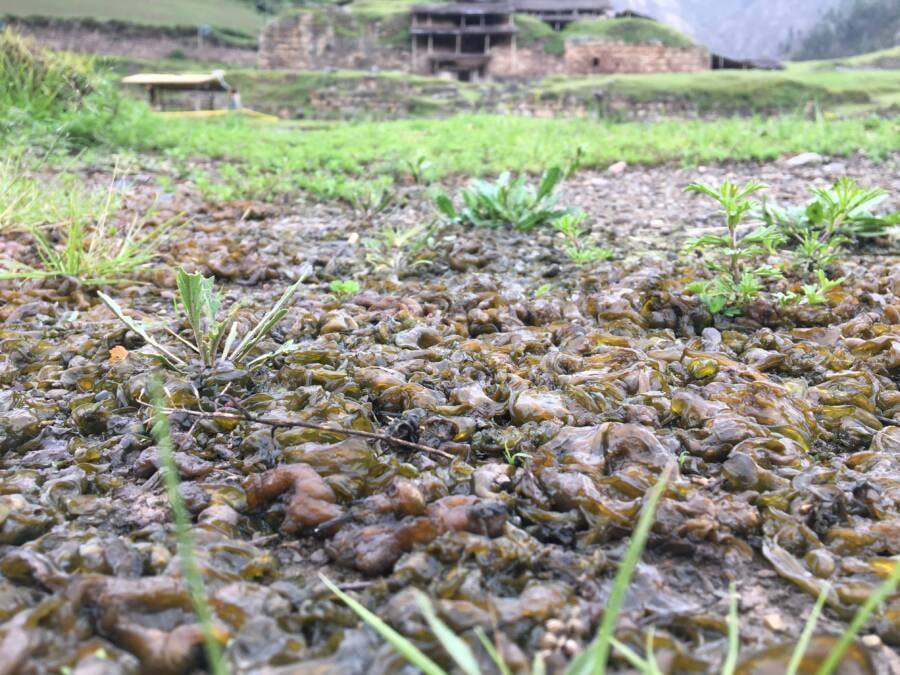
Carlo Brescia/Wikimedia CommonsNostoc, sometimes called troll’s butter or witch’s jelly, is a type of cyanobacteria that turns into a gelatinous mass when it gets wet.
Brandeis noted that Nostoc spores “may be wafted by the winds here and there, and they may be carried great distances. Wherever they may fall, and find congenial soil, namely, dampness or recent rain, they will thrive and spread very rapidly, and many cases are recorded where they have covered miles of ground, in a very few hours, with long strings of Nostoc.”
A week after the incident, The New York Times printed a satirical theory:
“The most obvious conclusion is that the Kentucky shower of meat was really a meteoric shower. According to the present theory of astronomers, an enormous belt of meteoric stones constantly revolves around the Sun, and when the Earth comes in contact with this belt she is soundly pelted. Similarly, we may suppose that there revolves about the Sun a belt of venison, mutton, and other meats, divided into small fragments, which are precipitated upon the Earth whenever the latter crosses their path.”
However, the theory that was most commonly accepted among scientists was actually one that the people of Bath County had suggested early on: The Kentucky Meat Shower was the work of passing birds.
Dr. A. Mead Edwards, the president of the Newark Scientific Association, wrote to the editor of Scientific American after reading Brandeis’ suggestion in the magazine. Edwards countered, “[T]he favorite theory in the locality is, that it proceeded from a flock of buzzards who, as is their custom, seeing one of their companions disgorge himself, immediately followed suit.”
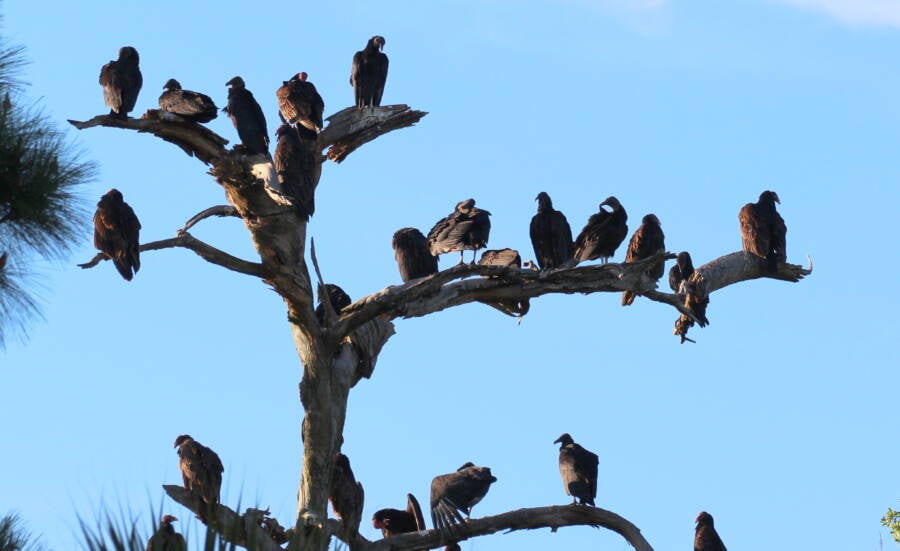
Gary Leavens/FlickrThe Kentucky Meat Shower was likely caused by vultures vomiting as they flew over the Crouch farm.
And Dr. L. D. Kastenbine, a professor of chemistry at the Louisville College of Pharmacy, agreed. In an article published in Louisville Medical News in 1876, he wrote, “The only plausible theory explanatory of this anomalous shower appears to me to be… the disgorgement of some vultures that were sailing over the spot, and from their immense height the particles were scattered by the then prevailing wind over the ground.”
Whatever caused the Kentucky Meat Shower — whether it be vomiting vultures or, as one person suggested, the dropped lunch of a passing balloonist — the incident went down in history as one of the world’s weirdest and most unexplainable events.
Today, one sample of the mystery meat remains. It sits in a glass bottle of alcohol at the Monroe Moosnick Medical and Science Museum at Transylvania University in Lexington, Kentucky, the last evidence of the “storm” that turned Mrs. Crouch’s normal March morning into the strangest day of her life.
After reading about the Kentucky Meat Shower, learn about the blue-skinned Fugate family of Kentucky. Then, discover the bizarre story of William Buckland, the Victorian zoologist who tried to taste every species of animal on Earth.