In the 1550s, an impostor named Arnaud du Tilh convinced a whole town he was a missing man named Martin Guerre, only to be found out in one of the most dramatic ways possible.

Erogers148/Wikimedia CommonsA depiction of Martin Guerre and his wife, Bertrande de Rols.
In 1560, a man with one leg entered the French city of Toulouse with an unbelievable claim: Someone had taken over his entire life. This included deceiving his family — and having several children with his wife.
While tales of impostors may be common in fiction, they’re incredibly rare in real life. Most of the time, there’s enough suspicion that family and friends are able to eventually sniff them out.
However, there’s one case in history in which an impostor appears to have convinced a whole town that he was a missing man, only to be found out in one of the most dramatic ways possible. This is the story of Martin Guerre — or, at least, the man many believed to be him.
Who Was Martin Guerre?
In a video with over 402,000 views, Avian Johnson (@aveovershares), a historian who goes on “historical horror deep dives” on TikTok, recounts a story from history that she says she “became obsessed with in grad school and that has haunted me ever since.”
In the early 1500s, a boy in Artigat, France, named Martin Guerre married Bertrande de Rols. Both of them were children at the time, with some contemporaneous reports claiming that Guerre was just 14 and de Rols may have been as young as nine.
“Certainly not a love match, the marriage was more of a practical arrangement between two well-matched families,” Johnson explains. “Of course, we can’t know the intimate details of the couple’s relationship, but in the eyes of the outside world, the marriage was far from a success.”

Google MapsMartin Guerre vanished from the small village of Artigat, France, in 1548.
In practical terms, this meant that the pair had not borne any children, even after eight years of marriage. There were also rumors that the union was not consummated in the first place — and that the couple was somehow cursed.
To resolve this, the village performed a folk ritual to free the couple of their hex. Shortly after, they had a son.
After this, Guerre was accused of stealing grain from his father. In response, Guerre promptly left — and was not heard from again for eight years.
“This would have been a s—t thing to do in any period. But in 16th-century France, it was even s—ttier,” Johnson explains. “Canon law did not permit an abandoned wife to remarry, not without proof of her husband’s death, at least.”
“Unable to build any other life,” Johnson continues, “Bertrande was forced to maintain the legal and social fiction of a marriage to a man who had abandoned her, waiting for either her husband to return or for news of his death.”
Eight years later, Guerre unexpectedly returned. However, something about him didn’t seem quite right.
The Supposed Return Of Martin Guerre
While eight years can significantly change a person’s appearance, some people thought that the new Guerre looked remarkably different from the Guerre of yore. That said, others countered that this Guerre knew things that only the real Guerre could know.
“This man who insisted he was Martin Guerre knew the names of relatives, friends, virtually every single person in the community,” Johnson summarizes. “He knew the landscape of the village and even the layout of his old house. He knew intimate details of Martin and Bertrande’s domestic life that no outsider should have had access to.”

European InternationalA 1982 film retold Martin Guerre’s incredible story.
His knowledge was so formidable that, despite the doubt that surrounded his return, the town — and Guerre’s wife — soon accepted that he had indeed come home. Over the next four years, “Guerre” and de Rols would have two more children and were seemingly content in their marriage.
However, doubts began to arise. For example, a soldier who came through town claimed that he’d served with Guerre. When he saw the new Guerre, he proclaimed that this was not the man he knew — as Guerre had lost a leg in battle.
These suspicions came to a head when Guerre tried to claim part of his family’s estate. Guerre’s uncle, Pierre, did a little research and alleged that the individual claiming to be Guerre was actually another man: Arnaud du Tilh. While de Rols initially refused to accept this, she later supported the accusation under pressure from Pierre, and the case went to trial.
In court, things initially seemed to be going well for the new Guerre. While witnesses were split on whether he was genuine or an impostor, the man himself held incredible composure.
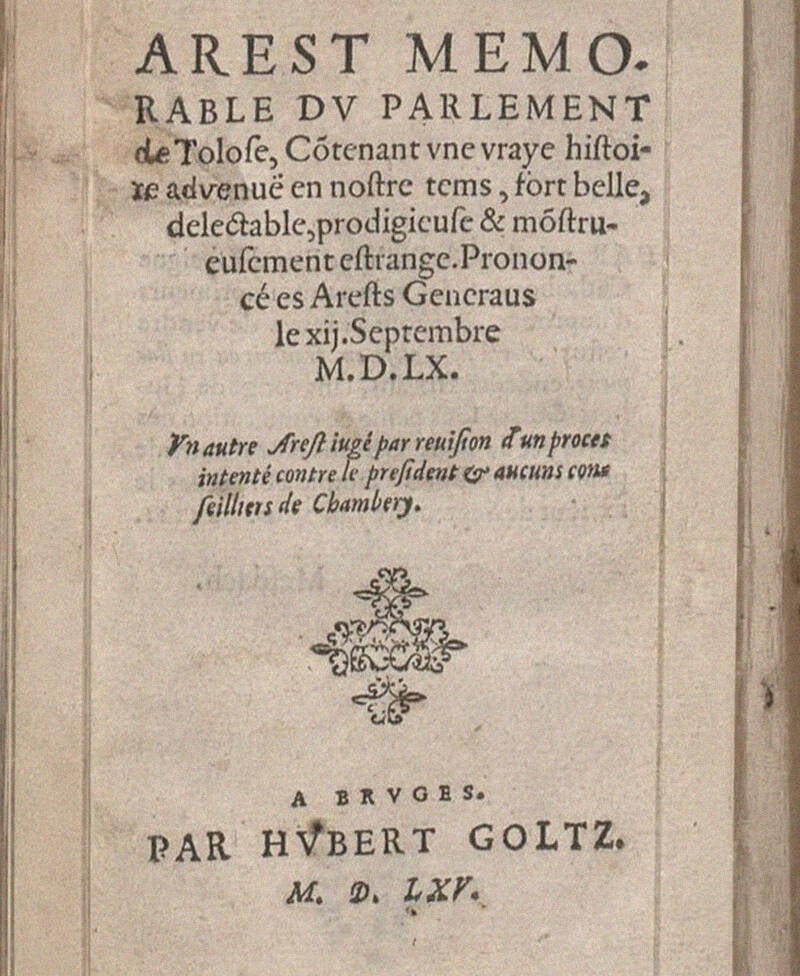
Public DomainIn 1560, Judge Jean de Coras documented his account of the Martin Guerre case.
“The accused was once more subjected to rigorous questioning about his past, and by all accounts, he performed flawlessly. His statements were checked and double-checked, and no contradictions were found,” Johnson explains. “The supposed Martin Guerre eloquently argued his case before the Toulouse judges, who seemed inclined to believe his version of the story.”
There was even a moment in the courtroom when the new Guerre challenged his wife to declare him to be an impostor. She would not do so.
Then, an unexpected guest arrived at the trial: the real Martin Guerre. This Guerre was, in fact, missing a leg, and while he was unable to recite his own personal history to the level of the new Guerre, his family was almost immediately certain that this Martin Guerre was the real one.
As it turned out, Pierre’s suspicions had been correct. The impostor was a man named Arnaud du Tilh. According to du Tilh, he had been mistaken for Guerre several times. Consequently, he decided to learn as many personal details as possible about him and, in a sense, become him.
When it became clear that du Tilh had been found out, he confessed, asked for forgiveness, and refused to state that Guerre’s wife, Bertrande, knew he was an impostor. Du Tilh was eventually hanged for his crime.
Did Bertrande De Rols Know The Truth?
Over the course of this story, one question tends to stick with both historians and casual readers alike: How much did Bertrande de Rols know?
At the time, the judges accepted that Bertrande had been deceived. However, some historians — specifically, one scholar named Natalie Zemon Davis — dispute this.
“Davis argues that Bertrande was complicit, that she knew — not immediately, perhaps, but that at some point during those nearly four years, she recognized the man in her bed was not Martin Guerre, and she chose to say nothing — chose, in fact, to participate, to build something like a life with a man who was in every practical sense a better husband than the one who had abandoned her: more attentive, more present, more interested in the management of the household, and the raising of their son,” Johnson explains.
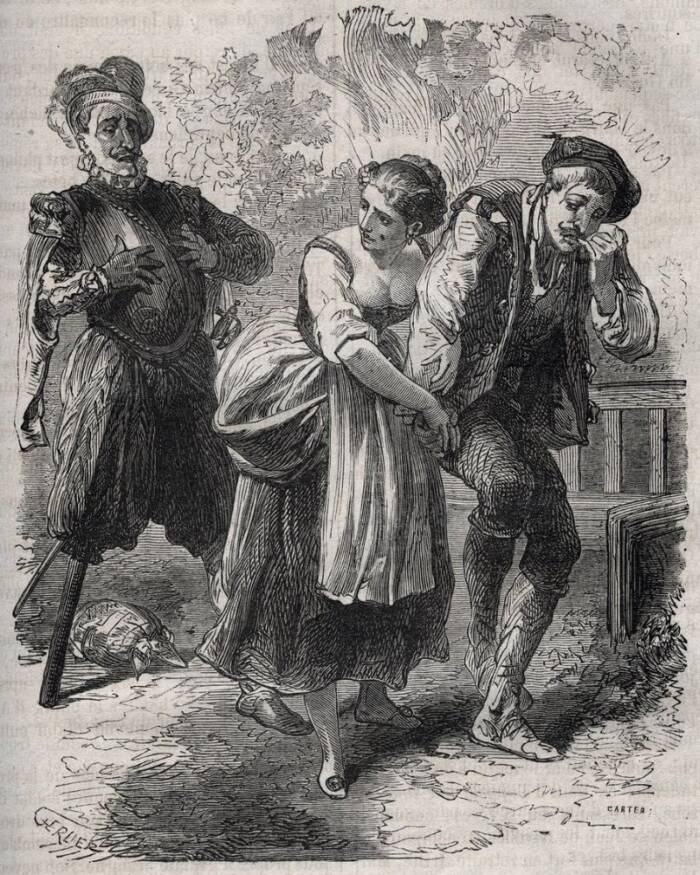
Public DomainMartin Guerre returned to France in the midst of the trial against his impostor.
“The evidence Davis marshals is circumstantial but certainly not trivial,” Johnson continues. “The intimacy of the details Arnaud possessed argues for an inside source. Four years of apparent domestic contentment argue against sustained, undetected deception. And then there is the silence in the courtroom, the moment when Arnaud offered Bertrande an unambiguous way out, and she did not take it.”
It should be noted that this is not a historical consensus and that some dispute Davis’ recounting of events. In a criticism, author Robert Finlay accused Davis of not having enough evidence to support her claims and that her work relied on too many assumptions to come to valuable, verifiable conclusions. Davis later responded to Finlay, agreeing with some of the critique but claiming that he had misinterpreted her argument.
Given the limited historical record, historians will likely never know what exactly happened here — but the mystery will likely continue to enchant us for centuries.
@aveovershares Definitely a “quieter” sort of historical horror, but this case still “quietly” wrecked my brain #darkhistory #historicalmystery #truecrime #france #weirdhistory
All That’s Interesting reached out to Johnson via Instagram direct message.
For more historical tales of impostors, learn about “Princess Caraboo,” a woman who managed to convince a city that she was the princess of a fictional island. Then, read about the strange disappearance of Walter Collins.