The “Screaming” Mummies Of Guanajuato: The Horrifying Remains Of Cholera Victims In Mexico
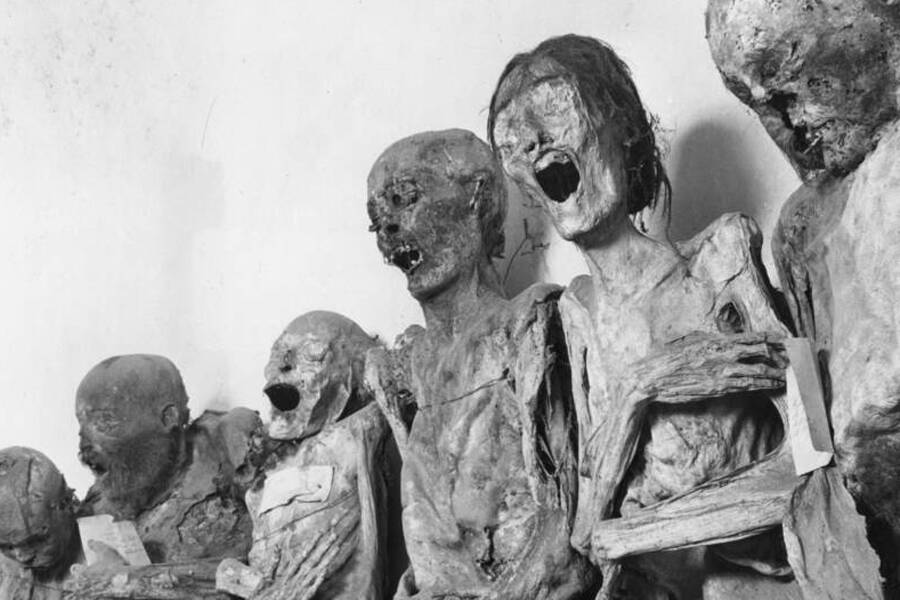
George Pickow/Three Lions/Getty ImagesMummies on display in the Panteon cemetery vault in Guanajuato, Mexico.
In the Mexican town of Guanajuato, the 1850s cholera epidemic wreaked havoc on those who lived there. So many people died that the bodies had begun to quite literally pile up, forcing townsfolk to forego burying their dead and instead place them in above-ground crypts — but the warm, arid environment caused the partially-embalmed corpses to start mummifying.
And in 1865, local authorities instituted a “burial tax” that forced families to make continual payments in order to keep their relatives underground. Those who couldn’t afford the tax had to stand by and watch as their loved ones were pulled out of the ground and moved into the crypts.
It was then that the crypt owners found the mummified bodies in the crypts, their faces forever frozen in expressions that look like screams.
And as the crypt owners took a closer look at the “Guanajuato Mummies,” they soon made several more horrifying discoveries.
One body, that of Ignacia Aguilar, had been found biting into her own arm. Many believe she had accidentally been buried alive after her cholera symptoms and other health conditions made her appear dead.
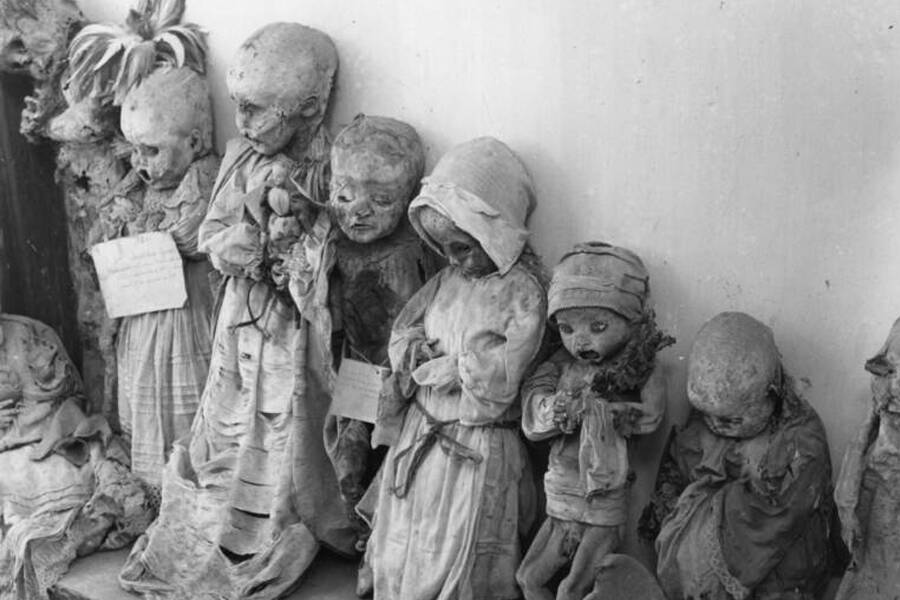
Three Lions/Getty ImagesMummified infants in Guanajuato, Mexico.
Another belonged to a woman who died in childbirth. Her 24-week-old fetus had also been mummified — one of the youngest mummies in existence.
The mummies became so well known that 111 were put on display by the early 1900s. And 59 are still on display today at El Museo de las Momias.
But despite the years passing, the horror of the mummies’ faces hasn’t faded. In 1947, nearly a century after the cholera epidemic, author Ray Bradbury visited a crypt in Guanajuato and could barely stomach the sight.
“The experience so wounded and terrified me, I could hardly wait to flee Mexico,” he said. “I had nightmares about dying and having to remain in the halls of the dead with those propped and wired bodies.”
The Guanche Mummies: The Mysterious Corpses Found On The Canary Islands
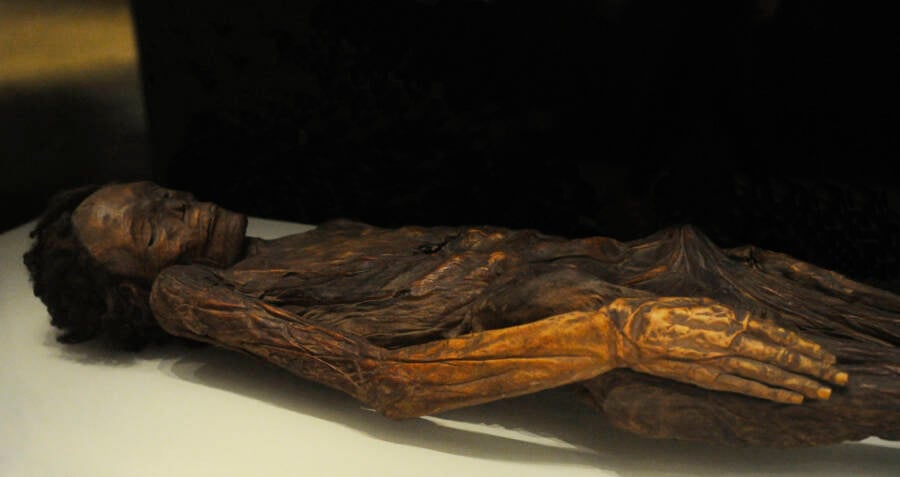
Universal History Archive/Universal Images Group via Getty ImagesMummified remains of a Guanche male at the National Archaeological Museum in Madrid, Spain.
The history of the Canary Islands — an archipelago that’s part of Spain but located much closer to the coast of Morocco — is still mysterious to researchers. It was once inhabited by the Guanches, a pre-colonial Indigenous people. But much of their way of life has been lost to time.
However, several Guanche mummies found in the caves on the Canary Islands are helping researchers uncover more of the islands’ history. These mummies are also helping experts separate fact from fiction.
According to National Geographic, researchers are hoping to learn more about the fabled Barranco de Herques, a “ravine of the dead” that allegedly houses the “cave of the thousand mummies.”
The story goes that, in 1764, Spanish regent Luis Román entered a cave within a gorge on Tenerife, the largest of the Canary Islands. There, he discovered, as the writer José Viera y Clavijo described, “a wonderful pantheon… So full of mummies that no less than a thousand were counted.”
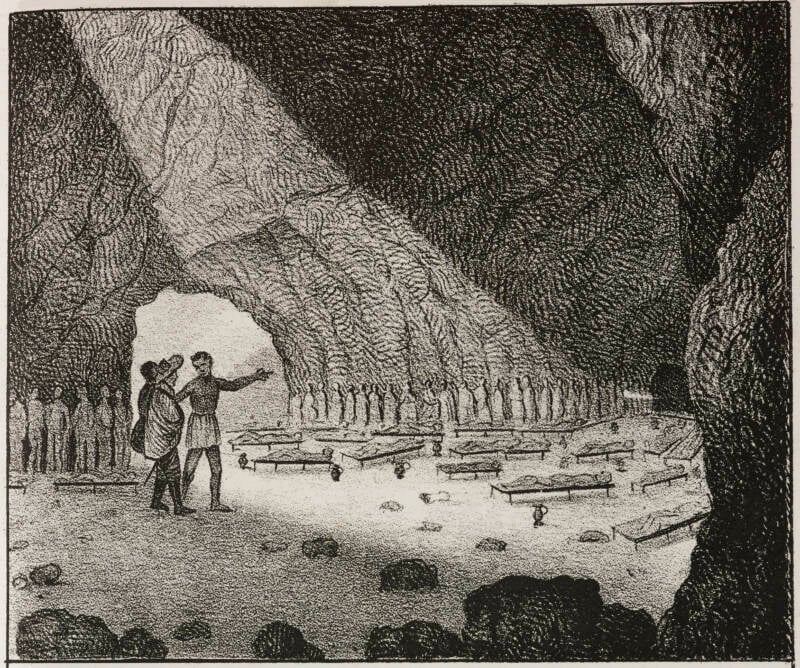
De Agostini Picture Library via Getty ImagesA cave filled with the Guanche mummies in the Canary Islands. Lithograph by Giuseppe Antonelli in 1838.
Most archaeologists agree that the description of “a thousand mummies” was an exaggeration, but it’s likely that there were hundreds of mummies hidden within this mysterious cave (with no recorded coordinates).
Local lore also maintains that a large sepulchral cave exists on the islands, housing the remains of the Mencey kings, the islands’ pre-colonial rulers.
While no distinct Guanche populations exist today, the few mummified corpses that archaeologists have managed to extract from the caves of the Canary Islands are helping to illuminate the history of the people — especially in regard to how they honored their dead.
The Guanche mummies — called xaxo — were treated with dry herbs and lard before being left to dry in the sun. Once dried, the body was smoked by a fire. In total, the process took a little over two weeks, and then the family of the deceased would place the body in a stitched animal hide bag.
Remarkably, Guanche mummies were very well-preserved, especially compared to their Egyptian counterparts. Many of their organs remained intact, preserved within their bodies thanks to a mixture of minerals, herbs, bark, and resin from dragon trees that prevented decay.
Javier Carrascoso, associate chief of radiology at Madrid’s QuirónSalud University Hospital, told National Geographic that one Guanche mummy had been so well-preserved that “it looked like a wooden sculpture of Christ.”
Unfortunately, the cave of a thousand mummies still remains elusive to archaeologists in the region. Some believe it may have been lost to a cave-in or, more likely, plundered when the islands were colonized.