On October 1, 1993, Polly Klaas was abducted at knifepoint during a sleepover at her home in Petaluma, California. She was later found murdered.

The Polly Klaas FoundationPolly Klaas was killed by a career criminal named Richard Allen Davis.
Polly Klaas was just 12 years old when she was kidnapped during a slumber party at her Petaluma, California home on October 1, 1993.
Polly’s disappearance quickly captured national attention, but her family went about two months with no answers as to where the young girl was.
Finally, answers came on Dec. 4, 1993, when Polly Klaas’ kidnapper Richard Allen Davis admitted to abducting and strangling Polly. He also led the police to Polly’s remains in a shallow grave near Cloverdale.
Though Davis was later convicted of murder and sentenced to death, no punishment could ever bring Polly back. Her horrific murder triggered outrage from the public, especially since Davis had been released on parole before killing Polly — despite the fact that he had a history of kidnapping.
This helped fuel a number of new “tough on crime” laws across America, including California’s “Three Strikes and You’re Out” law, aimed at preventing another terrible tragedy like Polly Klaas’ murder. But many people — including Polly’s own sisters — have expressed concern that some of these laws have strayed from the original good intentions behind them.
The Horrific Kidnapping Of Polly Klaas At The Hands Of Richard Allen Davis
Polly Klaas was born on Jan. 3, 1981 in Fairfax, California. Her parents, Marc Klaas and Eve Nichol, eventually divorced, and Polly was staying at her mother’s home in Petaluma, California at the time of her abduction.
On Oct. 1, 1993, Polly had a sleepover at her mom’s home with two friends. As Polly and her friends enjoyed their slumber party, Polly’s mother and sister fell asleep in the adjacent room. Then, a man broke into the home.
Around 10:30 p.m., Richard Allen Davis, an ex-convict on parole, climbed through a window in the home and entered Polly’s bedroom. Armed with a knife, Davis soon threatened to kill the three girls.

The Polly Klaas FoundationShortly before Polly Klaas was abducted by Richard Allen Davis, she reportedly pleaded with her kidnapper: “My mom and sister are in the next room. Please don’t hurt them.”
Ultimately, Davis bound and gagged Polly’s friends before abducting Polly at knifepoint. Polly’s friends were later able to untie themselves, after which they alerted Polly’s mother to what happened.
And just like that, Polly Klaas had been kidnapped. But it wasn’t the first time Davis had committed such a crime. In fact, he was a career criminal who had a long history of theft, burglary, assault — and kidnapping.
Back in 1976, he had abducted a young woman at knifepoint near Oakland, and in 1984, he kidnapped yet another woman from Redwood City before forcing her to take out $6,000 from her bank account. Not only was he caught and convicted, but he was also sentenced to 16 years in prison.
However, Davis was eventually released early on parole — shortly before he abducted and murdered 12-year-old Polly Klaas.
An Abduction And Murder That Captured The Nation’s Attention
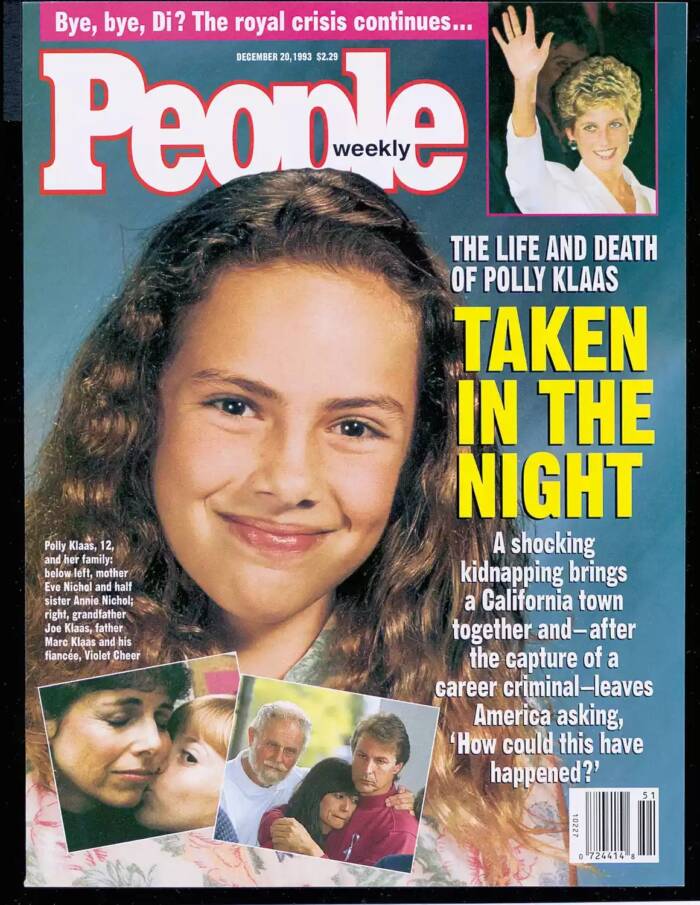
People MagazineA People magazine cover from 1993, discussing Polly Klaas’ kidnapping and murder.
Soon after Polly Klaas’ mother called the police to report Polly’s abduction, a nationwide search began for the young girl and her kidnapper.
Throughout October and November of 1993, Polly’s loved ones banded together to help the authorities find her. The case also caught the attention of actress Winona Ryder, who was raised in Petaluma. Ryder offered a $200,000 reward for anyone who could safely return Polly.
Though thousands of volunteers joined forces with investigators to track down Polly, the young girl was sadly already dead. It was later revealed that Polly had been murdered by her abductor just hours after he’d taken her.
Shockingly, Polly’s kidnapper and killer, Richard Allen Davis, had also encountered the police soon after the abduction. A woman named Dana Jaffe reported a “disheveled” and “panic-stricken” man whose car was stuck in a ditch near her home in Santa Rosa. The police let him go without checking his criminal history — as that wasn’t the standard practice at that time — and about two months later, Jaffe found girls’ clothing while hiking on her property.

YouTubeRichard Allen Davis showed no remorse for his crime and even flipped off Polly’s family during his murder trial.
Dana Jaffe quickly called the police again, reminding them about the suspicious stranger she had seen back in October, and authorities soon realized that he had a lengthy criminal history, including kidnapping.
Forensic evidence collected from Polly’s home and Jaffe’s property pointed to Davis being Polly’s abductor, including a palm print found at the crime scene that was a match for Davis. On Dec. 4, 1993, Davis himself admitted to kidnapping her and strangling her in his car before hiding her body in a field. Soon after his confession, he led the authorities to Polly’s remains, which were hidden in a shallow grave near Highway 101 by Cloverdale.
By 1996, Davis had been found guilty of first-degree murder. He was sentenced to death, and he remains on death row to this day (he eventually tried to apply for resentencing, but this was denied in 2024).
The Aftermath Of Polly Klaas’ Murder
Polly Klaas’ murder sparked the creation of the Polly Klaas Foundation, a nonprofit dedicated to protecting vulnerable youths, recovering missing children, and keeping kids safe in their communities.
Polly’s father Marc Klaas founded the KlaasKids Foundation in 1994 amidst his grief, helping to raise awareness of other cases of missing children and working to stop crimes against other kids. That foundation ran for 30 years.
Marc Klaas has also made a name for himself as an advocate for the death penalty. Shortly after his daughter’s killer was sentenced, Marc Klaas said, “The last thing Polly saw before she died was Richard Allen Davis’ eyes. The last thing Richard Allen Davis will see is my eyes, I hope.”
Meanwhile, public outrage surrounding Polly Klaas’ murder also inspired a number of “tough on crime” laws across America. One notable law was California’s “Three Strikes and You’re Out,” which was approved in 1994. This law was meant to establish life sentences for all felonies if the defendant in question had two prior convictions for serious or violent crimes.
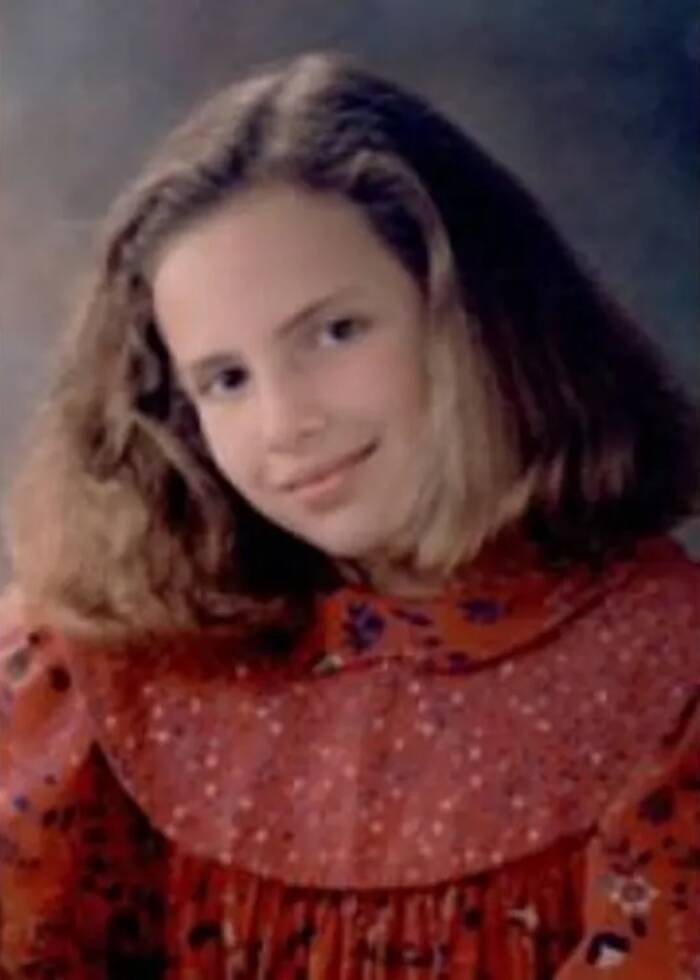
The Polly Klaas FoundationPolly Klaas’ sisters have spoken out against some of the laws that emerged after their sibling’s murder.
However, that law eventually became mired in controversy. According to The Guardian, “Three Strikes” not only led to a major increase in California’s prison population, but over 7,500 people were sentenced to life in prison within the first decade after the law passed — and nearly half of those people were sentenced for relatively minor and nonviolent offenses.
Polly Klaas’ own sisters, Jess and Annie Nichol, were later horrified to learn that “Three Strikes” was often disproportionately applied to defendants with disabilities and mental illness and that some defendants had received life sentences after committing crimes as minor as stealing baby shoes.
In recent years, “Three Strikes” has undergone modifications in the hopes of protecting people from being unfairly targeted or harshly punished for nonviolent crimes. Meanwhile, Jess and Annie Nichol have focused on emphasizing the prevention of violent crimes from happening in the first place. They also hope to improve treatment for survivors.
“There’s the trauma of losing Polly and then there’s the trauma of how her death was used to punish other people,” Jess Nichol told The Guardian in 2022. “We don’t want our pain to be used to punish anyone else.”
The sisters also launched a podcast called A New Legacy, meant to discuss alternatives to mass incarceration, issues with the criminal justice system, and the hopes for a new legacy connected to Polly Klaas’ tragically short life.
“There’s an underlying assumption that the thing that victims want is the harshest sentencing for the people who caused harm. And that’s really the only option,” Jess Nichol said. “It’s this revengeful ‘eye for an eye’ culture. I’ve come to realize we don’t really have a ‘department of corrections and rehabilitation.’ It’s a ‘department of punishment and revenge.'”
After reading about the kidnapping and murder of Polly Klaas, learn about the horrific death of Cherish Perrywinkle at the hands of a convicted pedophile. Then, read about Gary Plauché, the Louisiana dad who took deadly revenge on his son’s rapist on live television.