Between April and September 1945, more than one million captured Nazis were forced into 19 camps in western Germany called the Rheinwiesenlager, where they had to sleep in the dirt and live in "appalling" overcrowded conditions.
It’s well established that the Nazis operated a chilling network of concentration camps during World War II. But many people aren’t aware that the United States military also imprisoned over one million Germans in a series of prison camps — collectively known as the Rheinwiesenlager — at the end of the conflict.
The Rheinwiesenlager, or “Rhine Meadow Camps,” were constructed in 1945 to hold the influx of Wehrmacht troops and personnel who surrendered in the final days of the war in Europe. From April to September of that year, hundreds of thousands of German men and women were held in the camps to prevent an insurgency following the collapse of the Nazi Party.
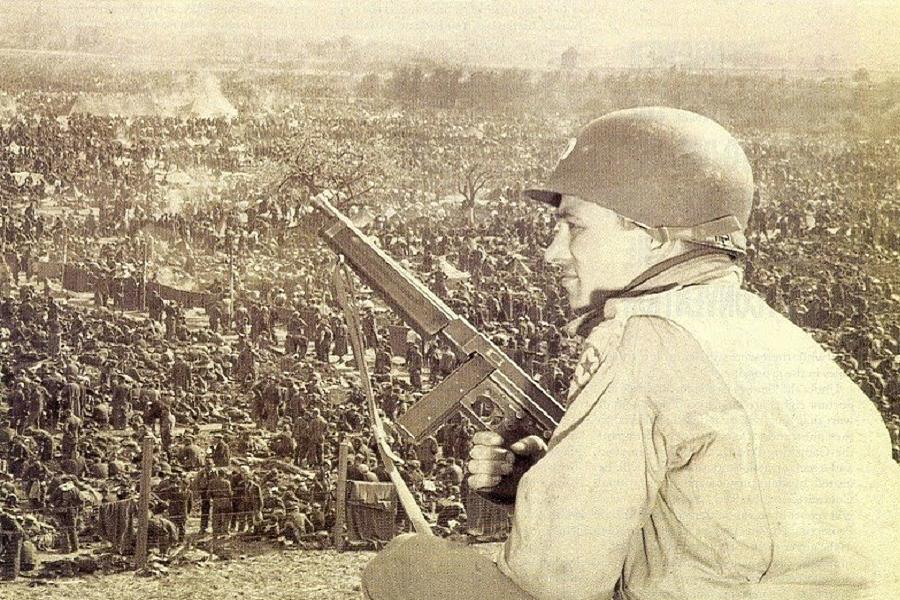
Public DomainA U.S. soldier at Remagen, one of the Rheinwiesenlager camps, guarding thousands of German soldiers captured in 1945.
The U.S. called the inmates at these 19 facilities “disarmed enemy forces” rather than “prisoners of war,” so they didn’t have to follow the Geneva Convention. This led to horrid conditions within the camps, and one report by the Army Medical Department even compared the Rheinwiesenlager to Andersonville Prison.
However, as noted in a 2020 German television special, The Horrors of the Rhine Meadow Camps, many believed at the time that “the Germans are responsible for the worst crimes in the war; they cannot expect any pity.”
Rheinwiesenlager: The Last Moves Of A Lost War
By the spring of 1945, the writing was on the wall for the Nazis. Millions of Allied troops poured into the Rhineland from the west, while the German SS and Wehrmacht forces staged desperate last stand actions in Vienna and Berlin to slow the Soviet Red Army’s advance in the east.
During this collapse, millions of German soldiers disengaged from the Eastern Front and trekked across Germany to surrender to American or British troops, whom they hoped would be less vengeful than the triumphant Soviets.
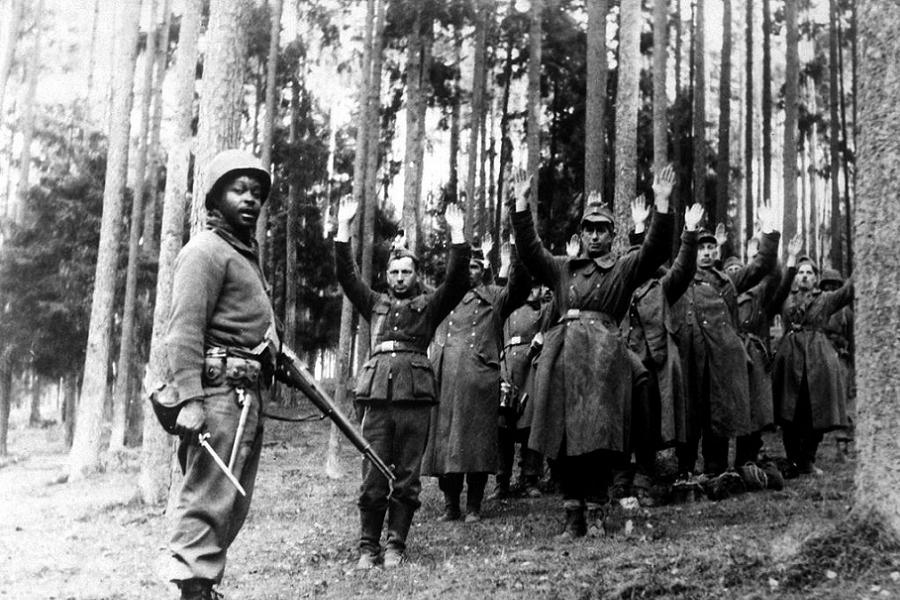
Flickr/ArmyDiversityA U.S. soldier guards a group of German soldiers captured in a forest. April 1945.
The German influx quickly grew so large that the British stopped accepting prisoners, citing logistical problems. With nowhere else for the soldiers to go, the U.S. started building crude camps along a newly occupied stretch of western Germany. They ultimately came to be known as the Rheinwiesenlager.
The U.S. Army constructed 19 camps in all, enclosing large sections of farmland with barbed wire and erecting simple structures to serve as kitchens, hospitals, and administrative offices. Each facility was divided into 10 to 20 sections that could hold between 5,000 and 10,000 prisoners each.
Between April and September 1945, anywhere from one million to nearly two million German troops were held at these camps — and the conditions were brutal.
A New Status For Prisoners
The Geneva Convention and the 1907 Hague Convention strictly regulate the treatment of wartime prisoners. Captured enemy soldiers cannot be tortured or executed simply for fighting for their country. They cannot be put on display or publicly humiliated, nor can they be overworked or punished for no reason.
The conventions are stringent about their provisions: Every single prisoner of war must be fed and housed up to a standard equal to what their guards are provided. If it is impractical to heat the prisoners’ barracks, for instance, the conventions’ rules say that the camp personnel should not have heated lodging, either.
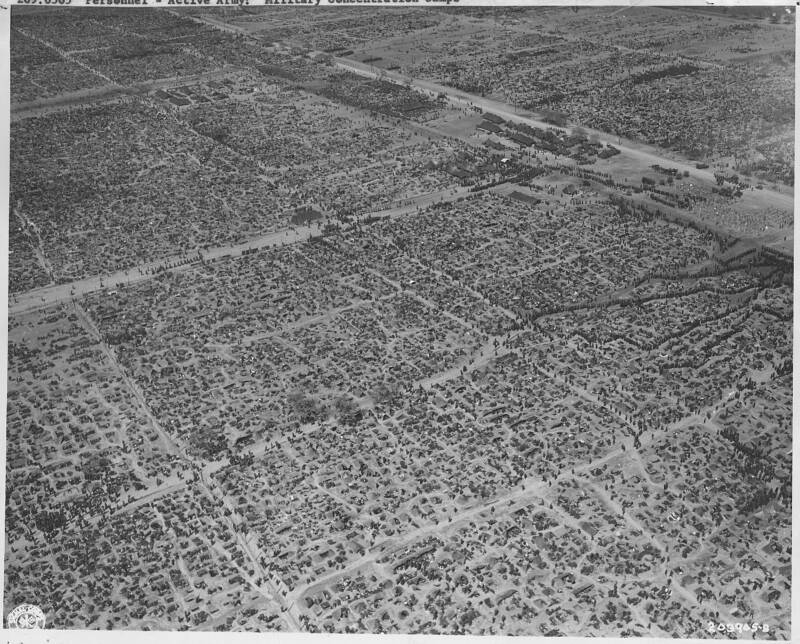
National Archives and Records AdministrationAn aerial view of one Rheinwiesenlager camp that held around 160,000 prisoners in April 1945.
However, during the construction of the Rheinwiesenlager, General Dwight D. Eisenhower — who was the commander of the Supreme Headquarters Allied Expeditionary Force at the time — decided that the surrendered German soldiers wouldn’t be classified as prisoners of war. Instead, they were called “disarmed enemy forces.”
As such, they weren’t entitled to any of the protections of the Geneva Convention. They were at the mercy of the U.S. Army.
‘Appalling Conditions’ In The Rheinwiesenlager
As prisoners began arriving at the Rheinwiesenlager in the spring of 1945, they quickly realized that they wouldn’t even be provided with basic shelter. They were forced to dig holes in the dirt to sleep in. As the U.S. Army Medical Department noted in a report published in 1969, “For most of the time, prisoners were without cover and were exposed to rain and snow and mud in the ending winter, and to heat, dust, or rain and mud as spring advanced to early summer.”
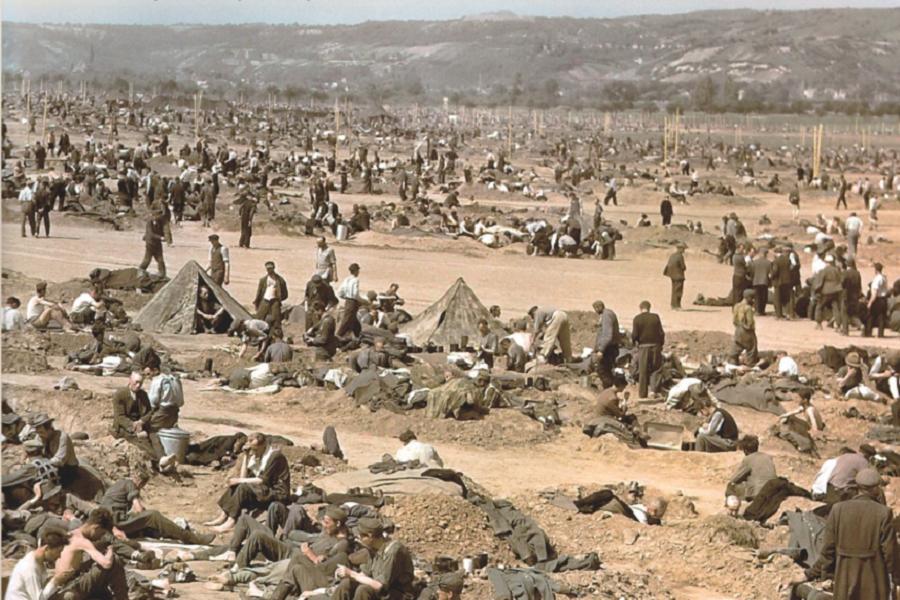
Public DomainMost German prisoners weren’t provided barracks and had to dig makeshift shelters in the dirt.
Many of the Rheinwiesenlager camps were overcrowded. One that was meant to hold 100,000 men was instead stuffed with 184,000. At first, some 40,000 U.S. soldiers were assigned to guard the prisoners, but they were so overwhelmed that some Germans were given extra rations in exchange for keeping order among their fellow inmates and preventing escapes.
This overcrowding also led to food shortages. According to a 1991 article by historian Stephen Ambrose in The New York Times, some of the inmates resorted to making “soup” out of water and grass to survive.
“Some of the enclosures resembled Andersonville Prison in 1864,” the Army Medical Department wrote.
The International Committee of the Red Cross purportedly wasn’t allowed to enter the camps for several months, and when the organization did gain access, officials described the conditions as “appalling.” But despite these issues, the death tolls in the Rheinwiesenlager remained relatively low.
The End Of The German Prison Camps
Most estimates for the number of German war prisoners who died in the Rhine Meadow Camps in 1945 range from 3,000 to 4,500. However, one writer has claimed that exponentially more people died within the barbed wire enclosures.
In 1989, Canadian author James Bacque published Other Losses, which alleged that nearly one million Rheinweisenlager prisoners perished from disease, starvation, and exposure. However, as Ambrose wrote in The New York Times, Bacque’s work was “flawed in its most fundamental aspects. Mr. Bacque misuses documents; he misreads documents; he ignores contrary evidence… and, as a consequence of these and other shortcomings, he reaches conclusions and makes charges that are demonstrably absurd.”
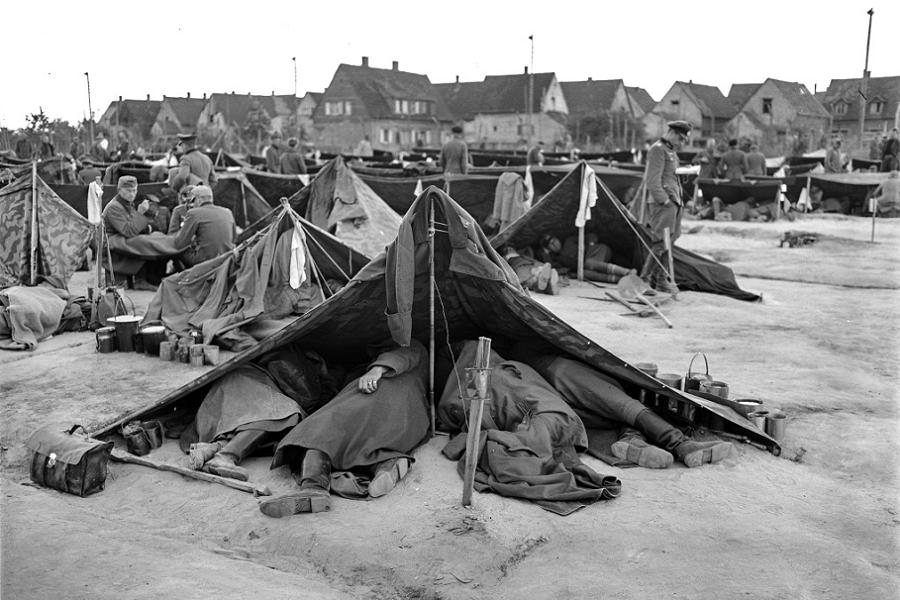
Public DomainConditions varied by camp, but even prisoners who did manage to secure a makeshift tent had to share their tiny quarters with others.
Indeed, most inmates at the Rhine Meadow Camps were released shortly after arriving. Within just a few weeks, members of the Hitler Youth and women who had worked as administrative personnel for the Wehrmacht were freed.
Soon after, laborers like farmers and miners were allowed to leave so they could assist with reconstruction efforts. By September 1945, five months after the Rheinwiesenlager opened, all but one small camp had closed, and it mainly served as a temporary holding station for German prisoners released from other facilities in France.
In the end, it’s clear that prisoners at the Rheinwiesenlager were subjected to horrid conditions. But while the exact number of Germans who lost their lives at these U.S. Army camps may never be known, the death toll was nowhere near comparable to that faced by the Holocaust victims who were brutalized by the Nazis.
After reading about the Rheinwiesenlager, go inside the worst war crimes in history. Then, learn about nine Holocaust heroes.