While excavating a settlement that was lost to a fire in the 4th century C.E., researchers found one storage jar filled with 23,000 coins weighing in at 83 pounds as well as another jar packed with 18,000 coins that weighed 110 pounds.
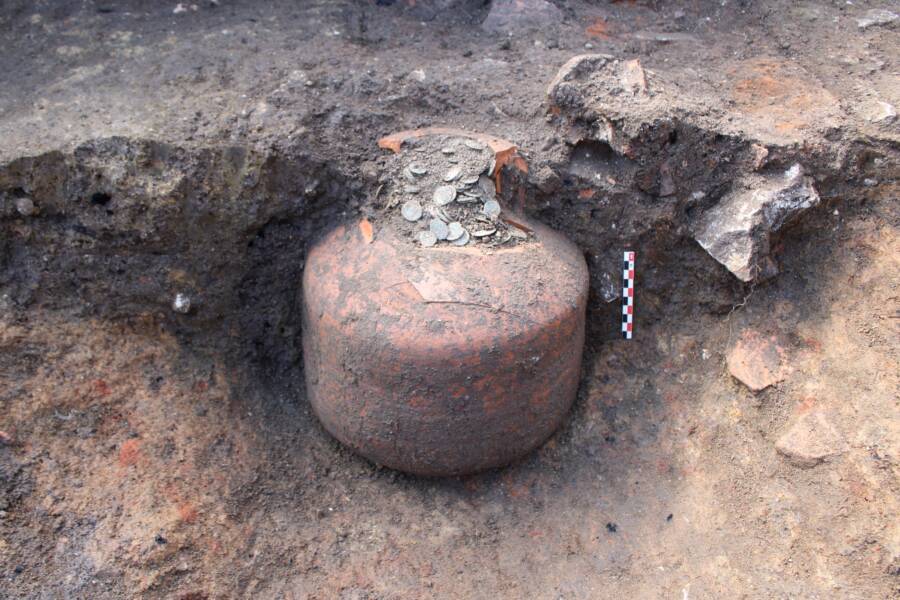
Simon Ritz/INRAPOne of the ceramic jugs contained approximately 23,000 to 24,000 coins.
Archaeologists have uncovered three 1,700-year-old ceramic storage jugs full of Roman coins in a village in northeastern France.
The jugs, also known as amphorae, were discovered during excavations of the village of Senon that were carried out by the National Institute for Preventive Archaeological Research (INRAP). The first jug alone weighed 83 pounds, which archaeologists estimate equals about 23,000 to 24,000 coins. The hoards of coins date back to about the last quarter of the third century C.E., or perhaps the early fourth century.
The Ancient Roman “Piggy Banks” Unearthed In Northeastern France
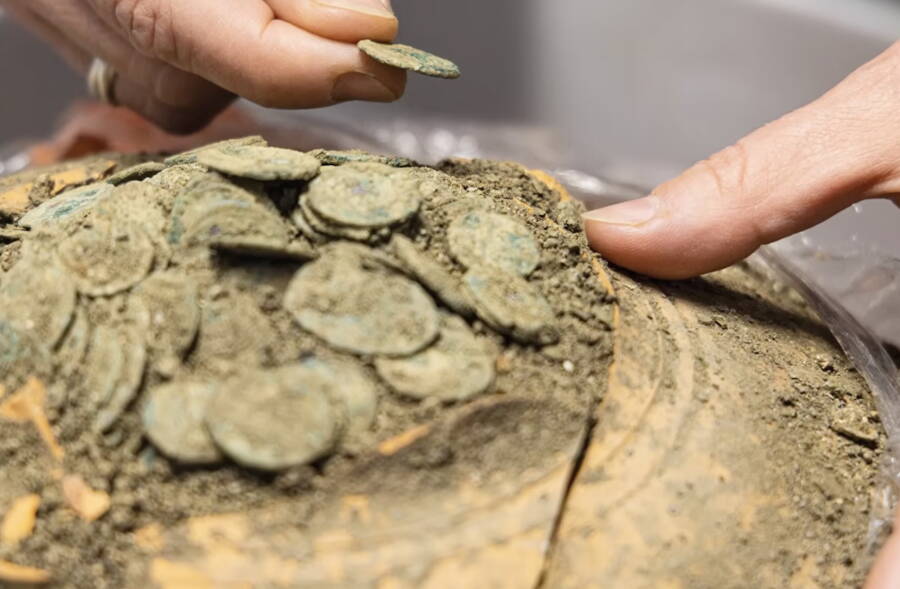
INRAPIt’s believed that these hoards were a type of long-term deposit rather than hastily buried treasure.
The first amphorae of coins was actually discovered before the INRAP excavation began. It was found by the Regional Archaeology Service, according to an INRAP statement. The other two jugs, however, were uncovered once the INRAP excavation began.
The second amphorae weighed about 110 pounds and contained about 18,000 to 19,000 coins. The third and final jug had already been retrieved from its cache during ancient times, and only three coins were left behind in the pit where the amphorae used to sit.
Archaeologists estimate that the three hoards in total contain at least 40,000 ancient Roman coins.
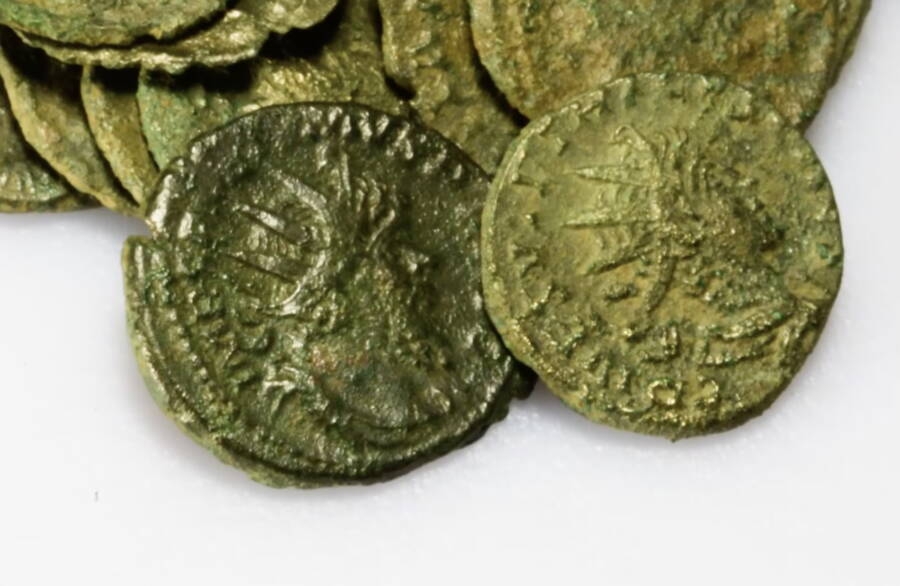
INRAPThe coins depicted various emperors from the Gallic Empire.
While it might seem as though these coins were hidden like buried treasure, archaeologists actually theorize that these amphorae functioned more like piggy banks and were used to store long-term savings.
Archaeologists came to this conclusion based on where the hoards were found within the remains of the residential homes that were excavated. Each jug was placed in a well-constructed pit that sat off of the living room. The pits were deep enough that the opening of the jug was level to the ground, making it easy to access.
Archaeologists found coins that were stuck to the rim of the jug, indicating that these coins were placed in the jug after it was situated in its pit. Based on the coins found in the amphorae, archaeologists believe these ancient piggy banks were buried sometime between 280 C.E. and 310 C.E., a tumultuous period in Gallic and Roman history.
The Gallic And Roman History Behind The Coins Found In Senon
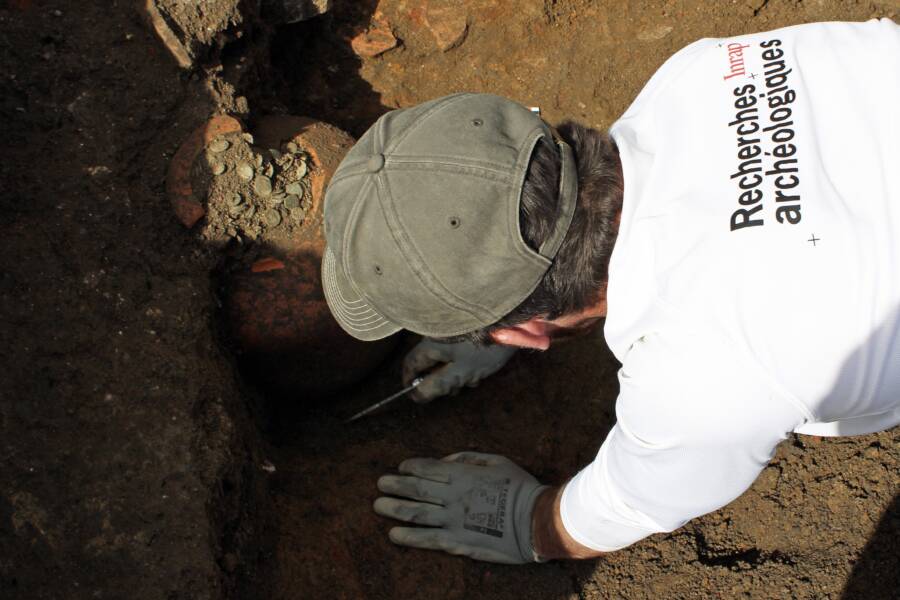
Lino Mocci/INRAPOne of the coin jugs being excavated from its pit in Senon, France.
The coins feature depictions of emperors Victorinus, Tetricus I, and his son Tetricus II. These men once ruled the Gallic Empire, which spanned the regions of modern-day France that were located north of the Roman Empire’s sphere of influence.
From 260 to 274 C.E., the Gallic Empire controlled Gaul as well as many of the surrounding provinces not under Roman rule. Then, in 274, the Roman Emperor Aurelian reintegrated these regions back into his empire.
These coins weren’t the only Gallic artifacts uncovered during the excavation. Archaeologists found remnants of many Gallic-era wood buildings in Senon, with some areas holding more than one structure per square meter.
This shows that even before Roman rule took hold in the area, there was a densely-populated settlement at Senon. Archaeologists also found stone buildings with underfloor heating, basements, and workshops.
While it appears that this settlement was flourishing, a fire in the fourth century led to its decline. After the fire seemingly destroyed Senon, an effort was made to re-establish it. However, after yet another fire, the settlement was abandoned for good in the 4th century C.E.
It’s believed that the newly-unearthed coins had gone untouched from then until now.
After reading about the tens of thousands of Roman coins uncovered in France, see the hoard of Roman gold coins found in Italy that could be worth millions. Then, learn about the hoard of Roman coins found by an illegal metal detectorist who didn’t report the discovery until years later.