From the executions of King Louis XVI and Marie Antoinette to a satirization of King Charles I's liquor tax, there are countless theories about the true meaning of "Jack and Jill."
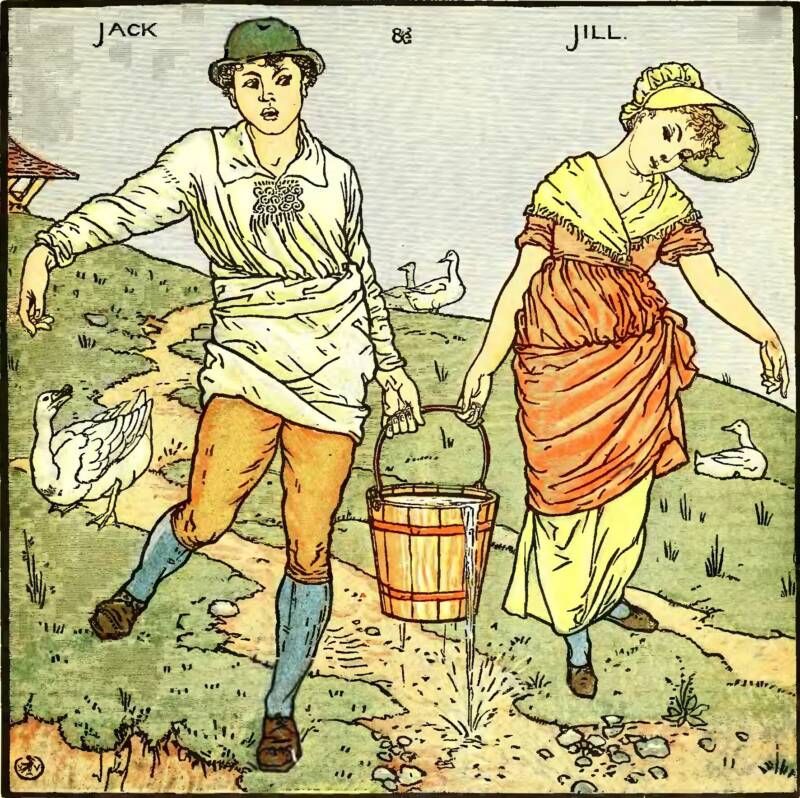
Public DomainA depiction of Jack and Jill from around 1900.
When it comes to the many children’s rhymes that have been written throughout history, the poem about Jack and Jill, the hill, and their fall is perhaps the most famous. But what exactly is the meaning of the “Jack and Jill” nursery rhyme? Does it even have one?
Ever since the verse first appeared in print in the 18th century, many scholars have speculated about its origins. Some believe that it could be an allegorical story, while others think that it could have roots in true events.
A few interpretations of the rhyme are light-hearted, but many are far darker — like the theory that it’s a metaphor for the execution of Louis XVI and Marie Antoinette.
So, what does the “Jack and Jill” nursery rhyme really mean? This is what people have speculated about the poem over the centuries.
The Emergence Of The Famous ‘Jack And Jill’ Nursery Rhyme
The nursery rhyme “Jack and Jill” first appeared in print around 1765 in Mother Goose’s Melody by John Newbery.
In this early edition, the rhyme appears as:
“Jack and Gill went up the hill,
To fetch a pail of water;
Jack fell down and broke his crown,
And Gill came tumbling after.”
Notably, the “Jill” character in this early version of the “Jack and Jill” nursery rhyme is spelled as “Gill.” Since Gill is a boy’s name, it seems that both the character’s gender and the spelling of their name changed over time. That said, the pairing of “Jack” and “Jill” predated even Mother Goose’s Melody.
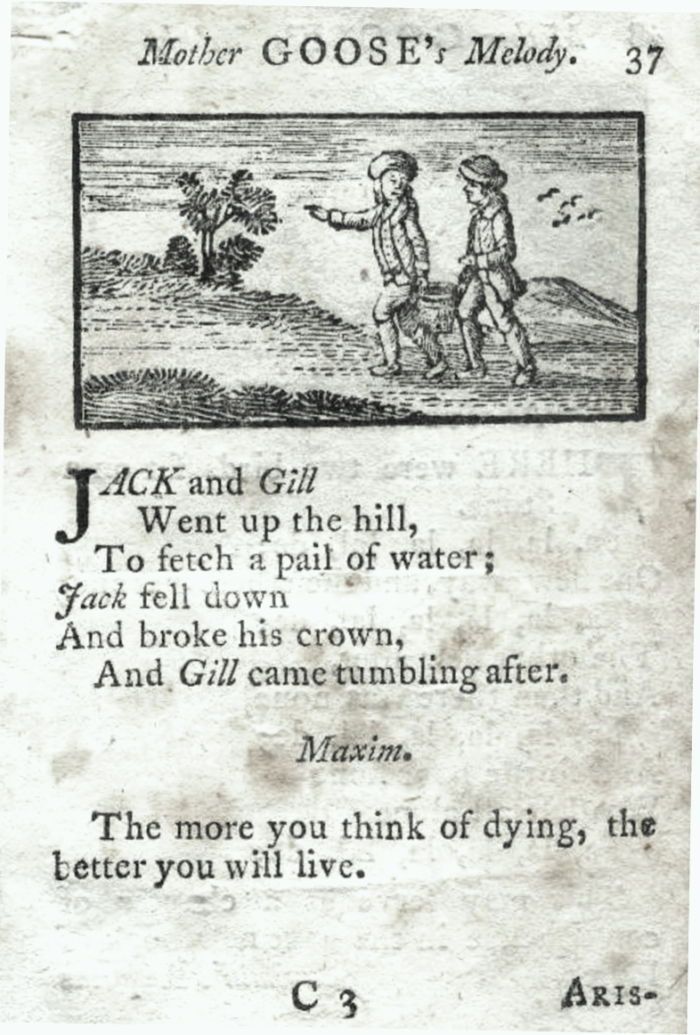
Public DomainThe “Jack and Jill” nursery rhyme as it appeared Mother Goose’s Melody.
Indeed, the two names were long used to indicate a generic man (Jack) and a generic woman (Jill). In Shakespeare’s A Midsummer Night’s Dream, for example, which was written at the end of the 16th century, the character Puck proclaims: “Jack shall have Jill; / Nought shall go ill; / The man shall have his mare again, and all shall be well.” Meanwhile, in Shakespeare’s Love’s Labour’s Lost, from the same era, another character laments: “Our wooing doth not end like an old play; / Jack hath not Jill.”
But what exactly is the meaning of the “Jack and Jill” nursery rhyme? While there’s not a single agreed-upon interpretation of the poem, many ideas have been floated since it emerged in the 18th century.
Theories About The Famous Rhyme’s Meaning
For such a short and simple story — though it has been expanded over the years — there are many possible meanings behind the “Jack and Jill” nursery rhyme. The first is that Jack and Jill were perhaps based on real people.
This is the belief in Kilmersdon, Somerset, a village in western England just south of Wales that claims to be the site of the poem’s origin story. The Kilmersdon interpretation of the rhyme states that Jack and Jill were a young couple who were expecting a baby out of wedlock. However, Jack perished in a rockfall, and Jill died either in childbirth or from heartbreak, depending on the version of the tale. What’s more, a common family name in Kilmersdon is “Gilson,” which some believe is a nod to the “Gill” character in the original rhyme.
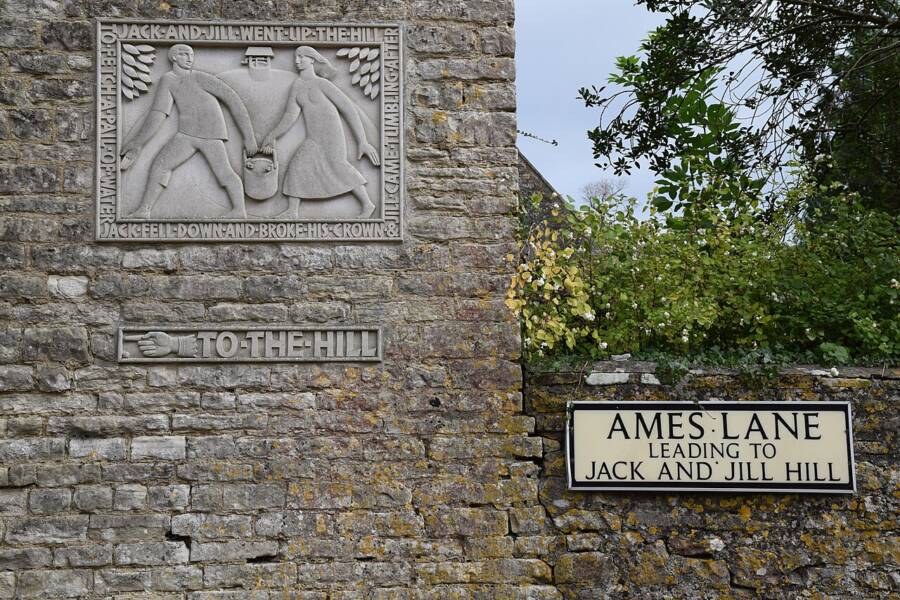
Hugh Llewelyn/Wikimedia CommonsA plaque in Kilmersdon, the English village that claims to be the true location of the hill in the “Jack and Jill” nursery rhyme.
Other theories about the meaning of the “Jack and Jill” nursery rhyme agree that the poem is rooted in history. Some scholars believe that Jack and Jill are references to Richard Empson and Edmund Dudley, ministers of King Henry VII who were executed when his son, King Henry VIII, ascended to the throne in 1509.
Another interpretation suggests that the rhyme is a metaphor for the executions of France’s King Louis XVI and Marie Antoinette. In this version, Jack’s broken “crown” represents Louis’ death at the guillotine — and the queen’s head “came tumbling after.” However, this doesn’t make sense, as the royals were put to death in 1793, nearly three decades after the nursery rhyme was first published.
Meanwhile, some theorists say that the poem was actually a sly nod to a 17th-century alcohol tax in England, when “Jack” was the name for an eighth of a pint of liquor, and a “Gill” signified a quarter of a pint.
It’s also possible that the “Jack and Jill” nursery rhyme is even older and originated in a totally different culture. A 13th-century collection of Norse legends known as Gylfaginning indeed contains a story about two young siblings who are abducted by the Moon while drawing water from a well. This bears a strong resemblance to the “Jack and Jill” poem, which describes the dark fates of two children “fetch[ing] a pail of water.” The siblings’ names are even fairly similar: Hjuki and Bil.
Or, perhaps, “Jack and Jill” is rooted in allegory. Chris Roberts, who speculated on the meanings behind popular nursery rhymes in his 2003 book Heavy Words Lightly Thrown, suggested that the story is about sex. Specifically, Roberts implies that Jack and Jill climbed the hill to lose their virginities, after which Jack swiftly fled the scene. While this is a much darker interpretation of the children’s rhyme, it does seem to connect somewhat to the Kilmersdon story.
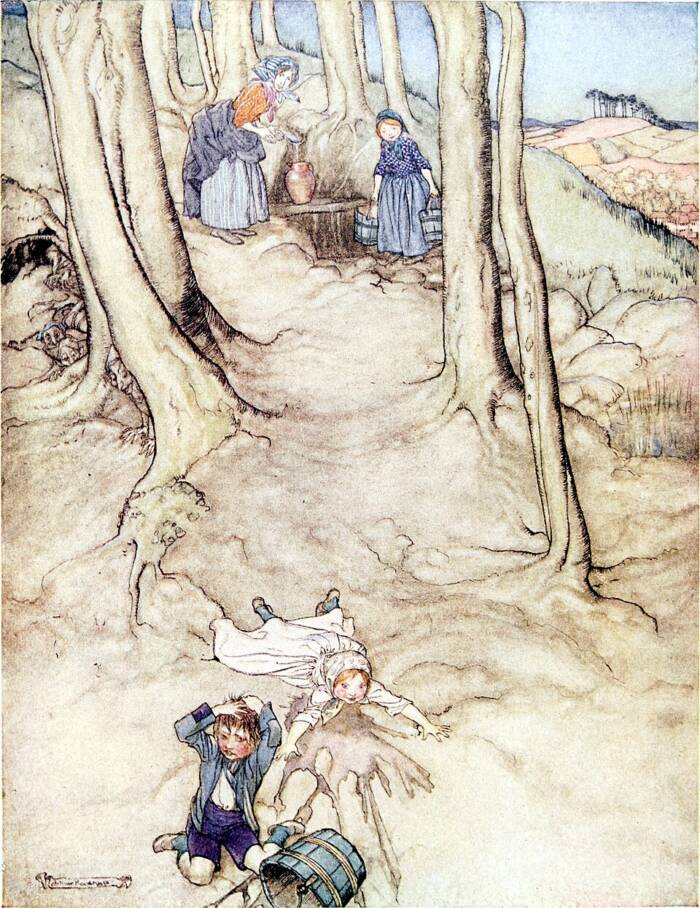
Public DomainIllustrator Arthur Rackham’s interpretation of “Jack and Jill.” 1913.
Then again, maybe the “Jack and Jill” nursery rhyme is simply about children being mischievous. One expanded version of the poem that was printed in a 19th-century book called National Nursery Rhymes reads:
“Jack and Jill went up the hill,
To fetch a pail of water;
Jack fell down and broke his crown,
And Jill came tumbling after.Up Jack got, and home did trot,
As fast as he could caper;
Went to bed to mend his head,
With vinegar and brown paper.Jill came in, and she did grin,
To see his paper plaster;
Mother, vex’d, did whip her next,
For causing Jack’s disaster.”
In the end, however, the meaning of “Jack and Jill” remains open to interpretation.
What Is The ‘Jack And Jill’ Nursery Rhyme About?
“Jack and Jill” is far from the only nursery rhyme with several different possible meanings. “Ring Around the Rosie,” for example, has long been linked with the Black Death by modern readers, though it likely has no connection to the bubonic plague at all.
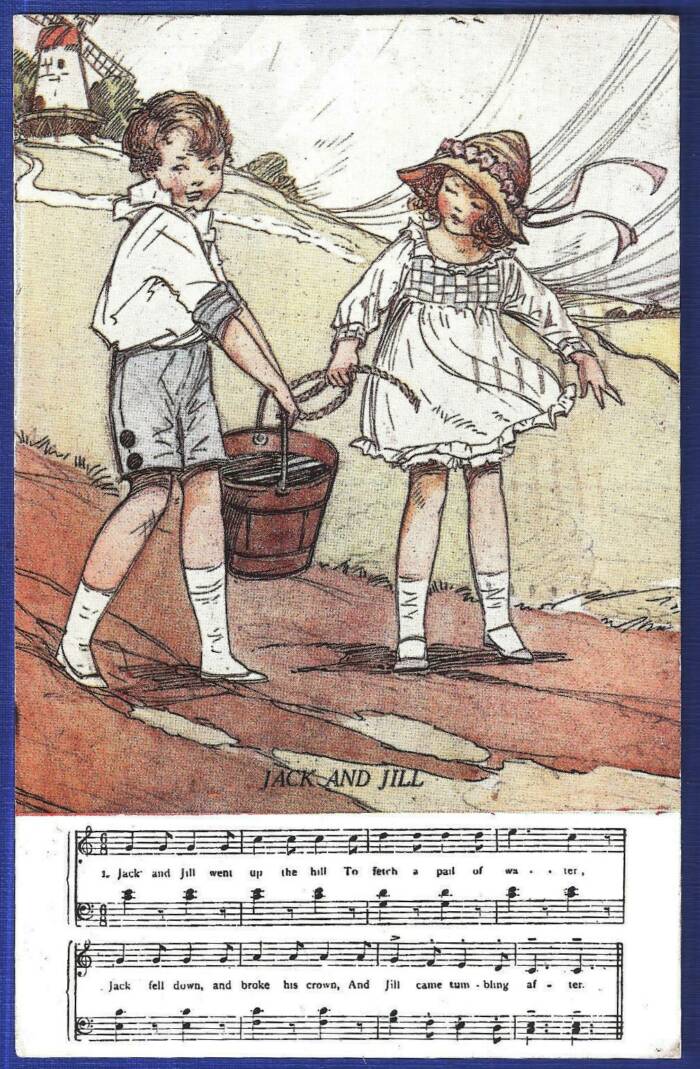
Public DomainThe “Jack and Jill” rhyme set to music. 1920.
Similarly, “London Bridge Is Falling Down” seems innocent enough, but some scholars believe it’s a reference to the practice of immurement, the medieval punishment of locking someone in a room until they die. And, like the “Jack and Jill” nursery rhyme, “Humpty Dumpty” has many possible meanings, ranging from rude slang to the reign of King Richard III.
Ultimately, “Jack and Jill” could be about history, local lore, mythology, or, really, nothing at all. Perhaps it’s a simple story of two children who fell down while fetching water. Perhaps it’s an allegory about virginity. Or maybe it’s a ditty that emerged from current events in 18th-century England.
However, if the nursery rhyme was written with a specific explanation in mind, it’s seemingly been lost to time.
After reading about the meaning behind the “Jack and Jill” nursery rhyme, discover the true story behind “Mary Had a Little Lamb.” Or, see why some people think that the “Muffin Man” is about an English serial killer.