On April 5, 1976, newspaper photographer Stanley Forman captured a shocking photo of a white demonstrator attacking a Black man with an American flag during an anti-busing protest in Boston — and it was soon clear that the image symbolized something much larger than the busing crisis.
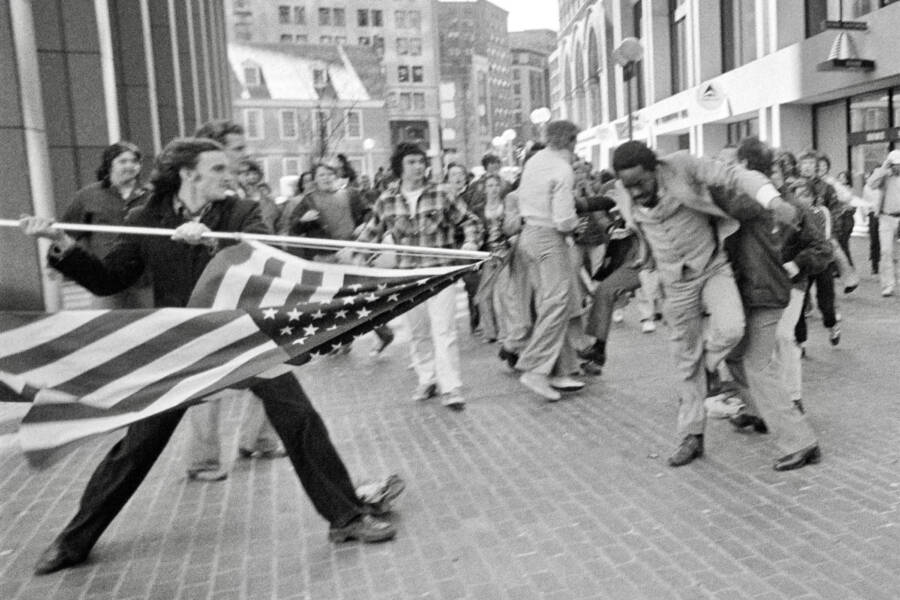
Boston Herald American“The Soiling of Old Glory,” taken by photographer Stanley Forman.
On a spring day in 1976, photographer Stanley Forman of the Boston Herald American headed to Boston’s City Hall Plaza to cover an anti-busing demonstration. The protests against busing, which was meant to help desegregate the city’s public schools, had been going on for years. But this protest would result in a Pulitzer Prize-winning photo, a disturbing image of a white student attacking a Black man with an American flag: “The Soiling of Old Glory.”
“The Soiling of Old Glory” image primarily concerns three people: Forman, the photographer, Ted Landsmark, a then-29-year-old Black lawyer, and Joseph Rakes, a then-17-year-old white student who attacked Landsmark. But the image is bigger than any one person. Though related to anti-busing, it’s resonated deeply because of its evocative imagery. In one image, Forman captured the deep — and often deeply violent — racial divisions in American society.
This is the full story of “The Soiling of Old Glory,” from the circumstances that led up to it, to the moment of Rakes’ attack on Landsmark, to what happened after it was printed in the Boston Herald American.
The Events Leading Up To Stanley Forman’s Famous Photo
By the time “The Soiling of Old Glory” photograph was taken in 1976, the Bicentennial of American Independence, racial tensions had spread across Boston. Some of this had to do with the larger civil rights movement, which had begun in the 1950s. But the tension in Boston often focused specifically on busing.
Though Brown v. Board of Education had ruled that the racial segregation of children in public schools was unconstitutional in 1954, desegregation efforts didn’t really begin in Boston until the 1970s. Whereas young Black students like Dorothy Counts and Ruby Bridges had bravely taken steps to desegregate all-white schools in the South, Boston had largely resisted such efforts. It wasn’t until 1974 that this changed in earnest.
Then, a judge found that Boston had a “systematic program of segregation affecting all of the city’s students, teachers and school facilities,” which had created a “dual school system.” This idea of “separate but equal” was exactly what Brown v. Board of Education had struck down, and the judge ordered the adoption of a busing plan meant to desegregate the schools.
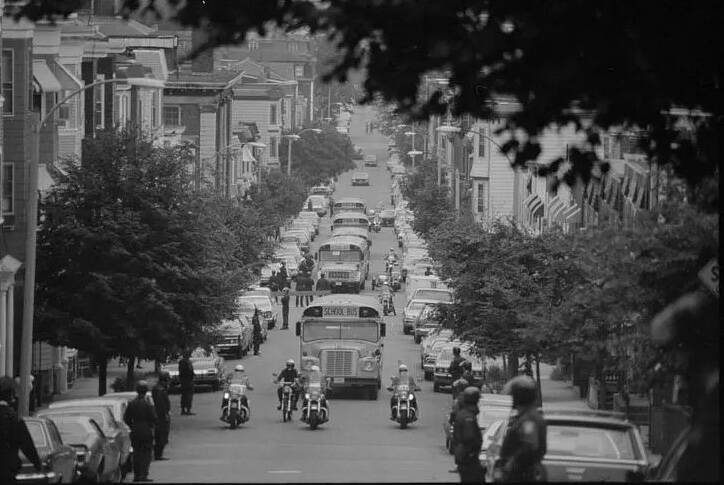
Boston Public LibraryPolice escorting school buses after a judge ruled that Boston needed to desegregate its schools.
Many white Bostonians were outraged. Some were resistant to the idea of sending their children to schools in different, less familiar neighborhoods; others were simply racist and didn’t want desegregation to move forward. Joseph Rakes, the white teenager in “The Soiling of Old Glory” photograph, claimed that his “blind anger” around busing arose because it meant separating many of his friends.
“When the busing started, it was, ‘You can’t have half your friends’ — that’s the way it was put towards us,” Rakes recalled to the Smithsonian Magazine in 2006. “They took half the guys and girls I grew up with and said, ‘You’re going to school on the other side of town.’ Nobody understood it at [age] 15.”
Anger around busing grew in the years after the 1974 order. And in 1976, it came to a head during an anti-busing protest at Boston’s City Hall Plaza.
The Story Behind “The Soiling Of Old Glory”
By April 5, 1976, there had been countless anti-busing protests in Boston; such protests were practically a daily occurrence. Still, photographer Stanley Forman of the Boston Herald American decided to grab his camera and head down to City Hall Plaza to check out that day’s student demonstration.
Forman had arrived and taken some photos of the students — a group which included Rakes, then 17 years old — when he noticed a Black man approaching the crowd.
“I saw this Black man coming around the corner and a bell went off in my head,” Forman told Smithsonian Magazine. “And I said, ‘They’re going to get him!’ I didn’t think they would get him with the flag.”
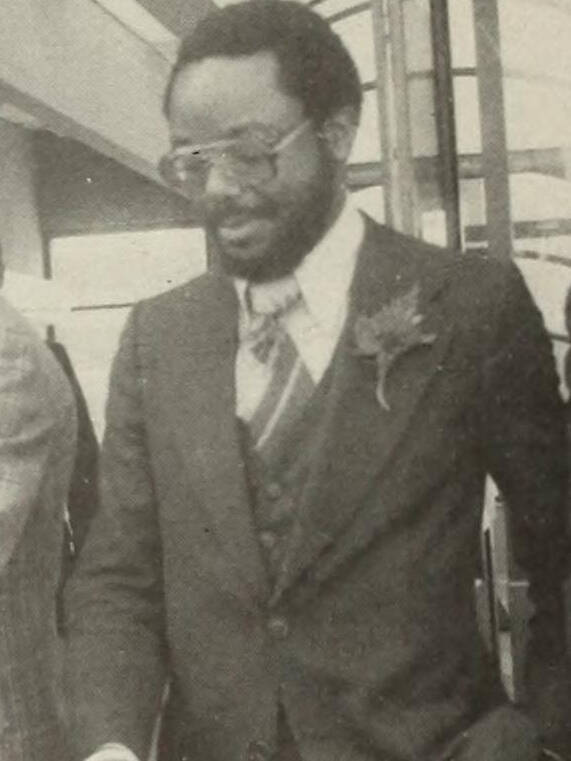
Public DomainTed Landsmark, the Black man attacked in “The Soiling of Old Glory.”
The man, a 29-year-old Yale-educated lawyer named Ted Landsmark, actually wasn’t aware of the demonstration happening that day. He was running late to an affirmative action meeting regarding city construction projects and thinking about what he was going to say during his presentation. But when Landsmark glanced up, he found himself on a collision course with the group of anti-busing protestors.
Before he could react, the protestors attacked.
“The first person to attack me hit me from behind, which knocked off my glasses and ended up breaking my nose,” Landsmark told NPR in 2016.
As Landsmark stumbled, Rakes charged at him with an American flag that he’d brought from home. In “The Soiling of Old Glory” photo, it looks like Rakes is trying to spear him. Actually, the 17-year-old was swinging the flag, attempting to hit him, according to Landsmark. The photo also seems to show a man grabbing Landsmark, as if to hold him in place. But the man, Jim Kelly, one of the adult organizers of the event, had actually stepped in to defend Landsmark from further harm.
“The flag being swung at me came at me just moments after that and missed my face by inches,” Landsmark recalled to NPR.
The attack lasted less than 15 seconds. The protestors moved on, Landsmark went to the hospital, and Forman called his editors.
But the story of “The Soiling of Old Glory” had just begun.
The Reaction To “The Soiling Of Old Glory”

American Archive of Public BroadcastingTed Landsmark, heavily bandaged and speaking to the press after the attack, which broke his nose.
By the time Stanley Forman got in touch with his editors at the Boston Herald American, news of the attack on Ted Landsmark was already spreading. And Forman had captured every second of it with his camera.
“I don’t want to say I was lucky to get it, because I knew what I was doing,” he told Smithsonian Magazine. “But I was lucky to get it.”
The Boston Herald American printed the photo — and the reaction to it was instantaneous. Forman’s image was full of violence and anger; it captured the tension around the busing crisis in Boston. But it also captured something deeper. “The Soiling of Old Glory” image seemed to symbolize racial tensions as a whole in the United States. For many Black people, it also represented the high stakes of the civil rights movement and the great hurdles that remained in the 1970s.
“I couldn’t put my Yale degree in front of me to protect myself,” Landsmark told a newspaper reporter a few days after the attack. “The thing that is most troubling is that it happened not because I was somebody but because I was anybody… I was just a n***er they were trying to kill.”
Forman ultimately won a Pulitzer Prize for the photo; Landsmark became a local celebrity in Boston, and used his rising platform to speak out against racial injustice. Rakes, meanwhile, was convicted of assault with a deadly weapon and received a two-year suspended sentence for his actions at Boston’s City Hall Plaza. He ultimately moved to Maine and became a labor foreman.
Though Landsmark later said he appreciated that the photo led to a new leadership role for him in the fight against racial inequality, he also expressed annoyance that the image overshadowed all of the other things he’d done in his life. As for Rakes, the former anti-busing protestor said, “The picture — it says what it says, but it doesn’t tell the whole story. You know, there’s nothing I can do about it. I just move on in my life.” The two men never spoke or even saw each other again after the infamous attack.
But “The Soiling of Old Glory” preserved their encounter forever. And it’s come to represent something larger than both men, the ongoing struggle in the United States to build a society that is equal and just for all.
After learning about “The Soiling of Old Glory,” discover the incredible story behind another Pulitzer Prize-winning photo, the “Kiss of Life.” Or, read about Robert Landsburg, the photographer who spent his final moments documenting the eruption of Mount St. Helens.