The Soyuz 11 space mission was supposed to be the Soviets' big answer to the U.S. Moon landing, but it ended in tragedy when three cosmonauts returned to Earth dead on June 30, 1971.
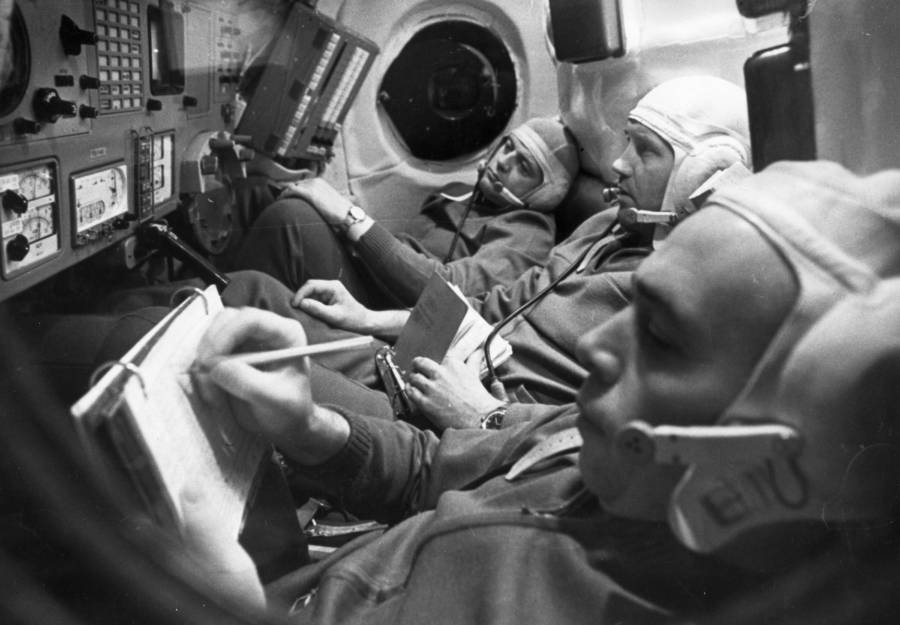
Sovfoto/UIG via Getty ImagesThe crew of the Soyuz 11 mission (left to right: Vladislav Volkov, Georgi Dobrovolski, and Viktor Patsayev), pictured on the day of the launch. June 6, 1971.
On June 30, 1971, a Soviet retrieval team anxiously awaited the return of the Soyuz 11 cosmonauts in a remote region of Kazakhstan. A nearby recovery helicopter spotted the scorched parachute of the spacecraft’s descent module as it plummeted toward Earth. After the team made their way to the crashed module, the would-be rescuers opened the hatch and discovered a gruesome and horrific sight: the dead bodies of cosmonauts Georgi T. Dobrovolski, Vladislav N. Volkov, and Viktor I. Patsayev.
By all accounts, until that moment, the Soyuz 11 mission had gone perfectly. The team had spent about 23 days in space, during which time they had established the first experimental space station in Earth orbit.
Their successful mission would stand as a triumphant answer to the U.S. accomplishment of putting men on the Moon. The Soviets would regain the international fame they had not enjoyed since the historic launch of Sputnik, history’s first artificial satellite, on Oct. 4, 1957.
However, these hopes dissolved into infamy in 1971, as the Soyuz 11 cosmonauts and would-be heroes had all returned to Earth dead.
What Happened During The Soyuz 11 Mission?
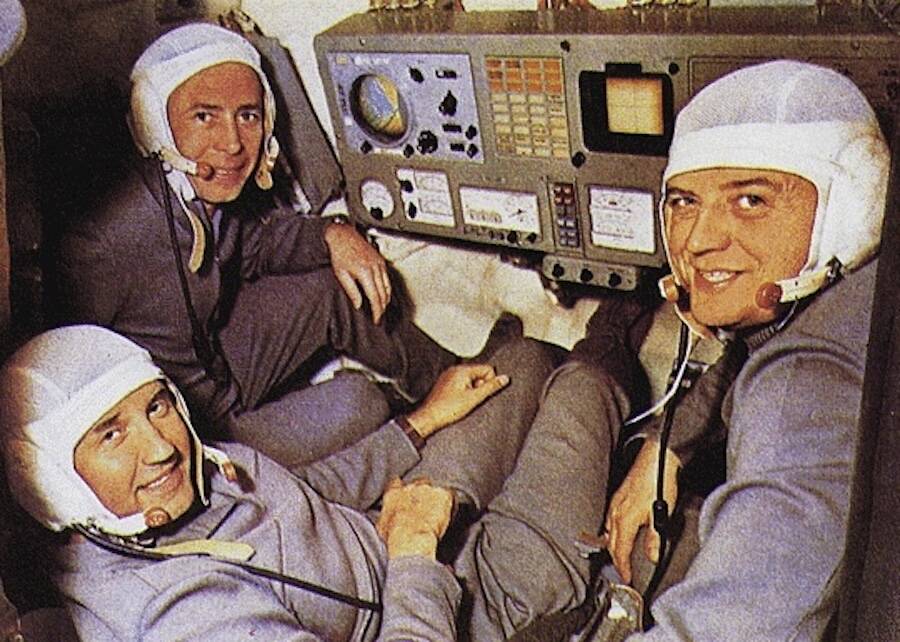
NASASoviet cosmonauts Georgi T. Dobrovolski, Vladislav N. Volkov, and Viktor I. Patsayev, pictured during the Soyuz 11 mission.
To this day, one of the most famous moments from the space race was when American astronauts Neil Armstrong and Edwin “Buzz” Aldrin became the first men to walk on the Moon on July 20, 1969.
Though the Soviets had been planning their own lunar landing, they canceled those plans and decided to pursue a new goal. They decided to focus their energy and resources on setting up the first experimental space station in Earth orbit, leading to the launch of the Salyut space station.
Soon after, the Soviets sent a crew of cosmonauts on the Soyuz 10 mission to help establish the station and perform experiments there, but the Soyuz 10 crew had trouble docking with the station, cutting their mission short.
Enter the Soyuz 11 mission, made up of cosmonauts Georgi T. Dobrovolski, Vladislav N. Volkov, and Viktor I. Patsayev. By this point, Soviet engineers had redesigned the docking probe so that the new team could dock without any issues in June 1971.
Indeed, the new mission seemed to be going according to plan. The cosmonauts ultimately spent a record-breaking 23 days at the world’s first space station.
The men conducted a variety of experiments, including nurturing plants like Chinese cabbage and bulb onions, taking spectrograms of stars, and monitoring the state of their health while aboard the station. These experiments were featured almost daily on Soviet television, with many of their countrymen tuning in to see them.
But when the cosmonauts began to make their return to Earth, something went horribly wrong.
What Caused The Deaths Of The Soyuz 11 Cosmonauts?
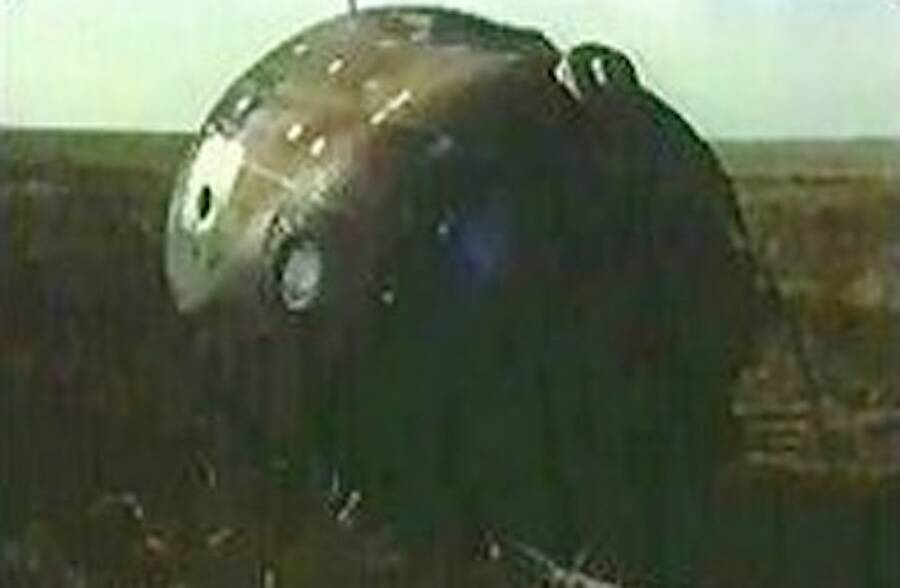
NASAThe Soyuz 11 capsule appeared to be in good shape upon its return to Earth, but tragically, the three cosmonauts inside were already dead.
After the Soyuz 11 module landed on Earth on June 30, 1971, the Soviet retrieval team excitedly knocked on the capsule, eager to greet the cosmonauts.
Chillingly, all they heard was an eerie silence.
After they opened the hatch, they were shocked and horrified to find Georgi T. Dobrovolski, Vladislav N. Volkov, and Viktor I. Patsayev all dead on arrival. The cosmonauts’ faces were covered with bruise-like spots, and blood was trickling from their ears and noses. Volkov and Patsayev were already cold, and while Dobrovolski was reportedly still warm, efforts to revive him tragically failed.
The three cosmonauts were the first — and, so far, only — men to die in outer space before their planned reentry into the Earth’s atmosphere. So what happened?
The sudden and untimely deaths of Dobrovolski, Volkov, and Patsayev quickly became the subject of intense debate. Tom Stafford, the chief of NASA’s astronaut corps, believed that the physiological stress of their long flight was what caused the cosmonauts’ demise. Meanwhile, the NASA physician Chuck Berry theorized that it was not a physiological cause, but that a toxic substance of some kind found its way into the descent module.
However, the United States would not learn the official reason why the Soyuz 11 cosmonauts died until The Washington Post reported on the mission in October 1973.
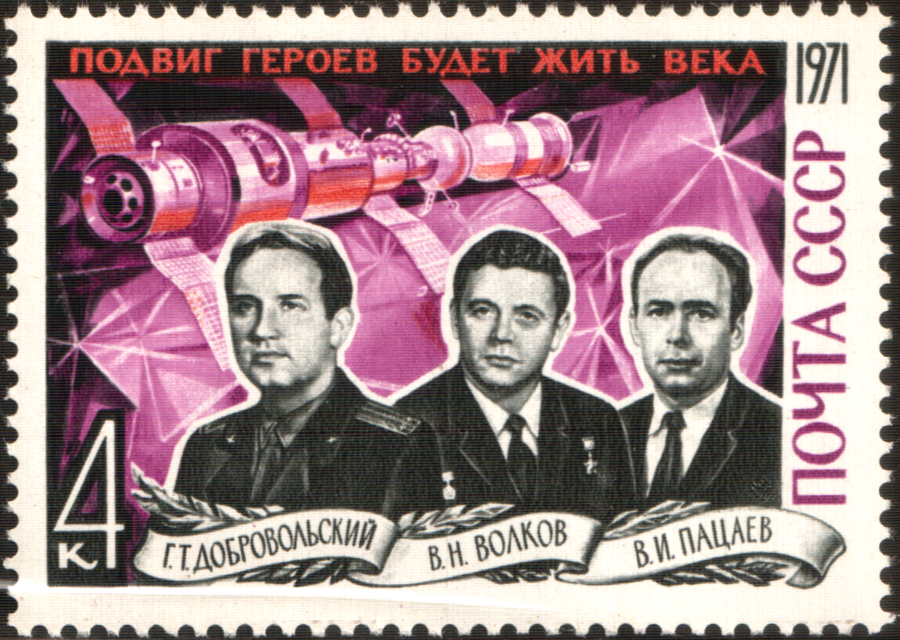
Wikimedia CommonsA Soviet stamp honoring the three cosmonauts who died during the doomed Soyuz 11 mission.
Ultimately, the conclusion was that a faulty breathing valve had broken open before the cosmonauts could make their return to Earth. This caused the men to die of decompression, which is the result of a sudden, large drop in air pressure, causing the air in your lungs to expand and tear the delicate tissue of the vital organs. Decompression also vaporizes the water in the soft tissues of your body, thus producing a certain amount of swelling.
The continued leakage of gas and water vapor would lead to a dramatic cooling of the mouth and airways. The water and dissolved gas would create bubbles that impede blood flow. After about a minute, blood circulation would come to a stop, your brain would be starved of oxygen, and you would fade into unconsciousness.
What the Soyuz 11 cosmonauts experienced in their final moments would not have been a painless end. The unexpected drop in pressure would have exposed them to the vacuum of space, and since none of them had been wearing pressure suits at the time, they had no chance of surviving such a sudden and significant change.
Although the official autopsies from the Burdenko Military Hospital remain classified, it is not difficult to surmise what symptoms they would have suffered. First, they would have felt an intense pain in their chests, abdomens, and heads. Then, their eardrums would have ruptured, and blood would have begun spilling out of their ears and mouths. During this, the men would have remained conscious for about 60 seconds.
With the men dead, Soyuz 11’s impeccable landing was completely automatic, as the capsule ran a programmed reentry with no need for living pilots. Their deaths transpired 104 miles above the atmosphere, cementing their status as the only human beings to have ever died in space — and marking one of the most tragic chapters of the space race.
After this look at the Soyuz 11 disaster, go inside the tragic story of the Space Shuttle Columbia disaster. Then, read about the horrific death of Vladimir Komarov, the cosmonaut whose space capsule smashed into Earth.