A long-standing theory suggests that civilizations in Egypt, Cambodia, and Mexico built similar structures that aligned with a mysterious cosmic event that took place in 10500 B.C.E. — but experts have debunked many of these claims.

Raimond Spekking/Wikimedia CommonsThe Pyramids of Giza are said to align with the belt of the constellation Orion.
Many ancient structures offer more questions than answers. While historians and archaeologists can glean a limited understanding of a building based on records and investigations of the surrounding areas, there is always a bit of mystery about a structure’s true purpose.
Because of this, it’s not particularly surprising that ancient history generates a lot of theories — some more conspiratorial than others. One of these theories has recently been garnering a considerable amount of attention online, and it relates to how seemingly disconnected civilizations appeared to be referencing the same cosmic phenomenon.
But is it true?
Were These Ancient Civilizations Mapping Out The Same Thing?
A popular theory spreading across the internet has to do with three separate, ancient structures that are located thousands of miles apart: the Giza pyramid complex in Egypt, Teotihuacan in Mexico, and the Angkor temple complex in Cambodia.
As explained in one viral TikTok from user @architecton_core with over 871,000 views, the curious thing about all of these structures is their layout.
“In 1983, engineer Robert Bauval noticed something,” the TikToker says, referring to the pyramids of Khufu, Khafre, and Menkaure. “The three pyramids viewed from above match the exact proportions of the three stars in Orion’s belt. Not approximately, exactly.”

Pascal Debrunner/UnsplashA debated theory states that the Pyramids of Giza would have lined up with Orion’s belt in 10500 B.C.E.
Not only that, but Bauval found that “the Nile River itself mirrors the Milky Way.”
“The way the galaxy curves in the night sky, the Nile curves the same way on Earth,” the TikToker explains. “The position of the pyramids relative to the Nile matches the position of Orion relative to the Milky Way.”
Assuming that the pyramids were built around 2500 B.C.E., this star position wouldn’t make sense. For the pyramid complex to accurately reflect stellar locations, it would have to be based on the skies of 10500 B.C.E. — “8,000 years before the pharaohs,” the TikToker says.
Similar shapes can be found in Mexico, specifically in the ancient Mesoamerican city of Teotihuacan.
Three structures — the Pyramid of the Sun, Pyramid of the Moon, and Temple of Quetzalcoatl — were completed between 150 and 250 C.E., according to the Metropolitan Museum of Art. This civilization had no connection to Egypt. Despite this, their structures shared a similar shape, claims the TikToker.
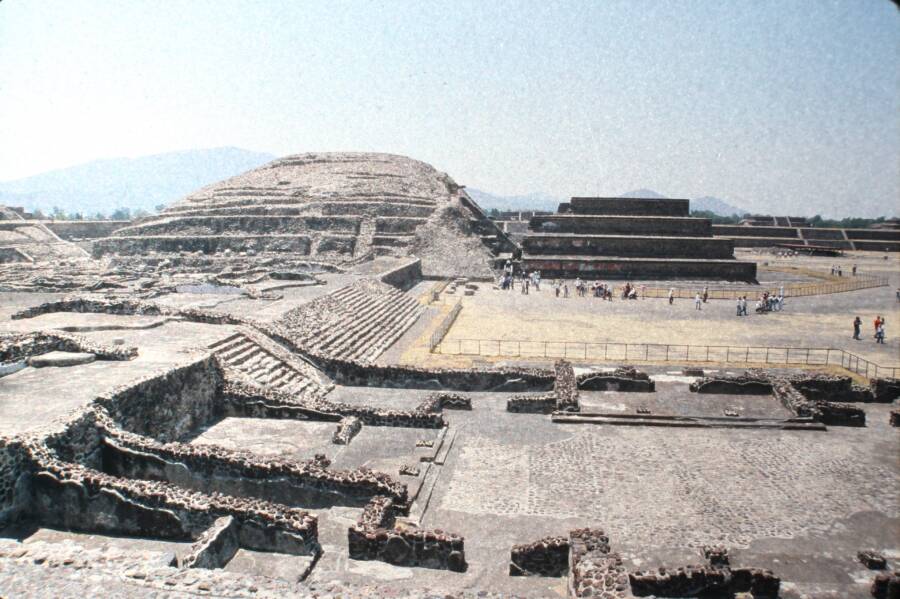
Gary Todd/Wikimedia CommonsThe ancient temples at Teotihuacan, which predates the Aztec Empire.
“Seen from above, the three pyramids form the same pattern as the three stars of Orion’s belt,” the TikToker says. “The proportions, the spacing, the offset angle: identical to the pyramids of Giza.” The TikToker says this, too, relates to the year 10500 B.C.E., though he does not explain how.
Finally, the TikToker alleges that the Angkor complex, built in 12th-century Cambodia, also displays this pattern.
“Every major temple in the Angkor complex faces east, except Angkor Wat. It faces west,” the TikToker explains. “For over a century, archaeologists called it an anomaly — until someone looked at the stars.”
According to the TikToker, researchers in 1996 discovered that, if one looked at the complex from above, the temples matched the constellation Draco.
“And the star positions they match don’t correspond to the 12th century, when Angkor Wat was built. They correspond to 10500 B.C.E.,” declares the TikToker.
So, were all of these societies linked? And what happened in 10500 B.C.E.?
A Deeper Look At The Theory
There’s no doubt that ancient civilizations oriented much of their lives around the stars. However, the claims made in videos like these stretch this idea to its extreme.
To start, the claims about all of the structures lining up with the skies in 10500 B.C.E. can be dismissed outright. While this has been claimed by people like Graham Hancock, Robert Bauval, and Adrian Gilbert, there’s just no compelling evidence that this is the case.
In a 1999 study published in the journal Astronomy & Geophysics, one researcher tested this theory on the pyramids of Giza. He found that the position did not, in fact, line up with how the stars would have appeared in 10500 B.C.E.
There’s also no evidence presented by the TikToker or any serious researchers connecting the structures of Teotihuacan to the year 10500 B.C.E., so this, too, can be dismissed.

Jakub Hałun/Wikimedia CommonsAngkor Wat was built around 1150 as a Hindu temple, though it later became a center of Buddhist worship.
Finally, the claim that the temples at Angkor line up with Draco as it appeared in 10500 B.C.E. appears to come from a book by Graham Hancock. Critics have noted that, in order for this to be true, one must intentionally disregard many temples in the Angkor complex. To demonstrate how malleable this idea can be, blogger Jason Colavito showed how the temples of Angkor could be connected into the shape of the Batman symbol.
Still, is it possible that these ancient structures were built with the sky and stars in mind?
The Connection Between Ancient Temples And The Stars
Researchers have speculated that many ancient structures have meaningful connections to the stars.
For example, in a paper published in Nature in 2000, Egyptologist Kate Spence used “trends in the orientation of Old Kingdom pyramids to demonstrate that the Egyptians aligned them to the north by using the simultaneous transit of two circumpolar stars.”
Similarly, archaeologist Ivan Šprajc found that Teotihuacan was likely designed with both astrological patterns and local calendars in mind. For example, the city’s main grid is slightly slanted and does not run perfectly from north to south or east to west. Šprajc speculates that this tilt allowed ancient people to track certain sunrises or sunsets, which may have been important for farming or rituals.
Finally, some researchers say that Angkor Wat was built so that the rising Sun aligned with its western entrance on equinox and solstice days.
Ancient people had a strong connection to the sky, the stars, and the constellations within. That said, they likely weren’t building to reference some event in 10500 B.C.E.; instead, they had more local interests in mind.
@architecton_core Three civilizations. Three continents. Never met. All built the same star map pointing to 10,500 BC. #orion #pyramid #angkorwat #teotihuacan #ancientmysteries #lostcivilization #history #mindblow #architecton
After reading about the theory that ancient structures aligned with the stars, discover the story behind the twists and turns of the Nazca Lines. Then, take a walk through nine of the world’s oldest structures.