While the remains of Diplodocus and the other prehistoric creatures found here are responsible for the very creation of Dinosaur National Monument, this is actually the first fossil excavation at the site in more than 100 years.
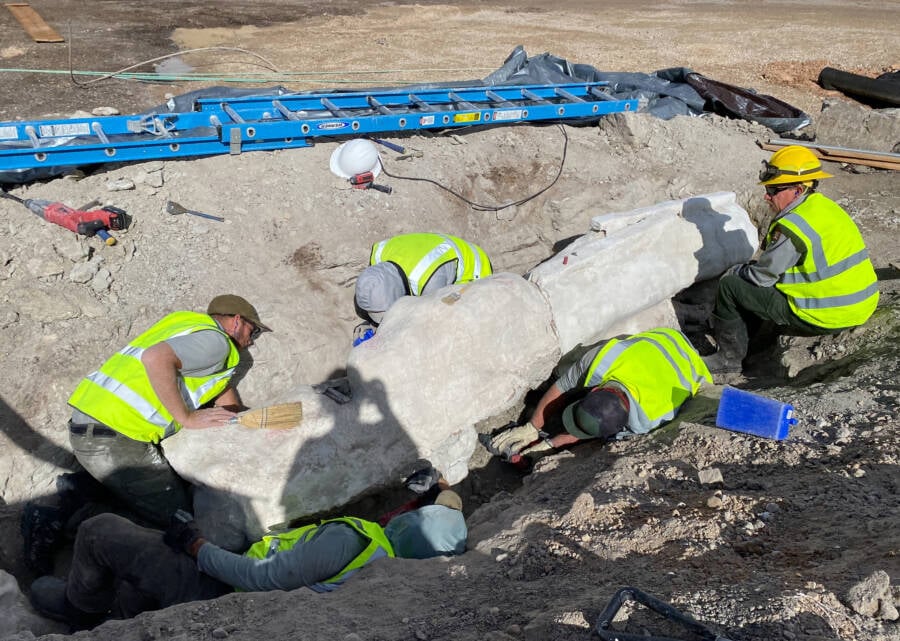
National Park Service/ReBecca Hunt-FosterThe excavation of the dinosaur fossil, thought to belong to Diplodocus, that was carried out at Dinosaur National Monument.
More than 100 years ago, paleontologists began flocking to Dinosaur National Monument on the border of Colorado and Utah to search for dinosaur fossils. Though excavations there have long since ceased, recent work on one of the monument’s parking lots happened to turn up even more dinosaur bones.
This astounding find — made completely by chance — has revealed the fossils of a dinosaur known as Diplodocus, a massive species with a long neck and tail that lived roughly 150 million years ago.
Discovering The Diplodocus Fossils At Dinosaur National Monument
According to the National Parks Service, the dinosaur fossil was discovered in September 2025 during parking lot construction work near Quarry Exhibit Hall. While removing asphalt, workers noted a chunk of “dinosaur-bearing sandstone,” and swiftly paused the project.
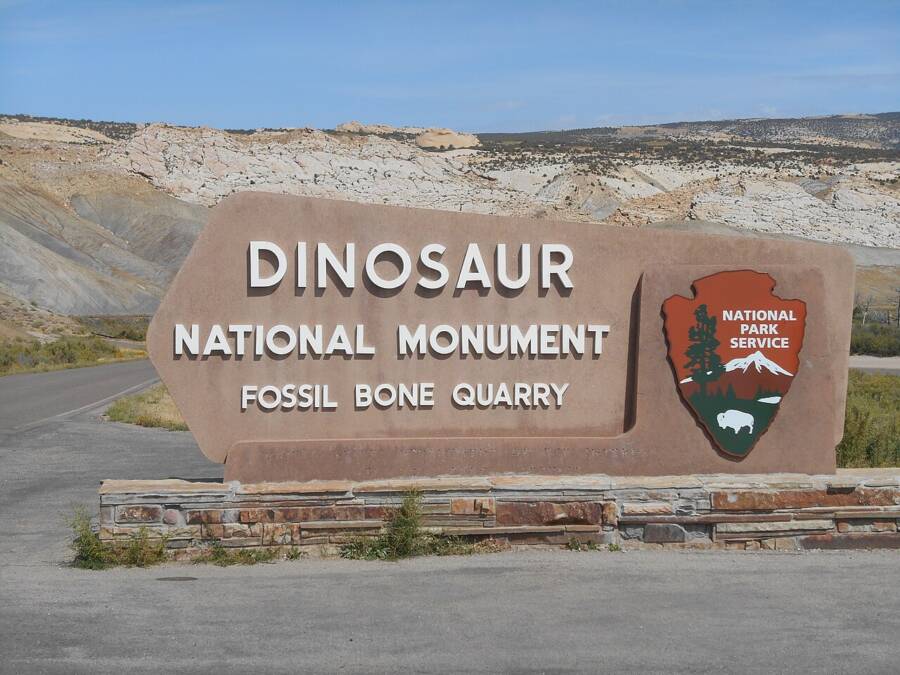
Carpenter, Kenneth/Wikimedia CommonsThe entrance to Dinosaur National Monument, where the Diplodocus fossil was unearthed.
Paleontologists, park staff, volunteers, and construction workers then began excavating the fossil. Experts quickly determined that these remains belonged to a dinosaur known as Diplodocus, a species once believed to be the longest dinosaur to ever live, and a species that has been documented in this area before.
In all, some 3,000 pounds of fossils and rock were removed from the site. Experts are now cleaning and studying the fossils, which are being held at the Utah Field House of Natural History State Park Museum in Vernal, Utah.
The discovery of the Diplodocus fossils beneath the parking lot is an exciting one because it was so unexpected, though such a discovery is not without precedent. In January 2025, dinosaur fossils were also found beneath the parking lot at the Denver Museum of Nature and Science.
However, it’s the first time that anyone has found dinosaur fossils at Dinosaur National Monument since 1924.
The History Of Fossils Unearthed At Dinosaur National Monument
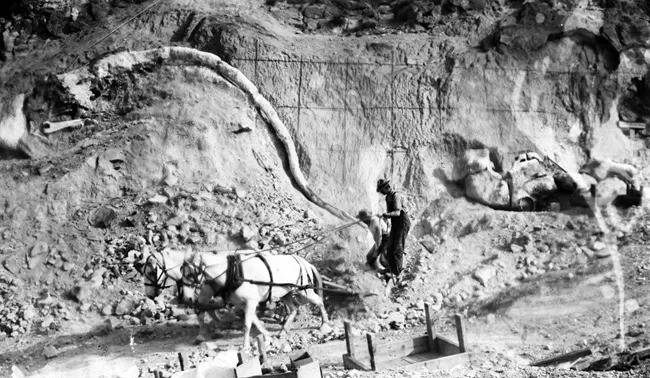
NPS Douglass Collection, edited by Evan HallThe tail of a Diplodocus at Dinosaur National Monument, this one uncovered during excavations in the early 20th century.
The history of Dinosaur National Monument stretches back hundreds of millions of years, to a time when a wealth of dinosaurs roamed the area. Diplodocus was once of the dinosaurs that lived here during the Late Jurassic Period, around 150 million years ago. It was a sauropod, a dinosaur marked by its long neck and tail, and it was an especially long species. Diplodocus stretched an average of 80 feet in length, with 80 vertebrae in its tail alone.
Long after the dinosaurs died off some 66 million years ago, the area was slowly settled by humans, primarily the Fremont people. Spanish explorers, settlers, trappers, and traders, also moved through the region in the 18th and 19th century, and in the 20th century paleontologists arrived.
Chief among them, paleontologist Earl Douglass arrived in 1909 on a mission from the Carnegie Museum of Natural History in Pittsburgh, Pennsylvania. Tasked with finding intact dinosaur bones that he could send back to the museum, Douglass and his team scoured the area and ultimately struck dinosaur gold in Jensen, Utah. There, in an area known today as the Carnegie Quarry, they began excavating a small slice of the Morrison Rock Formation which would yield more than 300 fossils.
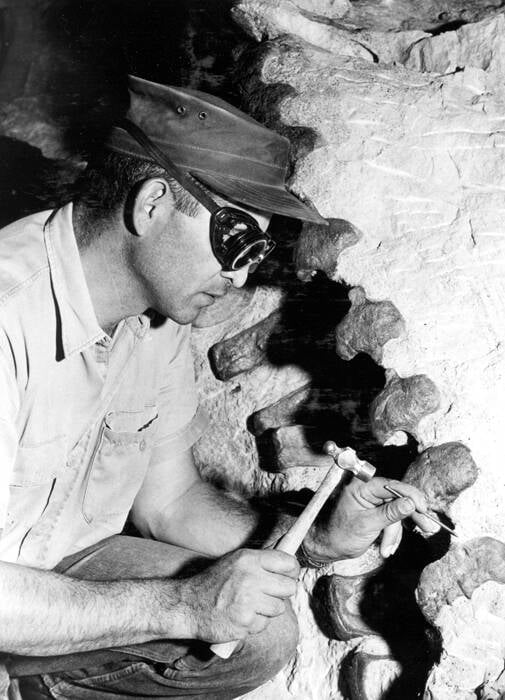
United States Geological SurveyA paleontologist working to gently unearth a dinosaur vertebrae at Dinosaur National Monument.
During the Carnegie excavations, which lasted from 1909 until 1922, Dinosaur National Monument was established in 1915. The Carnegie excavations were followed by excavations led by the Smithsonian National Museum of Natural History in 1923, and excavations led by the University of Utah in 1924.
However, after that point, excavations at Dinosaur National Monument ceased. By then, most of the visible fossils had been excavated, and Douglass himself suggested that what remained of the quarry be preserved so that “people can see the place where these ancient monsters have been entombed for ages.”
Though excavations at Dinosaur National Monument ended 100 years ago, the discovery of the Diplodocus proves that the area is still rich with dinosaur bones. Such a discovery makes it easy to imagine what the region was once like more than 100 million years ago, when the ground thundered with the sounds of sauropods, theropods, and ornithischians.
After reading about the enormous dinosaur fossils just found at Dinosaur National Monument, discover the stories of some of the most incredible prehistoric animals that once roamed the Earth. Then, learn about Quetzalcoatlus, the enormous pterosaur that is considered the largest flying dinosaur to ever live.