Exercise Tiger took place in April 1944 as a dress rehearsal for D-Day, but friendly fire and unexpected German attacks killed hundreds of men — and their deaths were concealed to prevent information about the upcoming invasion of Normandy from leaking.

Public DomainAmerican troops landing at Slapton Sands in Devon, England, during Exercise Tiger.
The Battle of Normandy during World War II remains one of the most hallowed military efforts of the 20th century. Tens of thousands of Allied troops valiantly stormed five beaches in France as part of the effort to liberate western Europe from the Nazis and create a second front to defeat the Axis Powers. But D-Day was almost canceled after a training operation known as Exercise Tiger went awry.
Six weeks before the invasion of Normandy, American troops gathered at Slapton Sands in Devon, England, to rehearse for the upcoming battle. From the beginning of the exercise, things went terribly wrong. First, communication issues led to casualties when thousands of men were dropped into a practice bombardment. Then, the Germans attacked.
Patrol ships were meant to be guarding the bay from enemy vessels, but several German E-boats managed to slip by. In the early morning hours of April 28, 1944, they fired torpedoes at the tank landing ships that were part of the operation, sinking two of them and killing hundreds of men.
By the time Exercise Tiger was over, an estimated 749 American troops had perished. And to make matters worse, the government decided to keep their deaths a secret.
Exercise Tiger, The Dress Rehearsal For D-Day
The planning for the Battle of Normandy, codenamed Operation Overlord, had already begun in early 1944. The massive invasion of Nazi-occupied France would commence on June 6, but it required careful coordination between Allied naval forces, air support, and infantry divisions.
Military leaders knew that the operation necessitated rehearsals and a realistic simulation of the conditions that awaited the troops. Commanders chose Slapton Sands in Devon, England, as the training site for American soldiers slated to storm Utah Beach in Normandy, as its terrain bore a physical resemblance to the French shore.

U.S. National ArchivesMilitary ships practice landing on Slapton Sands in March 1944.
Thousands of local civilians were forcibly evacuated before Exercise Tiger began, as it was among the largest and most important of these rehearsals — and would involve naval vessels blasting the coastline with live ammunition. The operation began in April 1944, with nearly 30,000 U.S. servicemen participating, including infantrymen, medics, engineers, naval crews, and armored units.
The bombardment from naval ships was meant to acclimate troops to the terrifying sights and sounds they would experience in a matter of weeks. The men would first board tank landing ships (LSTs), massive vessels designed to transport service members, vehicles, and equipment directly onto enemy beaches. They would then traverse Lyme Bay in a series of convoys meant to simulate an invasion. The rehearsal would be extremely realistic.
Unfortunately, it would end in friendly fire — and an actual encounter with the Germans.
How A Training Operation Turned Deadly
The first of several blunders during Exercise Tiger occurred on April 27, 1944. U.S. troops were to land at Slapton Sands following a 50-minute naval bombardment, which was set to end just as the initial wave of LSTs arrived onshore at 7:30 a.m.
However, some of the vessels were running behind, so Rear Admiral Don P. Moon decided to delay the operation by an hour. Not every ship received word of the change, though, and they landed at the scheduled time — right in the midst of a live naval shelling.
It remains unclear how many casualties resulted. Estimates range from 29 to 450, but due to the secretive nature of the operation, no official number was ever released. Tragically, the worst was yet to come.

U.S. National ArchivesSimulated firefights were meant to prepare troops for what was to come during the invasion of Normandy.
That night, German E-boats entered Lyme Bay. Enemy forces had been monitoring Allied activity in the English Channel for months, and upon spotting the convoys of tank landing ships, they seized the opportunity to attack.
The vessels had been left particularly vulnerable, as a British escort ship had departed the area for repairs hours earlier in yet another instance of miscommunication. Furthermore, some of the LSTs were operating on different radio frequencies and never received any warnings about enemy activity.
The Germans attacked around 2 a.m., with torpedoes ripping through multiple LSTs. The USS LST-507 burst into flames, trapping servicemen below deck. USS LST-531 sank immediately after it was hit, leaving hundreds of men fending for themselves in the frigid sea.
“I was stupidly trying to go topside to see what was going on, and suddenly ‘BOOM!'” recalled Lieutenant Eugene Eckstam, a medical officer aboard LST-507, according to the Naval History and Heritage Command. “There was a horrendous noise accompanied by the sound of crunching metal and dust everywhere. The lights went out and I was thrust violently into the air.”

U.S. National ArchivesUSS LST-289 suffered torpedo damage after German attacks during Exercise Tiger.
“The Germans just picked us off,” echoed Private John Perry, who was on LST-531. “We were sitting ducks,” he told the Los Angeles Times in 1994. “We never knew what hit us.”
Many survivors burned to death as a result of a layer of fuel floating atop the water. Others drowned due to the heavy combat gear they were forced to wear during training. Still more had fastened their life jackets incorrectly.
“The screams and cries of those many Army troops in there still haunt me,” said Eckstam.
With the darkness of night, sheer confusion about what had happened, and a baffling failure of radio communication, rescue efforts suffered. By sunrise, at least 749 American service members were dead. For comparison, 197 men died on Utah Beach during the actual invasion of Normandy.
In the aftermath of the attacks, General Dwight D. Eisenhower almost called off D-Day. Ten officers with classified knowledge about Operation Overlord were missing, and Eisenhower feared that they’d been taken captive by the Germans and tortured for intelligence.
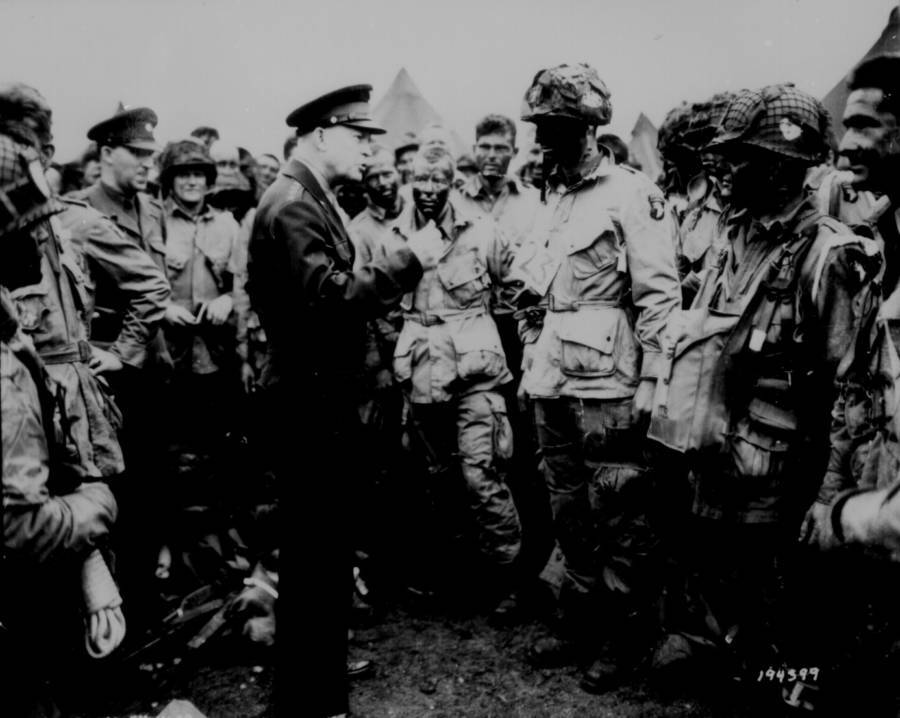
National ArchivesGeneral Dwight D. Eisenhower addressing soldiers just before the invasion of Normandy.
While their bodies were soon located, military officials still faced additional difficulties. Exercise Tiger needed to be kept secret to prevent any information about D-Day from leaking. If the deaths were reported, the cover could be blown. So, the survivors were ordered to stay silent — and a massive cover-up began.
The Cover-Up And Legacy Of Exercise Tiger
Following Exercise Tiger, D-Day preparations continued as normal, though the commanders of Operation Overlord did make some changes to the plans. Radio frequencies were standardized, landing troops received additional life jacket training, and small boats were enlisted to pick up any survivors stranded in the ocean.
The casualties from the operation were finally listed on Aug. 5, 1944, along with the official reports from D-Day. But the details of Exercise Tiger were still hidden from the public until the Pentagon declassified the records in 1974.
That same year, Devon resident Ken Small took it upon himself to commemorate the forgotten tragedy. He extensively researched the event and even helped recover a sunken tank from Lyme Bay. It now stands as a memorial for those who died at Slapton Sands.
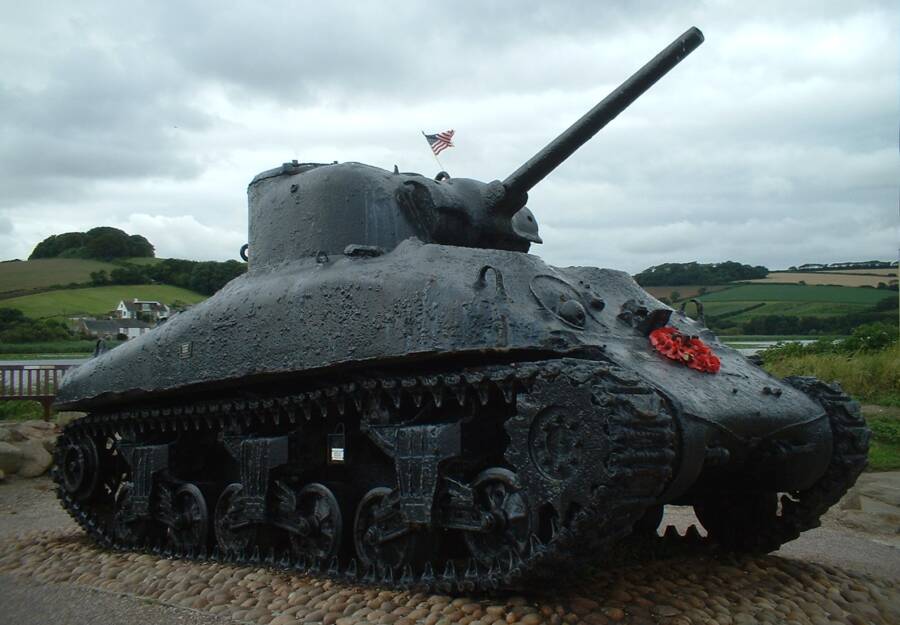
Shahirshamsir/Wikimedia CommonsA memorial to the lives lost in Exercise Tiger.
In the end, the impacts of Exercise Tiger stretched far beyond April 1944. Hundreds of families whose loved ones perished during the operation were left without closure. Rear Admiral Don P. Moon died by suicide the very day the casualty lists were released.
But at the same time, the lessons learned from the doomed exercise may have saved countless lives on D-Day. And Operation Overlord helped secure an Allied victory, leading to the collapse of the Nazi regime, the liberation of concentration camps, and the end of a war that killed tens of millions of people.
After learning about Exercise Tiger, read about the Allied victory at Sword Beach. Then, discover the true story of Lewis Nixon and his “Band of Brothers.”