These vintage sideshow performers were born with unusual physical attributes, giving them little choice other than to make their living doing "freak shows."
On May 19, 1884, the Ringling Bros. Circus opened for business, capitalizing on the extreme to earn a profit. And it worked: for years, the most popular component of the circus was the “freak show.” The Ringling Bros. were building on a much older tradition of exhibiting people with deformities and, alongside P.T. Barnum, “freak shows” became highly popular.
So who were the sideshow performers who appeared in them?

Wikimedia CommonsThe Ringling Bros. sideshow lineup in 1924.
Some sideshow performers had been kidnapped and were forced to go onstage against their will. Others, with few other options, chose to become sideshow performers, and often found that displaying themselves could be a lucrative career. But many were mistreated by abusive circus staff, and some were merely “manufactured” by greedy circus entertainers.
As Clyde Ingalls, the manager of the Ringling Bros. and Barnum & Bailey sideshow in the 1930s, once remarked, “Freaks are what you make them. Take any peculiar-looking person… play up that peculiarity and add a good spiel and you have a great attraction.”
As modern medicine began to explain the unexplainable — and as some audience members began to question the ethics of “freak shows” — these performances eventually fell out of fashion. But while they thrived, countless famous sideshow performers moved through their ranks.
These are some of their stories.
Annie Jones — ‘The Bearded Lady’
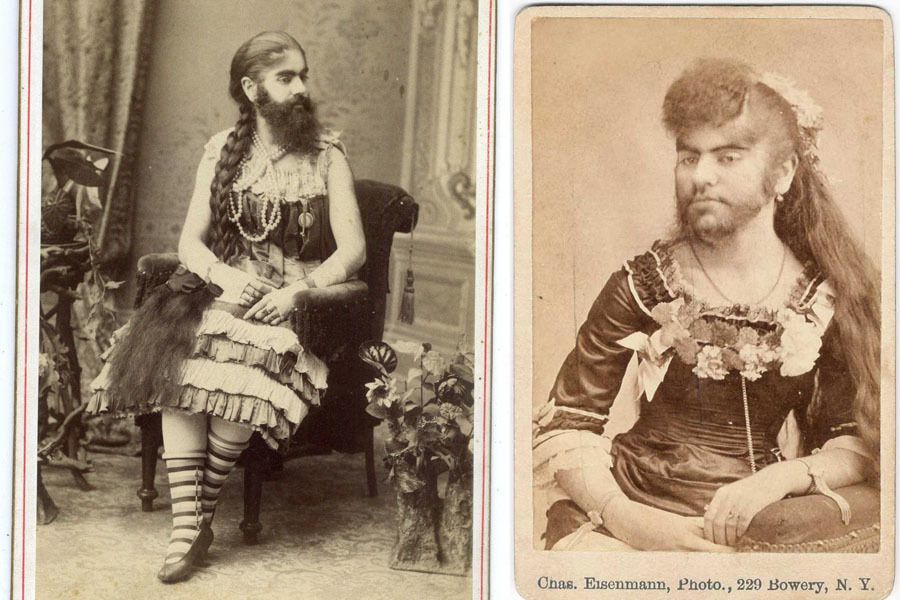
Charles Eisenmann/Wikimedia CommonsAnnie Jones, the world-famous “bearded lady” of the Ringling Bros. and Barnum & Bailey Circus.
One of history’s most recognized sideshow performers, Annie Jones was born in 1865 in Virginia with her chin already covered in hair. It’s still unknown what caused her facial hair, but it was most likely hirsutism, a condition that leads to “coarse hairs in females in a male-like distribution.”
She began her career before the age one — when she was featured at P.T. Barnum’s American Museum. After a successful stint at the museum, Barnum offered Jones’ parents a three-year contract at $150 per week.
Known as the “Bearded Girl,” Annie Jones had a mustache and sideburns by the time she was five years old. She was so popular with audiences that other circus recruiters wanted to feature her in their shows instead — and some were willing to resort to horrific measures to do so.
While under the care of Barnum’s appointed nanny, Jones was kidnapped by a New York phrenologist who attempted to exhibit Jones in his own sideshow. Luckily, Jones was soon found in upstate New York. But then, the kidnapper made a wild claim that the girl was actually his child.
When the matter went to court, Jones quickly ran into the arms of her real parents. The judge called the case closed, and Jones’ mother remained close to her daughter for the rest of her career as a performer.
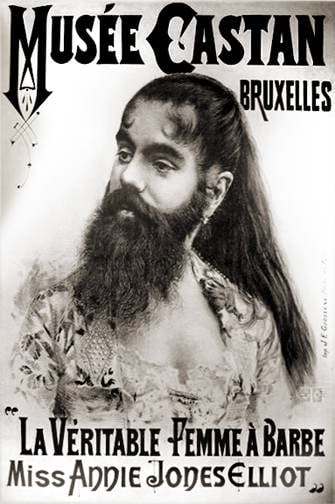
Wikimedia CommonsA French poster advertising “The Bearded Woman” Annie Jones.
As an adult, Jones performed as the “Bearded Lady” or the “Bearded Woman.” And she also began to pursue her own interests, becoming just as well known for her musical skills as her bearded face.
In her final years, she began to campaign against the use of the word “freak” to describe sideshow performers. But she was ultimately unsuccessful, and by the end of her life she had “known no other life than that of a freak.”
Outside the circus, Jones was married twice — the second time widowed — before becoming ill during a visit to her mother’s home in Brooklyn. There, she passed away from tuberculosis in 1902 at the age of 37.
Jack Earle — ‘The World’s Tallest Man’
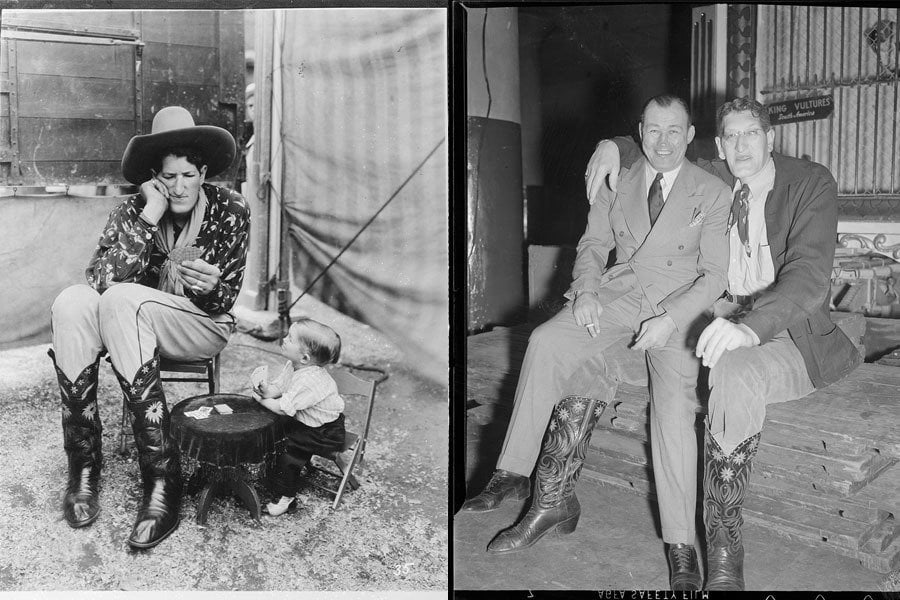
Boston Public Library/FlickrLeft: Jack Earle with fellow performer Major Mite, who stood 2’2″. Right: Earle with an average-sized man.
Born in El Paso, Texas, in 1906, Jack Earle stood six feet tall by the age of 10. By the age of 13, he was already over seven feet tall. And as an adult, Earle grew to be 7 feet, 6 inches — though he was popularly proclaimed as the “World’s Tallest Man” and his height was publicized as 8 feet, 6 inches.
The reason why he was so shockingly tall was that he had a condition known as acromegalic gigantism. And while his height could be advantageous for him in some situations, it was downright dangerous in others.
Earle had been a Hollywood actor (appearing in films like Hansel and Gretel and Jack and the Beanstalk). But according to reporting from Texas Hill Country in 2018, a bad fall from scaffolding caused him to develop major health problems, causing Earle to retire from movies for good.
Afterward, in 1925, the Ringling Bros. and Barnum & Bailey Circus “freak show” came through El Paso, and Earle happened to attend one of their shows. He was considerably taller than the show’s current “giant,” and Ringling Bros., seeing an opportunity, offered Earle a one-year contract.
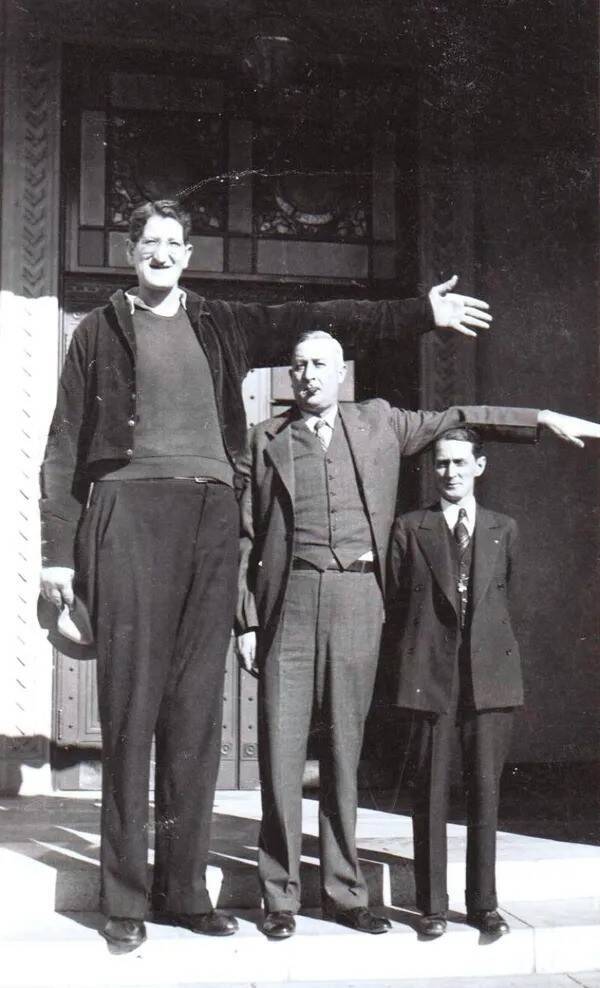
El Paso Historical SocietyJack Earle with two average-sized men.
Earle didn’t want to be in a “freak show.” But he needed to make a living, so he decided to become a sideshow performer. And on his first day, Earle was put at ease when a performer with dwarfism named Harry Doll explained that there were more “freaks” in the audience than in the show itself.
The gentle giant thus began his Ringling Bros. career alongside two feet, two inch tall Major Mite (Clarence Chesterfield Howerton). He would spend the next 14 years on the road with the sideshow — often posing alongside extremely short men or average-sized men to further emphasize his height.
After retiring, Earle went on to become a traveling salesman for the Roma Wine Company. He died of kidney failure in 1952 at the age of 46.