Experts believe that one of the defenders of the ancient Greek city of Hippos used this bullet against an invading force sometime in the late 2nd or early first century B.C.E.
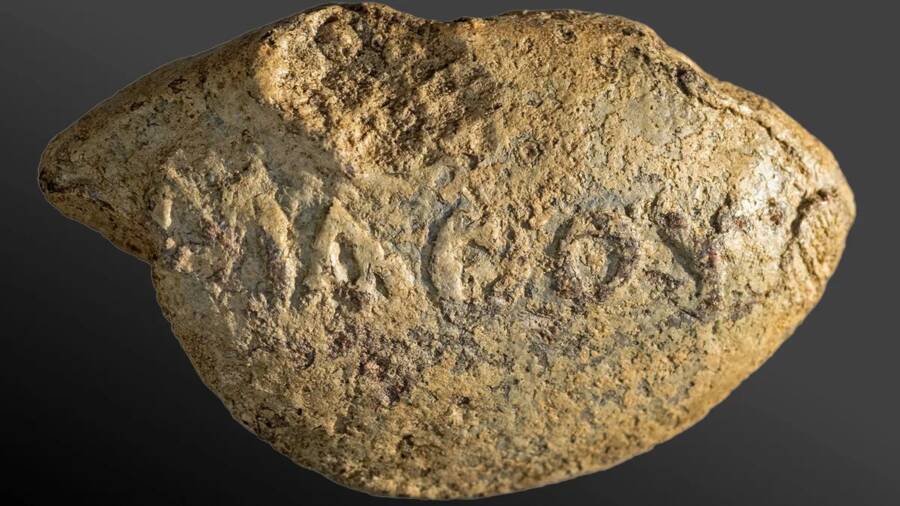
Michael Eisenberg/University of HaifaThe 2,100-year-old sling bullet has a Greek inscription reading “ΜΑΘΟΥ,” translated as “learn your lesson.”
During excavations in the ancient city of Hippos (also known as Sussita) in the Golan Heights, archaeologists found a small sling bullet that dates back 2,100 years. Such ancient relics have been unearthed many times in this area, but this one stood out. Upon closer examination, archaeologists realized that it bore an inscription.
On the side of the bullet, written in Greek, someone had carved out the letters “ΜΑΘΟΥ.” This is Greek for “learn,” and researchers believe that a defender of Hippos fired the sling bullet at an enemy invader in order to convey the message “learn your lesson.”
The Inscribed Sling Bullet Found Among Ancient Ruins In The Golan Heights
According to a study from the University of Haifa, archaeologists came across the sling bullet during excavations in Hippos in late 2025. The bullet was found with a metal detector near the riverbed of the Sussita Stream, and though 70 sling bullets had already been found, this one stood out.
Almond-shaped and made of lead, the bullet is roughly 1.3 inches long and weighs 1.6 ounces. On its side is an inscription in Greek: “ΜΑΘΟΥ,” translated as “learn.” Though sling bullets inscribed with words have been found elsewhere, the sling bullets in Hippos have so far only had threatening images, like scorpions or thunderbolts. This is the first bullet found in Hippos to bear a linguistic inscription, and archaeologists believe it was a “sarcastic” taunt for the enemy.

AVRAM GRAICER/Wikimedia CommonsAn aerial view of the ancient city of Hippos, where the inscribed sling bullet was found.
They believe that this particular usage of the word, as well as the context, suggests that “ΜΑΘΟΥ” would translate as “learn your lesson!” This lines up with other documented sling bullets from this era with inscriptions like “take a taste,” “take it,” and “receive this.”
But who fired this bullet and why? Researchers suspect that it was launched by a Greek-speaking defender of Hippos some 2,100 years ago. But questions remain about who exactly the bullet was fired upon.
Sling Bullets In The Ancient Mediterranean
A popular projectile in the ancient world, sling bullets were originally made from stone or clay, but lead soon became more popular because it was cheap and easy to produce. Attackers would swirl the bullet aloft, held in a leather pouch, before flinging it at an enemy.
Such projectiles could easily strike an individual at a short distance, or a group of people at a longer distance. Perhaps most famously, such a bullet was said to be used by David to defeat Goliath.
Like the bullet found in Hippos, they sometimes bore inscriptions, including the names of cities, gods, military units, or wartime commanders, like Julius Caesar.
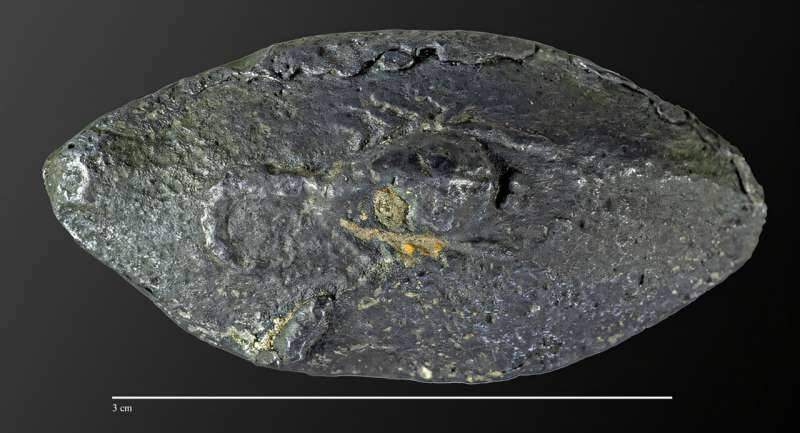
Michael Eisenberg/University of HaifaAnother example of a sling bullet found at Hippos, this one inscribed with a scorpion.
Sling bullets were a popular weapon in Hippos, as evidenced by the dozens of examples found in the area — but the exact origin of the inscribed sling bullet is difficult to pinpoint.
Hippos itself was founded by descendants of captains of Alexander the Great in 199 B.C.E. as part of the Decapolis (a confederation of 10 Hellenistic cities) following the Battle of Paneion. It was perched on the frontier of the Greek, then Roman, empire until Pompey’s conquest of Syria in 64 B.C.E.
As such, there are many possible battles in Hippos’ history where the sling bullet could have been fired.
“The inscribed bullet, as well as other slingshots found at the site, could have been used in any of the several battles during the Hellenistic period in which Hippos was involved,” the researchers wrote in their study. “The first was before the city’s establishment, during the Ptolemaic rule, when a fortress stood atop the hill.”
That said, researchers believe that the bullet was fired by a Greek defender, and that it was fired over the city walls toward the streambed. “This streambed route,” they noted, “is also the most convenient point of attack towards the city’s main gate on the east for any besieging forces.”
But though the circumstances of the bullet’s final battle remain lost, its final message rings clear through the centuries: “Learn your lesson!”
After reading about the 2,100-year-old sling bullet inscribed in Greek that was found in the Golan Heights, learn about the story of the Schwerer Gustav gun, the biggest gun in world history. Then, go inside the strange story of the Panjandrum, a wheel-weapon propelled by rockets that was designed during World War II, but was ultimately deemed too dangerous and unwieldy to use.