

Though chastity belts were supposedly worn by some women during the Middle Ages in order to ensure their fidelity to their husbands, the real history is not so straightforward.
During the Victorian Era, torturous metal devices went on display at museums across Europe accompanied by supposed historical accounts that identified them as chastity belts. They were exactly what they sounded like: padlocked contraptions that covered a woman’s nether regions to preserve her chastity and ensure that she remained loyal to her husband.
Stories had already been circulating for centuries about medieval knights locking their wives into such devices before they departed to fight in the Crusades, heading off to far-flung lands with keys in hand and the assurance that no infidelity would occur while they were gone. These tales may be captivating, if not simultaneously unsettling — but there’s no evidence that these types of chastity belts really existed, at least not during the Middle Ages.
The first historical reference to chastity belts appeared in 1405 in a manual about military technology written by German engineer Konrad Kyeser. A sketch of an uncomfortable metal belt was captioned, “These are hard iron breeches of Florentine women which are closed at the front… I recommend them to the noble and obedient youth.” However, Kyeser was known to include satire in his work, and no physical evidence of these devices has ever emerged from this time period.
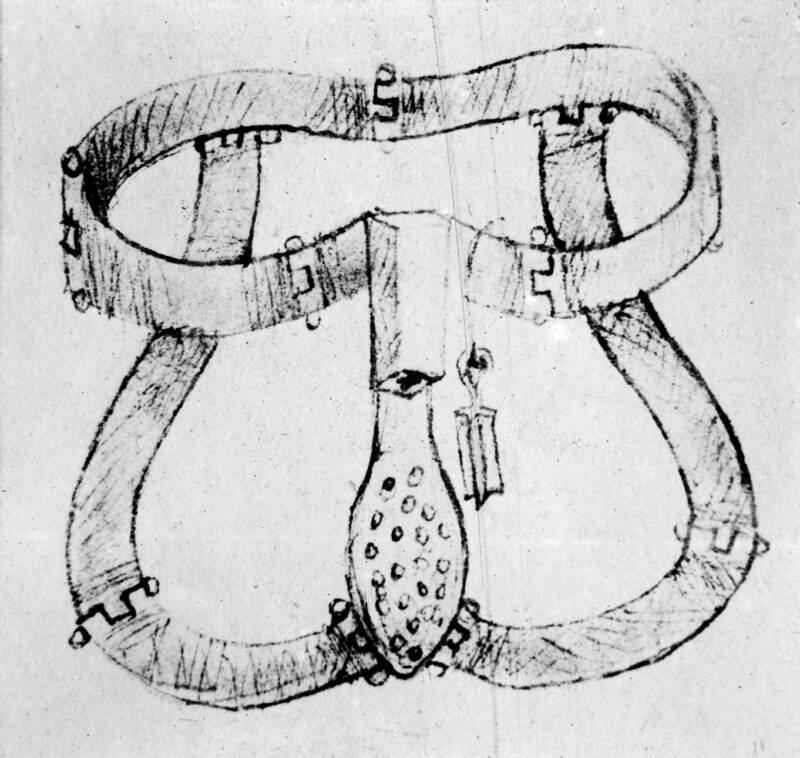
Wellcome ImagesKonrad Kyeser’s sketch of a chastity belt from his 15th-century manual Bellifortis.
In the 1990s, scientists tested a chastity belt at the Musée de Cluny in Paris that was said to have been worn by Catherine de Medici in the 1500s. Analysis revealed that it was actually created in the 19th century, throwing the authenticity of similar artifacts into question.
Historians have also pointed out that chastity belts wouldn’t have been practical. Knights going to war would have departed with hopes that they’d left behind an heir, and childbirth wouldn’t have been possible with an iron belt. Wearing the devices for extended periods of time would have also led to infections that progressed into sepsis and eventually death.
That said, patents for chastity belts were filed in the late 19th and early 20th centuries. But these devices weren’t meant to guarantee fidelity to one’s partner. Instead, they were designed for both male and female anatomy to prevent masturbation, which was believed at the time to cause both physical ailments and mental health issues.
During the same period, women who had to work outside of the home sometimes wore chastity belts to protect themselves from sexual assault. And in the modern world, they’re popular in certain BDSM communities. But for the most part, chastity belts as we think of them today didn’t exist.
The myth has been perpetuated by pop culture for centuries. A 16th-century woodcut shows a woman handing the key to her chastity belt to her husband as two men lurk behind her bed with a second key. And in the 1993 comedy Robin Hood: Men in Tights, Maid Marian sets out to find the man who holds the key that unlocks her belt. The movie ends with Robin Hood calling a locksmith — a joke that audiences would have found just as humorous 500 years ago.
Learn more about the music used in our podcast. History Uncovered is part of the Airwave Media network. Learn more about your ad choices by visiting megaphone.fm/adchoices.