
Whether it's "The Times They Are a-Changin'," "Blowin' in the Wind," or "Tangled Up in Blue," many of Bob Dylan's most enduring songs have important stories and historical meaning behind them.
In 1961, Robert Allen Zimmerman moved from Minnesota to New York City to pursue his love of music. Not long before leaving Minnesota, he’d taken on a stage name — one allegedly inspired by a character on the western TV show Gunsmoke — and began calling himself Bob Dylan. And before long, Dylan would be known across the world for his raspy voice, evocative lyrics, and generation-defining songs, many of which became some of the 1960s most beloved anthems.
Still, it took a while for Dylan to become well-known outside of New York, or even within it. His self-titled debut album came out in 1962, containing a handful of original songs and several covers of popular folk tunes. Though the album wasn’t a hit, it sold fairly well and even earned Dylan a Grammy nomination for Best Folk Recording. But things really took off for Dylan in 1963.
It was then that he released The Freewheelin’ Bob Dylan, which contained one of his most iconic songs, “Blowin’ in the Wind.” The next year, Dylan further solidified his burgeoning “voice of a generation” reputation as he reflected on America’s rapidly changing political landscape with his album, The Times They Are a-Changin’.
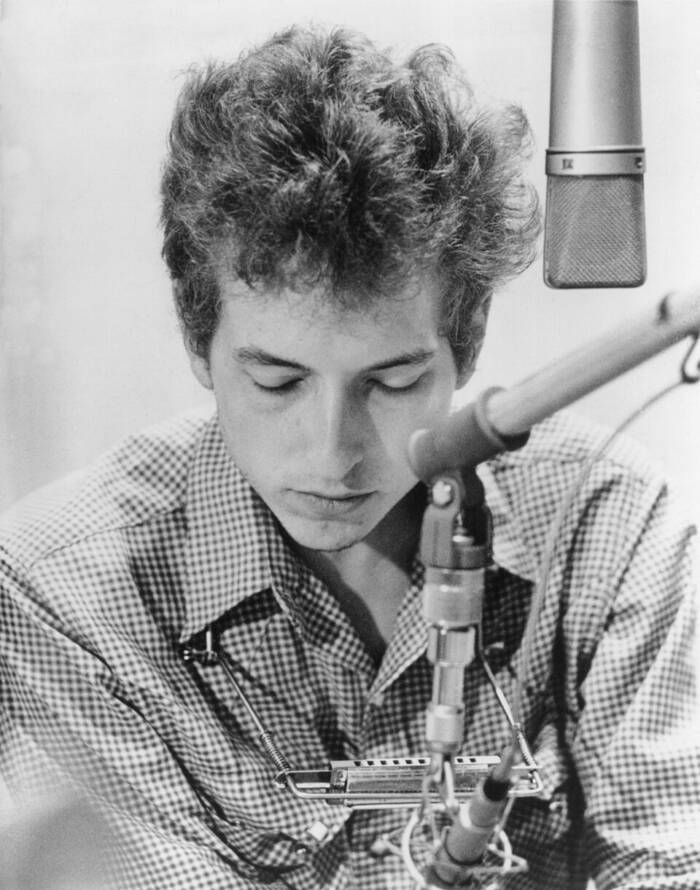
Wikimedia CommonsBob Dylan in 1963, the year his career reached new heights thanks to the success of his album, The Freewheelin’ Bob Dylan.
Indeed, the United States in 1964 was a very different country from the one that it had been just a few years earlier, when Dylan was still in Minnesota. The Civil Rights Movement was gaining steam, the conflict in Vietnam was expanding — as were protests against it — and the assassination of President John F. Kennedy on November 22, 1963 had left the entire nation in shock. Dylan’s music, poetic and unafraid to engage with politics, rose up and met the changing times.
That said, many of Dylan’s most beloved songs only gained historic meaning in retrospect. Look no further than “Blowin’ In The Wind” — which Dylan claims is not a protest song at all. Dylan, who allegedly wrote the song in just 10 minutes, introduced it with a major caveat when he played it for the first time in New York City, saying: “This here ain’t no protest song or anything like that, ’cause I don’t write no protest songs.”
Despite this, a line like “How many roads must a man walk down, before you call him a man?” certainly seems like a clear reference to the Civil Rights Movement, especially because both Dylan and the folk group Peter, Paul and Mary sang the song during the 1963 March on Washington.
That said, some songs of Dylan’s do have backstories; even though others remain vague, or were later given significance by listeners that Dylan never articulated himself. But like the famous folk song “Tom Dooley,” many of Dylan’s songs were based on real-life events, from the murder of civil rights activist Medgar Evers to the imprisonment of boxer Rubin “Hurricane” Carter.
Today, we’re digging into the meaning behind those songs and more of Bob Dylan’s most celebrated records, from “The Times They Are a-Changin'” to “Tangled Up in Blue.”
Learn more about the music used in our podcast. History Uncovered is part of the Airwave Media network. Learn more about your ad choices by visiting megaphone.fm/adchoices.