Made sometime between 550 and 123 B.C.E. and measuring just 1.2 inches in length, this tiny relic was likely a product of the post-Talaiotic culture.
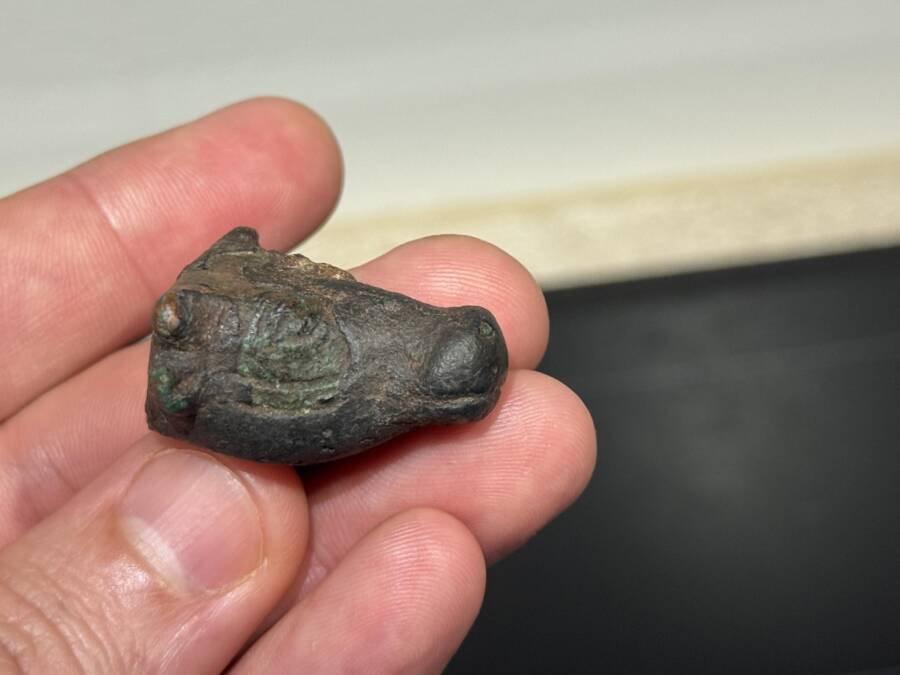
Almallutx: ArqueoTramuntana/FacebookThe bull’s head figurine was found completely by chance — some 2,200 years or more after it was made.
While hiking in the Serra de Tramuntana mountain range on the Spanish island of Mallorca, a man happened to spot a tiny object. It soon became clear that he’d stumbled upon a bronze bull’s head figurine that archaeologists believe is at least 2,200 years old.
This tiny artifact — an incredibly rare and surprising find — remains somewhat mysterious. However, archaeologists say it bears some resemblance to other, more famous depictions of bulls found in the region, including a set of life-sized bronze bull heads from roughly the same period.
The Chance Discovery Of An Ancient Bull’s Head Figurine In Mallorca’s Serra de Tramuntana Mountains
According to reporting from Diario de Mallorca, the tiny bronze bull’s head was indeed found entirely by chance. A hiker in the Serra de Tramuntana mountain range happened to spot the artifact on a trail near the village of Valldemossa. The hiker asked friends if they knew any archaeologists, and ultimately got in touch with researcher and historian Jaume Deyà, who passed the artifact to the Consell de Mallorca (Mallorca Council).
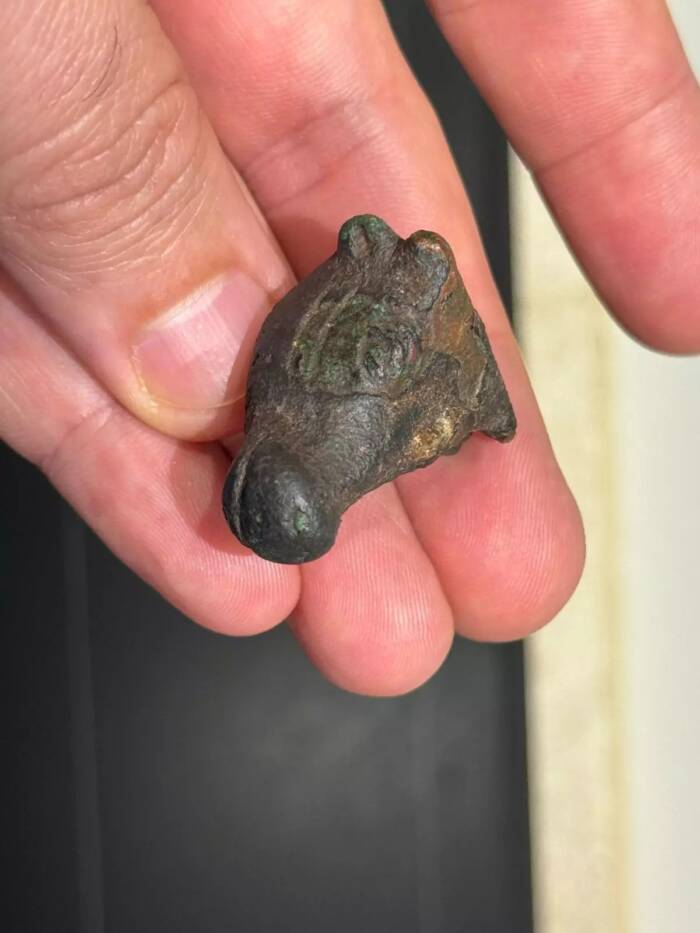
Jaume DeyàThe bull’s head is believed to date back to at least 123 B.C.E.
Archaeologists believe that the bull’s head dates back to between 550 and 123 B.C.E., an era known as the post-Talaiotic period. Small enough to be held in the palm of the hand, the artifact is just 3.2 centimeters long, 1.7 centimeters tall, and 2.9 centimeters wide.
“The finely carved details make it very special,” Deyà explained to Diario de Mallorca. “It stands out for its well-achieved proportions and the features of the horns, ears, muzzle, and eyes, as well as some incisions intended to highlight the animal’s features.”
Deyà suspects that the bull’s head could have once been part of a “larger element.” It could have been the head of a statue, for example, or perhaps a “decorative motif” placed on a larger bull’s horn. Indeed, there is a small hole in the back of the piece, which suggests that it was originally connected to something else.
And while questions about the bull’s head remain, Deyà believes that it may have a connection to a group of more famous Spanish bull artifacts from antiquity.
How This Bronze Age Bull’s Head May Connect To Other Artifacts Found In Spain
Bulls have long been an important animal in Spanish culture, and Deyà suspects that the bull’s head found in Serra de Tramuntana may have a connection to a set of other bull artifacts found in the Mallorcan town of Costitx. Discovered in the late 1800s, these three, life-size bronze bull heads date back to sometime between 550 and 200 B.C.E., roughly the same era as the newly-uncovered bull’s head.
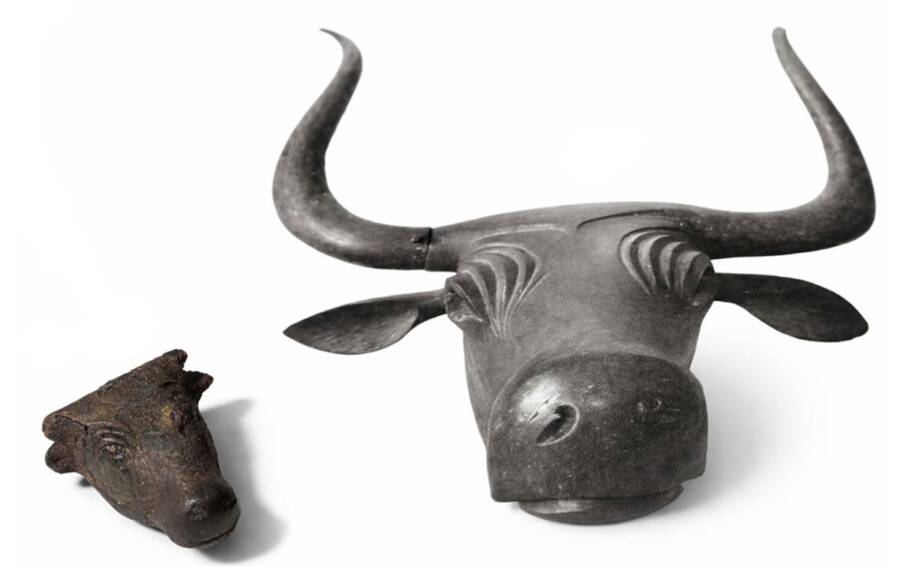
Jaume DeyàThe small bull’s head bears some resemblance to the Costitx bulls, one of which is seen on the right above.
According to Deyà, the smaller bull’s head bears a strong resemblance to two of the Costitx bulls, although its horns and ears are much smaller.
“It’s as if we were looking at a representation of the head of a young bull or heifer,” Deyà remarked.
If the artifacts are connected, the Costitx bulls may offer some hint about the origin and purpose of the smaller bull’s head. They’re thought to be depictions of a deity, or perhaps connected to the ancient practice of bull worship, found everywhere from Sumeria to Canaan. And the recently-discovered bull’s head could fit into this interpretation as well.
Regardless of its original meaning, however, the newly-uncovered bull’s head is indisputably an important find. As Deyà told Diario de Mallorca, three similar artifacts have documented, but have since vanished. What’s more, these bull’s heads were all unearthed more than 50 years ago, with nothing similar found since. The bull’s head discovered in Serra de Tramuntana is thus an incredibly rare find.
Indeed, Deyà is hopeful that this stunning relic could lead archaeologists to other discoveries in these mountains. As he explained to Diario de Mallorca, he’s asked the Mallorca Council to conduct an archaeological survey of the area where the hiker found the bull’s head in hopes of uncovering other similar artifacts from the region’s ancient past.
After reading about the tiny bronze bull’s head found by a hiker on a trail in Spain, discover the gruesome story of champion matador Víctor Barrio, who was gored by a bull on live TV. Then, learn about the Brazen Bull, the legendary torture device that was allegedly used in ancient Greece.