From August to October 1720, Mary Read fought with the crew of "Calico Jack" Rackham while disguised as a man before she was captured and died in prison.
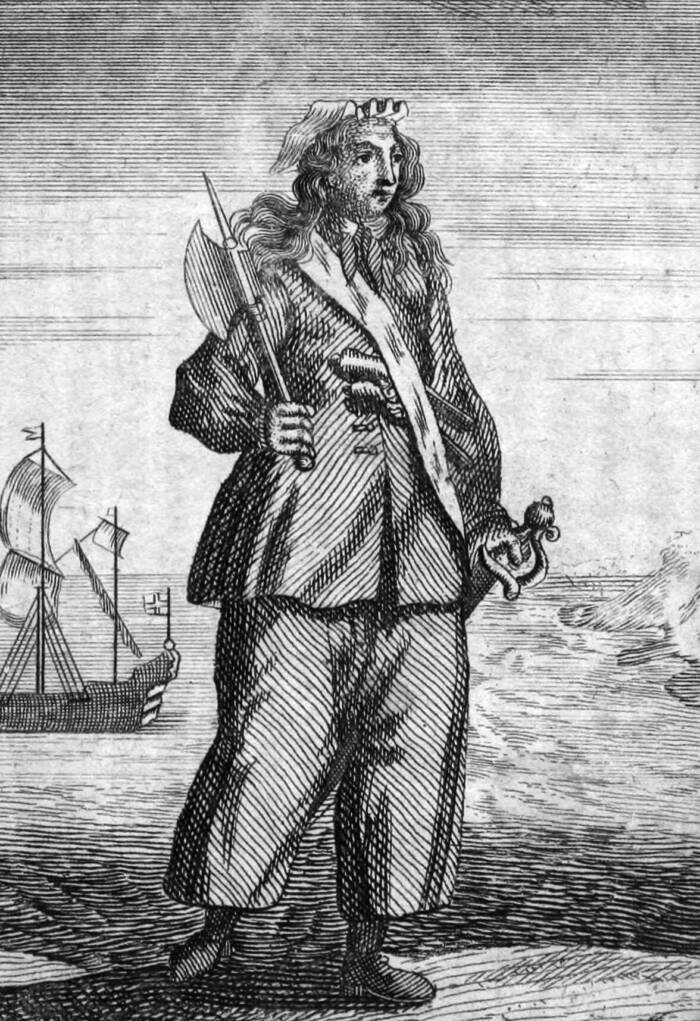
An 18th-century engraving of Mary Read from Captain Charles Johnson’s A General History of the Pyrates.
The years between 1650 and 1730 are often referred to as the “Golden Age of Piracy.” Notorious buccaneers like Stede Bonnet, Captain Kidd, and Blackbeard terrorized the high seas. But there was another — perhaps unexpected — pirate working in the Caribbean during that time: Mary Read.
Little is known about Read’s life before piracy, but she was born in England and had made her way to the Bahamas by August 1720. There, she joined the crew of “Calico Jack” Rackham alongside another female pirate, Anne Bonny.
Despite her lasting infamy, Read’s career lasted just two months. She was captured along with the rest of Rackham’s crew in October 1720 and sentenced to death. She claimed that she was pregnant, and her execution was delayed, but she died behind bars the following April anyway.
Mary Read may have faded from history if it weren’t for Captain Charles Johnson, who published A General History of the Pyrates in 1724. Although the text is unreliable and likely fabricated much of Read’s story, it led to countless adaptations of Read’s tale, cementing her legacy as one of the most fearsome swashbucklers of the Golden Age of Piracy.
Mary Read’s Life Before Piracy
The only information about Mary Read’s early life comes from A General History of the Pyrates, which contains questionable facts. In the book, Captain Charles Johnson claims that Read was born in England to a single mother whose husband had vanished at sea, leaving her with a young son. The son died, and Mary was born shortly after to an unknown father.
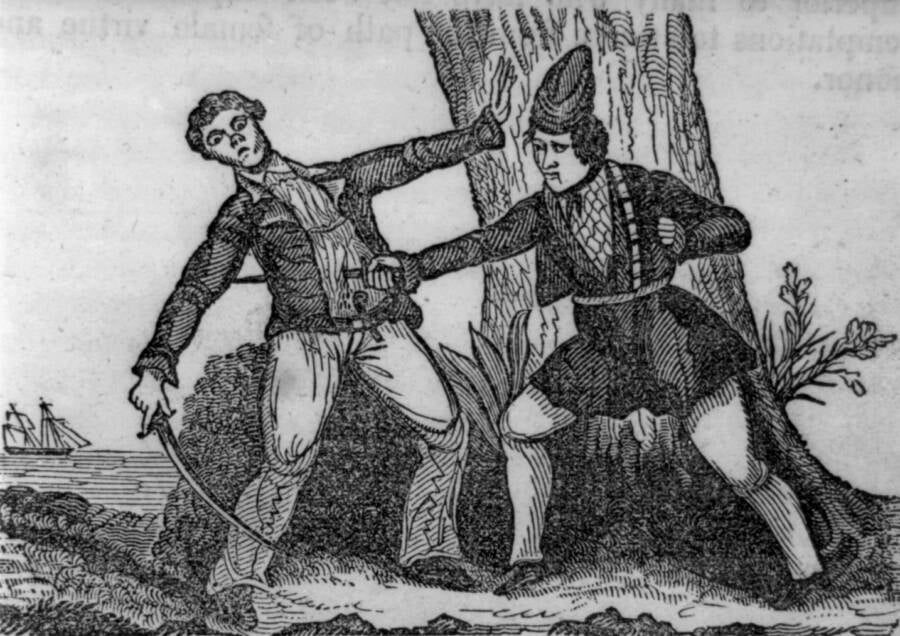
Public DomainA 19th-century depiction of a duel between Mary Read (right) and an unidentified man.
To keep receiving money from her former mother-in-law, Mrs. Read disguised young Mary as the legitimate son who had died, dressing her in boy clothes throughout her childhood. As the story goes, Mary Read continued wearing male clothing into adulthood, ultimately enlisting in the British army.
Johnson claimed that Read then fell in love with a fellow soldier, married him, and opened a tavern. When he died, Read decided to seek a fresh start, and she boarded a ship for the West Indies.
The Fearsome Female Pirate Of The Caribbean
After reaching the Bahamas, Read — still disguised as a man — joined the crew of John “Calico Jack” Rackham. Like Read, Rackham doesn’t appear in historical records until the summer of 1720. He’s known to have captured a series of fishing boats in addition to several larger vessels.
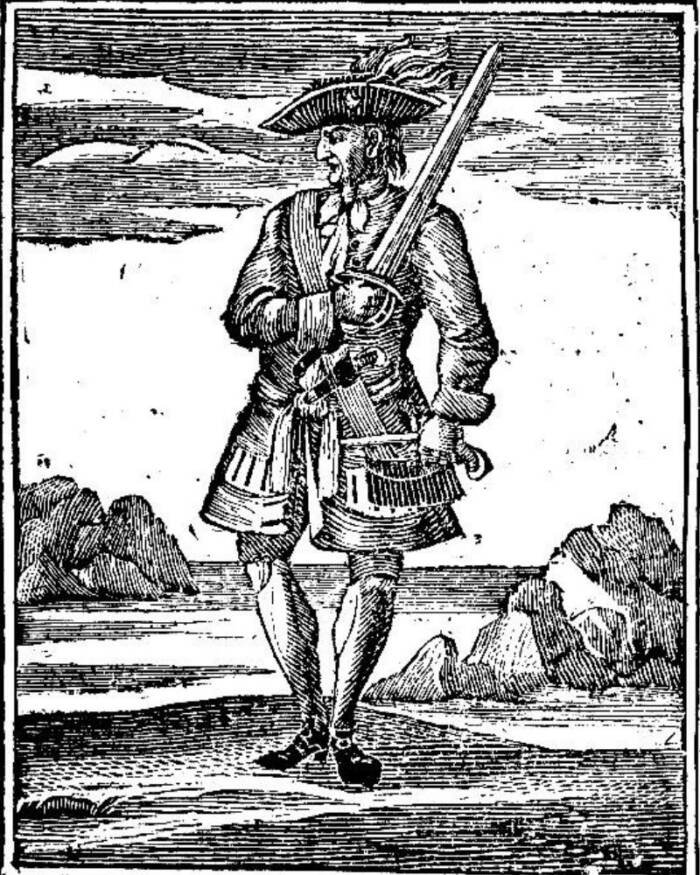
Public DomainPirate captain Calico Jack was active in the Caribbean until he was captured and hanged at Port Royal, Jamaica, in November 1720.
Read also became close friends with Anne Bonny, another female pirate onboard Rackham’s ship. According to Johnson, however, Bonny didn’t initially realize that Read was a woman:
“Anne Bonny took her for a handsome young Fellow, and for some Reasons best known to herself, first discovered her Sex to Mary Read; Mary Read knowing what she would be at, and being very sensible of her own Incapacity that Way, was forced to come to a right Understanding with her, and so to the great Disappointment of Anne Bonny, she let her know she was a Woman also.”
Rackham was reportedly so disturbed by their intimacy — as he was Bonny’s lover — that he threatened to slit Read’s throat, so she had to reveal her secret to him, too.
Over the next two months, Rackham, Bonny, Read, and the rest of the crew terrorized the Caribbean. On August 22, 1720, they stole a sloop in Nassau. This crime led the governor of the Bahamas, Woodes Rogers, to release a proclamation naming Mary Read and demanding her arrest. As such, Read’s true identity was clearly not as secret as Johnson made it out to be in his narrative.
The remainder of Read’s life is fairly well-documented — because it was spent behind bars.
The Fall Of Mary Read And Her Enduring Legacy
By October, the law had caught up to Rackham’s crew. A privateer named Jonathan Barnet tracked them down off the coast of Jamaica, where they were celebrating a recent payday by drinking rum. Legend has it that Mary Read and Anne Bonny single-handedly battled Barnet’s men because their male counterparts were too intoxicated to fight.
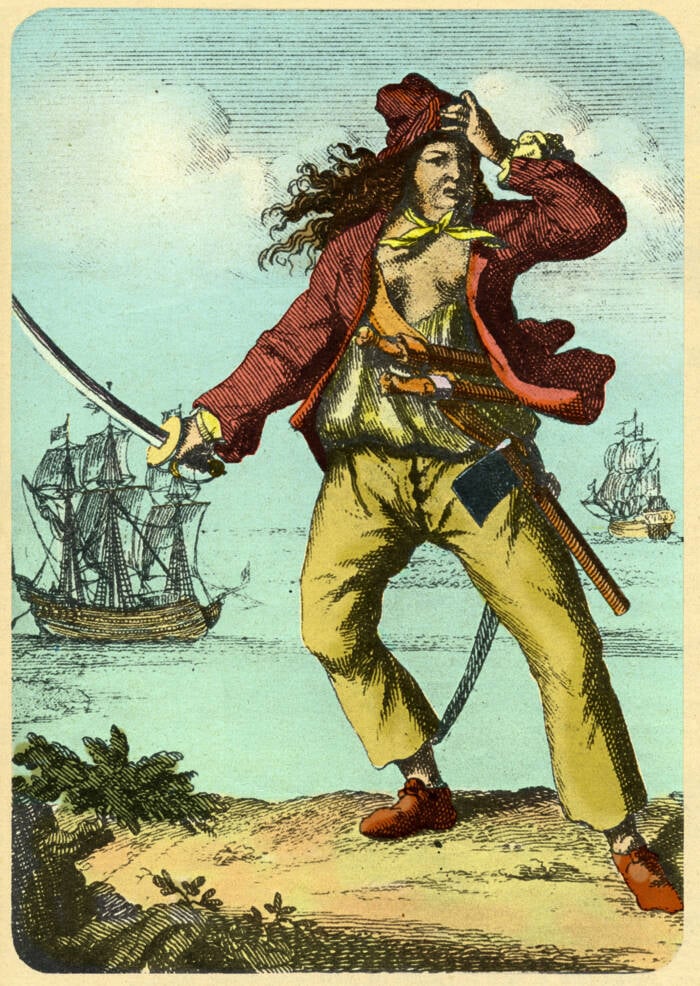
Public DomainMary Read purportedly disguised herself as a man to join the crew of “Calico Jack” Rackham in 1720.
In the end, the entire crew was arrested. Mary Read’s trial was recorded in The Tryals of John Rackham and Other Pirates in 1721. She faced charges for “Piracies, Felonies, and Robberies committed… on the High Seas.”
One of the victims of Rackham’s crew, Dorothy Thomas, gave a witness deposition speaking of the ferocity of Mary Read and Anne Bonny. Thomas stated:
“That the Two Women, Prisoners at the Bar, were then on Board the said Sloop, and wore Men’s Jackets, and long Trousers, and Handkerchiefs tied about their Heads; and that each of them had a Machet and Pistol in their Hands, and cursed and swore at the Men, to murder the Deponent; and that they should kill her, to prevent her coming against them; and the Deponent further said, That the Reason of her knowing and believing them to be Women then was, by the largeness of their Breasts.”
Two Frenchmen who were aboard a vessel that was taken by Rackham’s crew also testified that Read and Bonny “were very active on Board, and willing to do any Thing… That they did not seem to be kept, or detain’d by Force, but of their own Free-Will and Consent.” In addition, witnesses noted that Read and Bonny “were both very profligate, cursing and swearing much, and very ready and willing to do any Thing on Board.”
In the end, all of the pirates were sentenced to death, but Bonny and Read both claimed to be pregnant. So, while Rackham and the other men were hanged, Bonny and Read were imprisoned to await a later execution.
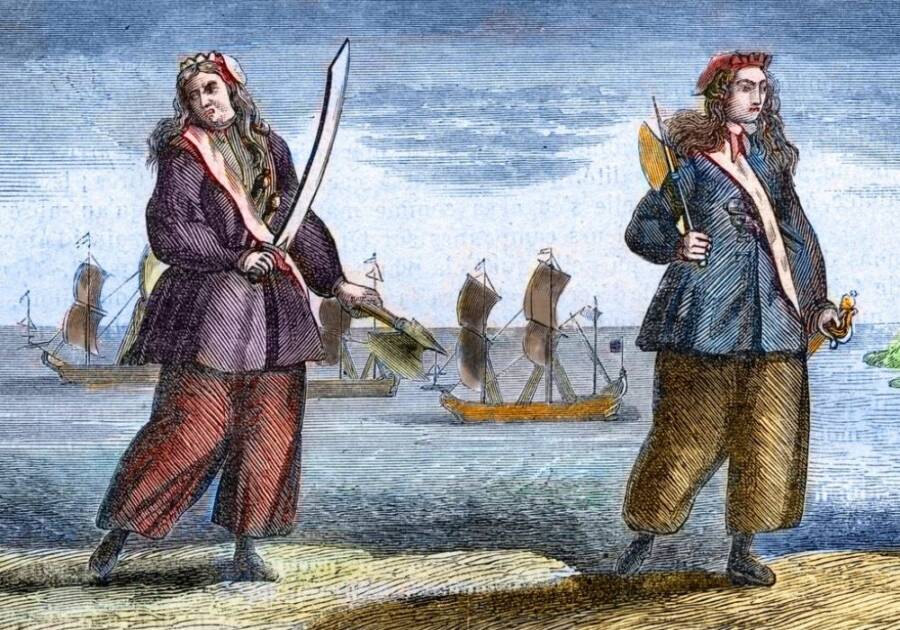
Public DomainMary Read (right) and Anne Bonny (left) were both members of Calico Jack’s crew.
Mary Read died behind bars in April 1721. Johnson wrote that “she was seiz’d with a violent Fever,” but her true cause of death is unknown. She was buried in Spanish Town, Jamaica. There are no records of her child’s burial, so she either died before the baby was born or had never been pregnant at all.
In the centuries since her death, Read’s story has been retold in countless books. She also appears in the video game Assassin’s Creed IV, as well as several movies and television shows. Today, Mary Read is one of history’s most famous pirates — despite the fact that she only sailed the high seas for two months.
After learning about the exploits of Mary Read, check out the story of Ching Shih, China’s famed female pirate lord. Then, read about Henry Avery and history’s most lucrative pirate raid.