Found inside a ceramic vessel tucked away in a second-floor vault, these coins were likely hidden during Russia's Time of Troubles, the period of political instability that defined the turbulent turn from the 16th century into the 17th.
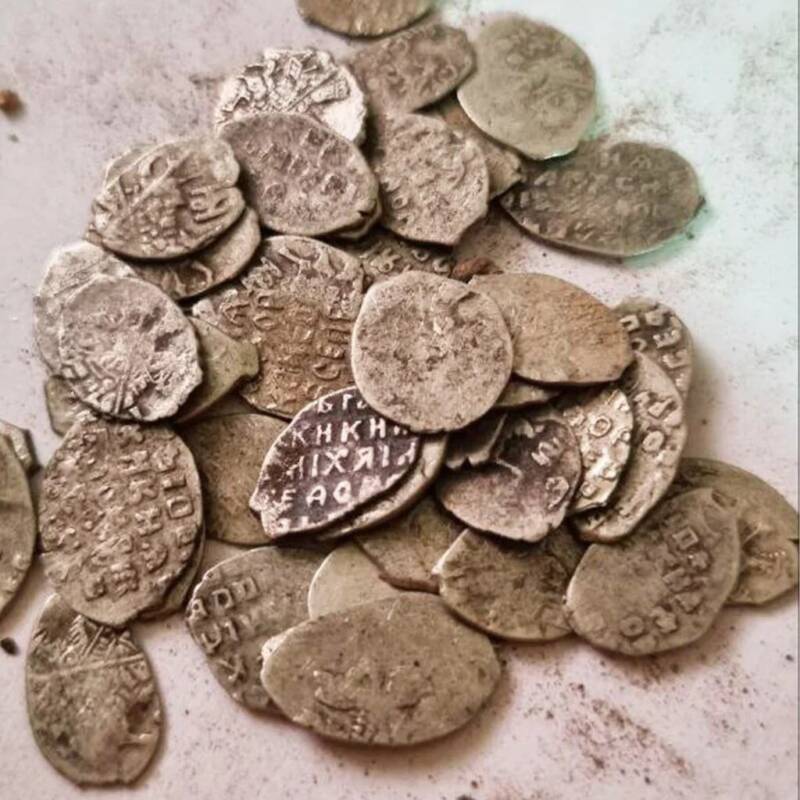
Olga Lyubimova/TelegramThis discovery has been hailed as one of the most significant coin hoards found in Russia in recent years.
During restoration work at the historic home of 17th-century merchant Averky Kirillov in Moscow, archaeologists opened up a ceramic vessel and came across nearly 20,000 silver coins. This astounding hoard is not only an incredible numismatic discovery, it also helps shed light on an especially turbulent and pivotal period in Russian history.
Nevertheless, many questions remain about who originally owned the coins, how they fell into the hands of Kirillov, and why they were hidden away in his opulent Moscow home roughly 400 years ago.
The 20,000 Silver Coins Found In The Historic Home Of Averky Kirillov
According to an announcement from Olga Lyubimova, Russia’s Minister of Culture on Telegram, the coin hoard was found during restoration work at merchant Averky Kirillov’s home, which Kirillov constructed in the 17th century along the Bersenevskaya Embankment near the center of Moscow.
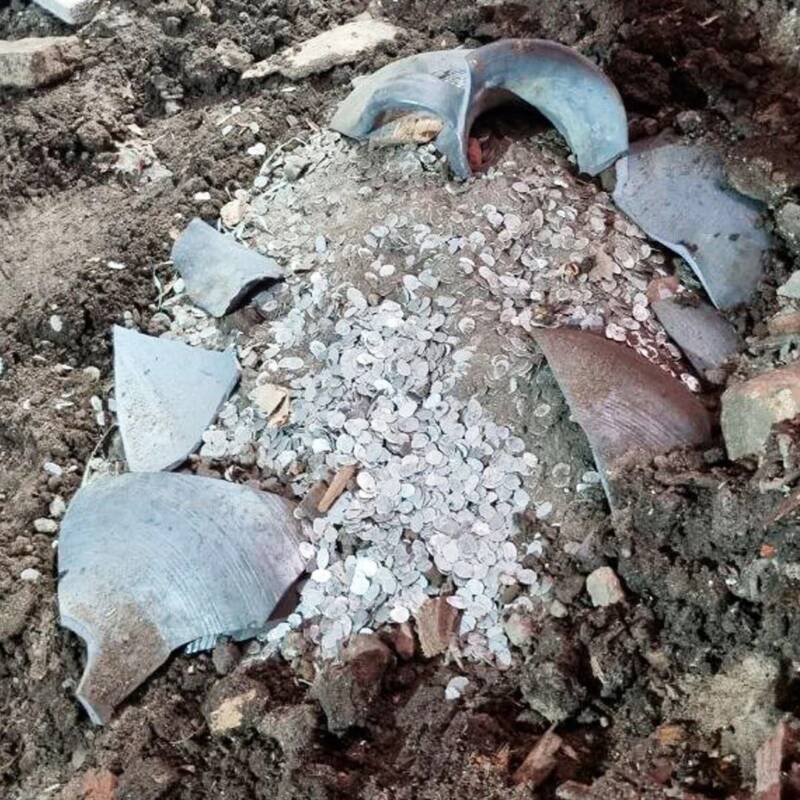
Olga Lyubimova/TelegramThe coins were found in a ceramic vessel on the second floor of Averky Kirillov’s historic home in Moscow.
The 20,000 coins were hidden inside a ceramic vessel on the second floor of the building, and have been preliminarily dated to the late 16th and early 17th centuries. However, experts are still examining the markings on the coins.
Such markings will be a valuable data point, as coins from this era were often simultaneously issued by various parties that were claiming power at the same moment. And the era when the coins were minted was a tumultuous one indeed, which may explain why they were hidden in Averky Kirillov’s home in the first place.
Why Did The Coins End Up In Averky Kirillov’s Home Following The Time Of Troubles?
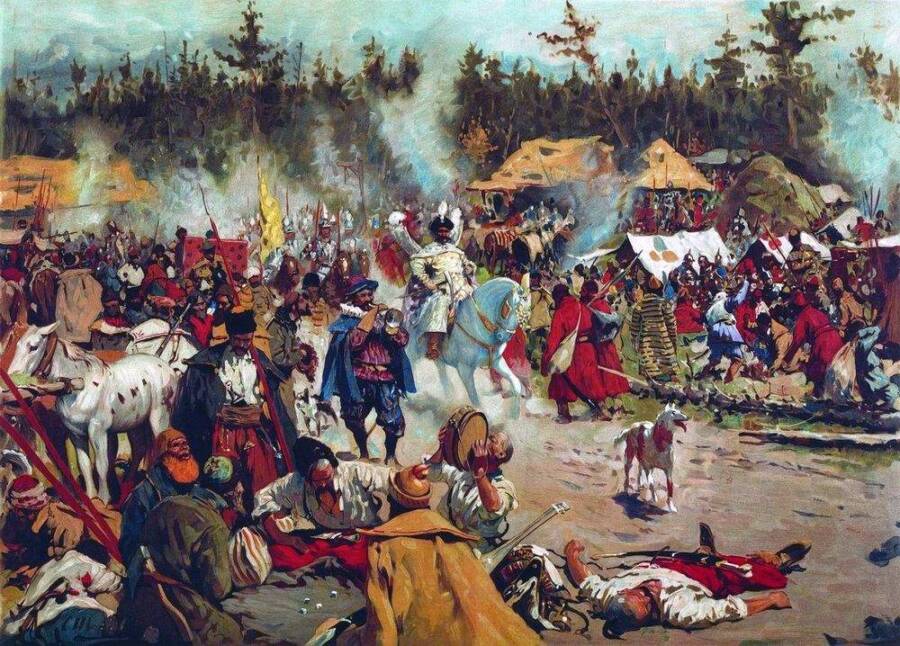
Public DomainA 20th-century depiction of Russia’s Time of Troubles, an era of political violence and famine that killed as many as 1 million people.
Though the 20,000 coins found in Kirillov’s home still need to be studied, experts believe for the moment that they were minted during the late 1500s and early 1600s. This was an especially tumultuous period of Russian history known as the Smutnoye vremya, or the Time of Troubles.
This period began in 1598, when the ineffective ruler Feodor I, the son of Ivan the Terrible, died without an heir. He was the last of the Rurik dynasty, which had ruled Russian since the 9th century, and his death left a power gap that many factions rushed to fill. Feodor’s father had infamously killed Feodor’s older brother, Ivan, in 1581, but false rumors spread that Feodor’s younger brother was still alive, prompting many to claim to be this “lost” heir to the Rurik dynasty.
The political upheaval led to widespread violence. And this, combined with a famine that began at the beginning of the 17th century and lasted for three years, killed up to a million people. Conditions didn’t stabilize until 1613, when Michael Romanov became tsar and established the Romanov dynasty. The Romanov dynasty, of course, lasted until 1917, when the tsar and his family were toppled during the Russian Revolution.
It was during this era of political upheaval, violence, and famine, that the coins appear to have been minted. So how did they end up in Averky Kirillov’s home in Moscow? Experts think there are several possibilities.
Kirillov is thought to have acquired the home, then a wooden property, around 1656. He replaced it with the striking red, two-story stone building that stands there today. Experts think that the coins could represent Kirillov’s personal savings, or that the hoard was merchant capital stored during a period of political unrest, or that it had been collected for trade or taxation purposes, but never collected — possibly because its owner was exiled or killed.
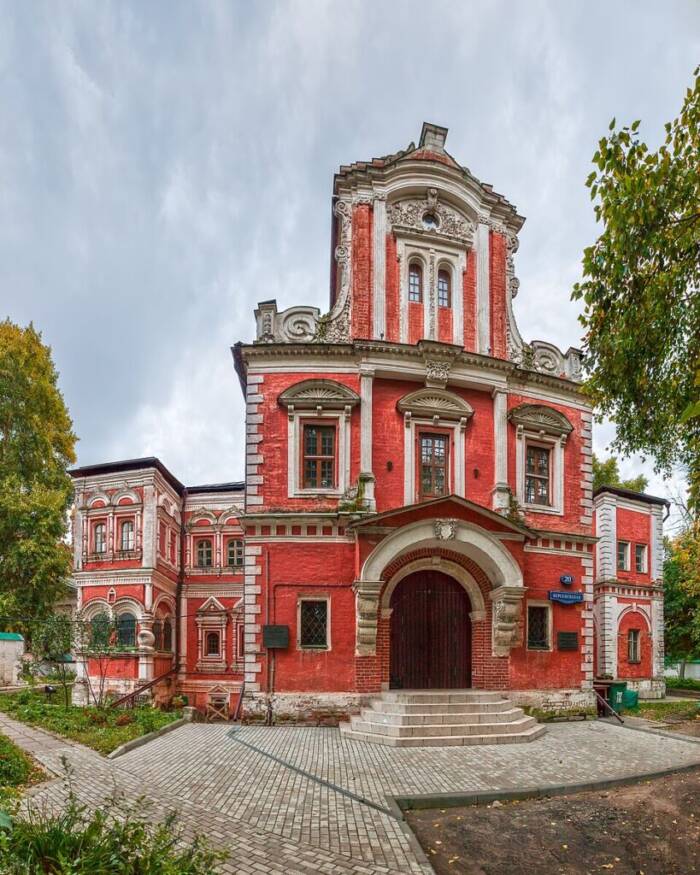
Wikimedia CommonsRussian merchant Averky Kirillov’s historic home along the Bersenevskaya Embankment in Moscow.
While many questions thus remain about the coin hoard found in Averky Kirillov’s home, future study will assuredly provide more answers about when the coins were made, and to whom they belonged. Hopefully that will in turn shed more light on why and when they were hidden — and how this treasure trove remained forgotten for the past several centuries.
After reading about the hoard of 20,000 silver coins that were found in the Moscow home of merchant Averky Kirillov, discover the astounding story of the Lykov Family, which fled their village in Russia in 1936 and spent the next four decades living in total isolation in the wilderness. Then, look through these photos of life in Oymyakon, Russia, the coldest inhabited place on Earth.