Nancy Hart was a mother of eight who allegedly disguised herself as a man, spied on Tory camps, and shot multiple Loyalist soldiers from her cabin in the backcountry of northern Georgia during the Revolutionary War.
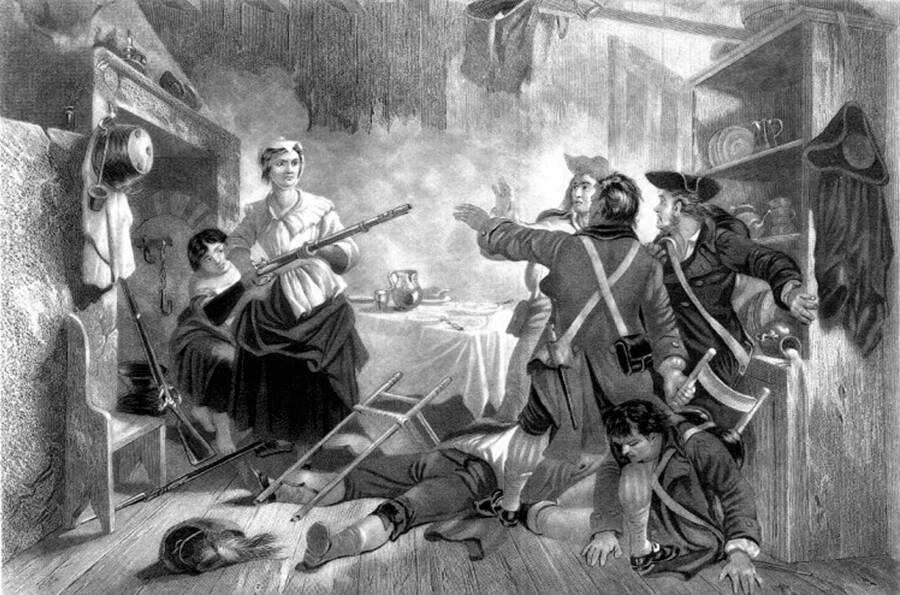
Science History ImagesA depiction of Revolutionary War patriot Nancy Hart.
If legend is to be believed, the most fearsome patriot in Georgia during the American Revolution was not a soldier — or even a man. Instead, it was a pioneer woman named Nancy Hart, whose fearless service on behalf of the nascent United States has become the stuff of myth.
Said to stand six feet tall with red hair and crossed eyes, Hart purportedly spied on the British, passed on intelligence, and even killed Loyalist soldiers. She’s become one of the most famous women in Georgia history and has been honored with several monuments in the South.
But how much of Nancy Hart’s story is actually true? This is everything we know about the famous Georgia patriot.
An American Patriot Born On The Frontier
Born around 1735, Nancy Morgan Hart grew up in the Yadkin River Valley in North Carolina. Little is known about her early life, though many accounts state that Nancy stood six feet tall and had red hair, crossed eyes, and skin scarred by smallpox. According to the New Georgia Encyclopedia, one early account of Hart stated that she had “no share of beauty — a fact she herself would have readily acknowledged, had she ever enjoyed an opportunity of looking into a mirror.”
Nancy married a man named Benjamin Hart in 1760. Benjamin worked with Nancy’s father for several years on legal matters like wills and land transfers. Then, in the early 1770s, Benjamin and Nancy Hart moved to Georgia.
There, the couple settled along the Broad River. Hart soon gained a reputation among local Native Americans, who allegedly noticed her fierce attitude and domineering personality and dubbed her “Wahatche,” which may have meant “war woman.” A talented herbalist and hunter, Hart seemed well-suited for frontier life, and she and her husband raised eight children in their small log cabin.
At the same time, the Hart family had begun to witness the slow birth of what would become the United States.
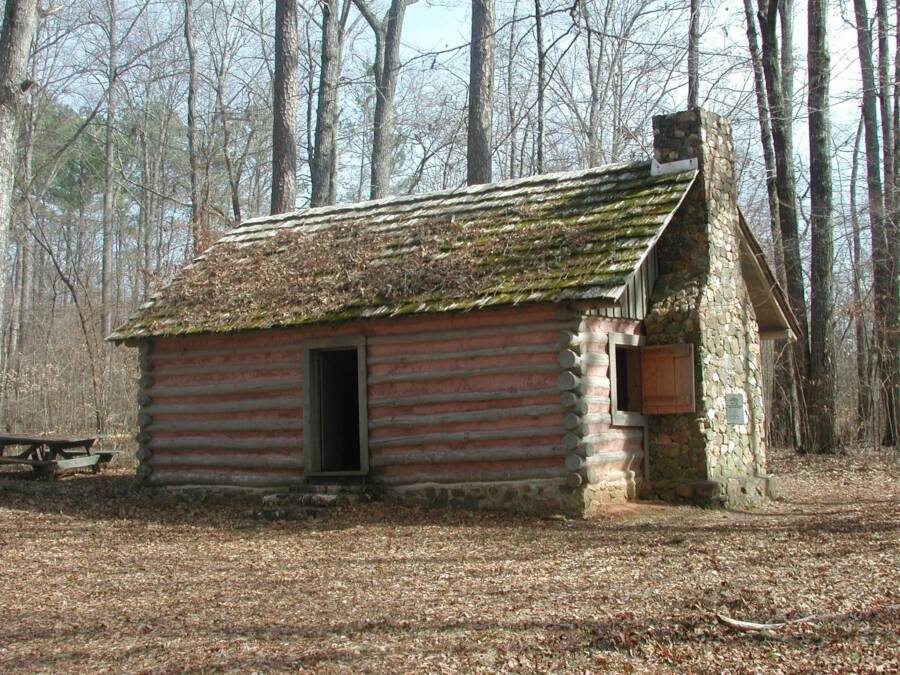
Elbert County Chamber of CommerceA replica of Nancy Hart’s cabin in Georgia, which was rebuilt in the 1930s after it was destroyed by floods.
Tensions between the American colonies and the British had increased since the Seven Years’ War (1756 to 1763), which had plunged the British into debt. The British attempted to alleviate this debt through a number of unpopular taxes on the colonists, including the Stamp Act (1765), the Townshend Acts (1767), and the Tea Act (1773). These tensions led to events like the Boston Massacre in 1770, the Boston Tea Party in 1773, and, eventually, the outbreak of the Revolutionary War between the British and the colonists in 1775.
In Georgia, the Harts swiftly threw their support behind the American cause. Benjamin joined the Georgia militia, leaving Nancy to take care of their farm and children. But Nancy Hart wasn’t content to sit back and let the men fight for independence. She wanted to play her own role in the conflict.
Nancy Hart During The Revolutionary War In Georgia
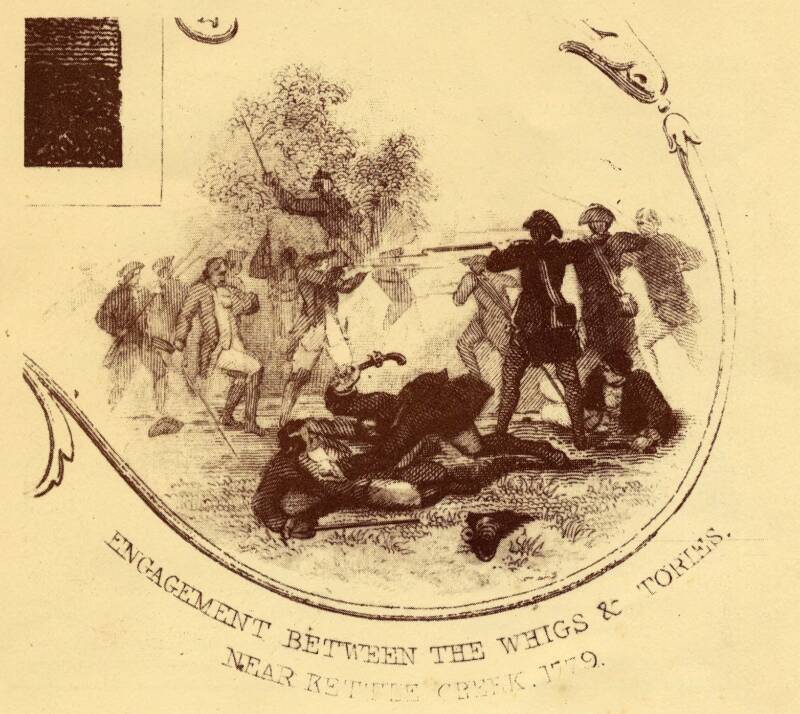
Kettle Creek Chapter of the National Society Daughters of the American RevolutionA depiction of the Battle of Kettle Creek in February 1779, which some believe Nancy Hart witnessed.
Many of Nancy Hart’s exploits during the Revolutionary War have been retold so many times that they’ve become myth, with the truth of her actions difficult to determine. But according to oral tradition, Hart played an active — and sometimes violent — role in the American Revolution.
She purportedly disguised herself as a mentally ill man and wandered through the British camps, picking up intelligence. She may have also been present at the Battle of Kettle Creek on Feb. 14, 1779, though it’s unclear if Hart — a talented hunter — participated in the battle, which ended in a British defeat. Regardless, Nancy Hart fiercely defended her homestead.
On one occasion, one of Hart’s children alerted her that a Loyalist was spying on the family through a hole in the wall. Hart, who was making soap at the time, allegedly filled a ladle with the boiling liquid and flung it through the hole, scalding the man’s face. Some sources state that Hart tended to the soldier’s wounds before he was taken prisoner.
Her most famous moment also occurred at the family cabin. In the summer of 1779, a group of five or six Loyalist troops descended on the Hart homestead in search of a Patriot soldier. When Nancy Hart refused to tell them if she had seen the man (she purportedly had, just minutes earlier), they killed her prized turkey and demanded that she cook it for them. Hart calmly obliged, and she also offered them copious amounts of alcohol. Meanwhile, as the soldiers became more inebriated, she quietly instructed one of her daughters to sound the alarm.
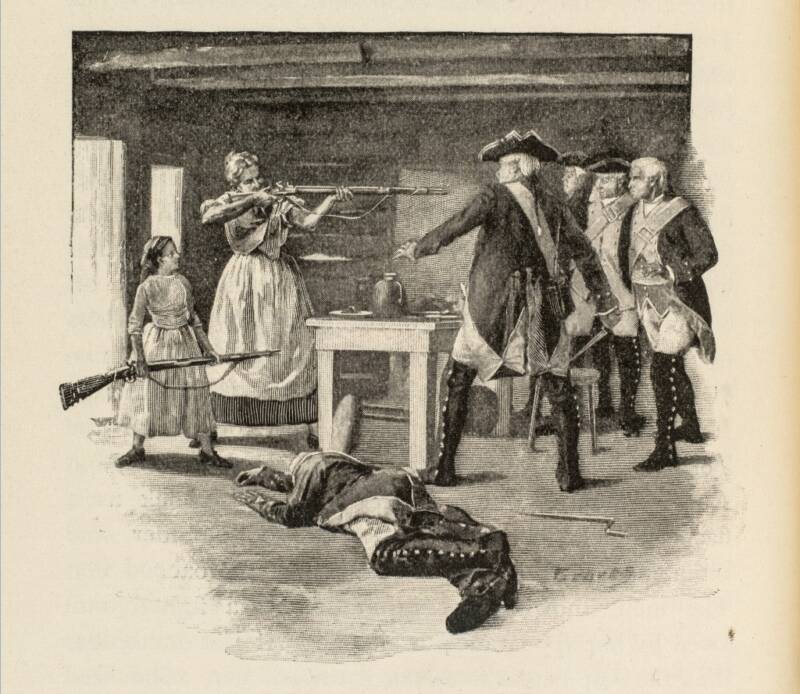
New York Historical Society LibraryNancy Hart’s most famous moment came in 1779, when she supposedly single-handedly took a group of Loyalist soldiers hostage.
Then, as the soldiers continued to drink, Hart started to sneak their weapons out of the cabin. When one of the soldiers noticed what she was doing, Nancy Hart killed him — and took the others as hostages, potentially shooting a second man in the process.
The remaining Loyalists were then hanged by the local militia. And in 1912, several bodies were reportedly found buried near the Hart homestead in Georgia, lending credence to the story.
The Enduring Legend Of Nancy Hart
After the Revolutionary War ended, Benjamin and Nancy Hart moved their family to Brunswick, Georgia, near the coast. There, the family thrived. By 1794, the Harts owned 50 acres and had 15 enslaved workers. When Benjamin died in 1801, Hart moved in with one of her sons in Kentucky. It’s unknown when she died, but it was probably sometime before the 1820s (though some believe that she lived until 1830).
Around the time of her death, the story of Nancy Hart appeared in print for the first time. In 1825, a local newspaper in Milledgeville, Georgia, published a story about her, which was subsequently reprinted across the South. But because the narrative appeared so long after the Revolutionary War — and because Hart was never honored during her life — some believe that many of the tales about her are more myth than fact.
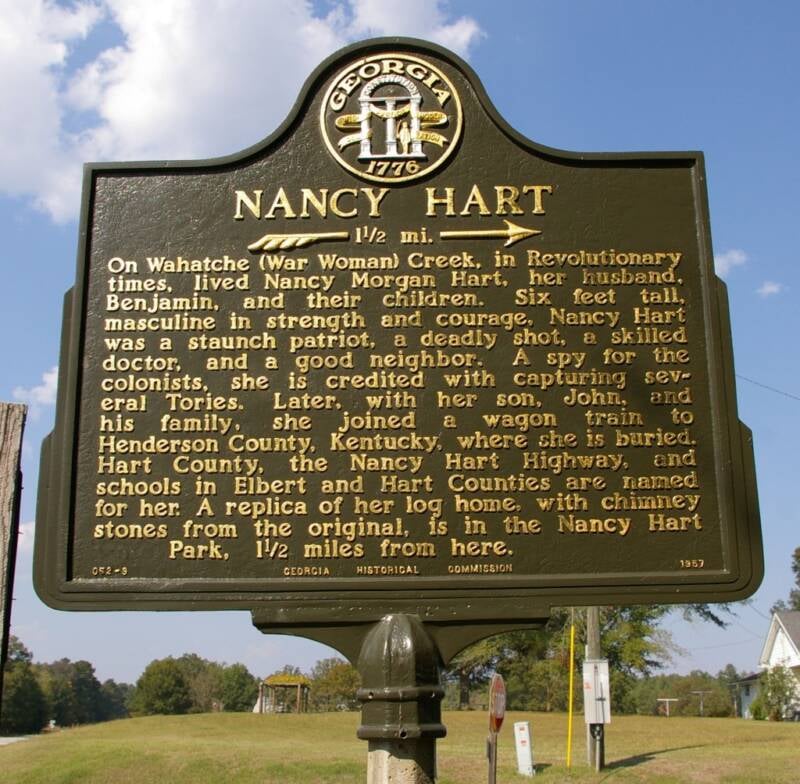
Georgia Historical SocietyA historical marker in Georgia commemorating the life and deeds of patriot Nancy Hart.
Regardless of the truth, however, Nancy Hart has become a folk hero in the South. During the Civil War, women in Georgia formed a militia that was named after Hart. The state of Georgia has given her name to counties, a park, a lake, and a highway. And after the Hart cabin was destroyed in a flood, the Daughters of the American Revolution rebuilt it. In 1997, Nancy Hart was also inducted into the Georgia Women of Achievement.
So, is the story of Nancy Hart true? Certainly, someone named Nancy Hart existed during the Revolutionary War, and evidence like the bodies found near her farm gives her story the ring of truth. But the full tale of the woman with red hair and crossed eyes, whom the Indigenous people purportedly called “war woman,” is sadly lost to time.
After reading about the legend of Nancy Hart, the American patriot who fought the British during the Revolutionary War, discover the story of William Dawes, the “midnight rider” who rode alongside Paul Revere to warn his fellow colonists about the British — but who has been forgotten. Or, go inside the sticky history of being tarred and feathered.