The author of Think and Grow Rich, Napoleon Hill claimed to have interviewed Andrew Carnegie and advised Woodrow Wilson — with zero evidence.
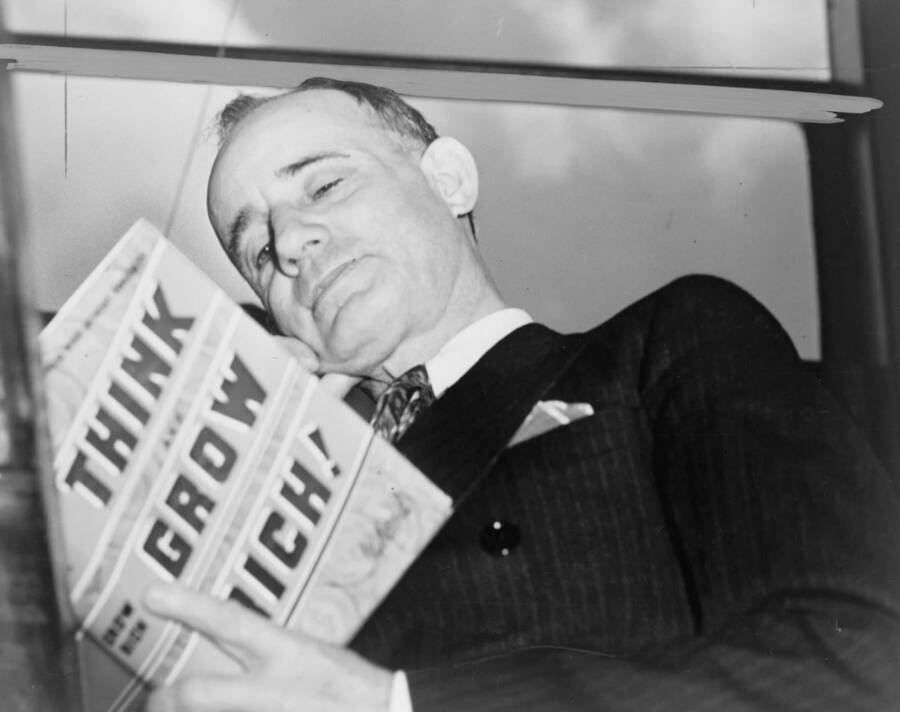
Library of CongressThe title of Napoleon Hill’s bestselling book said it all: Think and Grow Rich.
Napoleon Hill was known for making lofty claims about his life. The self-help author declared that he personally helped Woodrow Wilson end World War I. Hill also wrote an entire book inspired by his alleged conversations with his mentor, Andrew Carnegie. And he even claimed that he helped write FDR’s famous fireside chats.
But the reality was far different. Hill founded more than one scam college. He fled more than one state with warrants out for his arrest. The FTC charged him with false advertising. And there’s zero evidence that Hill ever even met Carnegie or worked for multiple sitting presidents.
His personal life was even more controversial, as he became a member of a New York-based cult determined to create an “immortal baby” in the 1930s. He also faced disturbing allegations of subjecting his second wife Edith Whitman — and their toddler daughter — to brutal violence. Shockingly, he was even accused of throwing the young girl to the floor and choking her.
In spite of his dark and dishonest past, Napoleon Hill sold millions of self-help books, claiming that you simply had to think about success to achieve it. So how did a fraudster become a pioneer of the self-help genre?
The Myth Of Napoleon Hill And Andrew Carnegie
Born on Oct. 26, 1883, Napoleon Hill grew up in a small Appalachian town in Virginia. His big break purportedly came when he was a young reporter. Hill later said that one big interview would change the course of his life.
In 1908, Napoleon Hill supposedly met and interviewed the wealthy industrialist and philanthropist Andrew Carnegie. “It’s a shame that each new generation must find the way to success by trial and error when the principles are really clear-cut,” Carnegie purportedly related to Hill.
As Hill’s story went, the industrialist challenged him to interview America’s most successful and influential men to learn their secrets. Then, Carnegie connected Hill with Henry Ford, Alexander Graham Bell, Thomas Edison, and John D. Rockefeller — a who’s who of America’s most powerful.
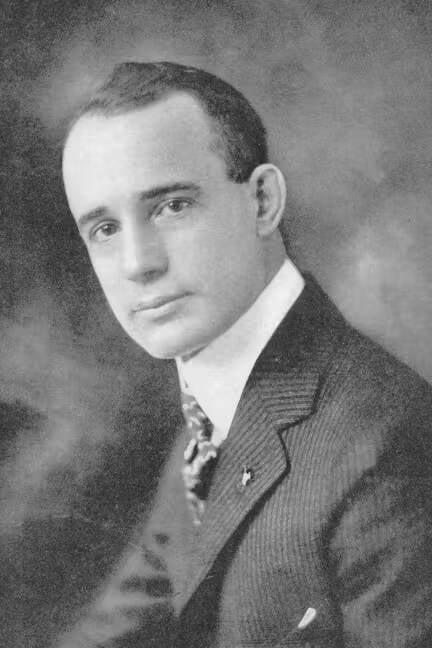
Wikimedia CommonsNapoleon Hill claimed that Andrew Carnegie was his personal mentor.
This is the story of his life that Hill sold. Hill even published a whole book that was inspired by his conversations with Carnegie.
Yet historian and Carnegie biographer David Nasaw has “found no evidence of any sort that Carnegie and Hill ever met,” according to Gizmodo. Nasaw also said he found zero evidence that Hill’s book was authentic.
Carnegie never had the opportunity to set the record straight — Hill waited until after Carnegie’s death to talk about his alleged mentorship.
Fact And Fiction In Napoleon Hill’s Early Years
Was Napoleon Hill an impoverished youth who used his passion for writing to rise to success? Hill’s father was a dentist (though an unlicensed one), and Hill’s stepmother bought him a typewriter to keep him out of trouble, especially when he recklessly carried around a pistol.
“If you become as good with a typewriter as you are with that gun,” Hill’s stepmother told him, “you may become rich and famous and known throughout the world.” Still, Hill chased trouble.
At 19, Hill reportedly landed a job as a manager at a coal mine after covering up the shooting of a Black bellhop at a nearby hotel. By 1908, Hill was the leader of a lumber company in Alabama. Until he fled, chased by a warrant for fraud of up to $20,000. As it turned out, he’d been buying lumber on credit, refusing to pay his suppliers, and then selling the lumber for cash. Then in 1909, he founded the Automobile College of Washington in Washington, D.C., a scam that exploited unwitting “students” for free labor.
Next, Hill moved to Chicago, where he claimed to be an attorney. Later, he was helping to run a candy shop until his business partners had him “arrested on a false charge,” in Hill’s words.
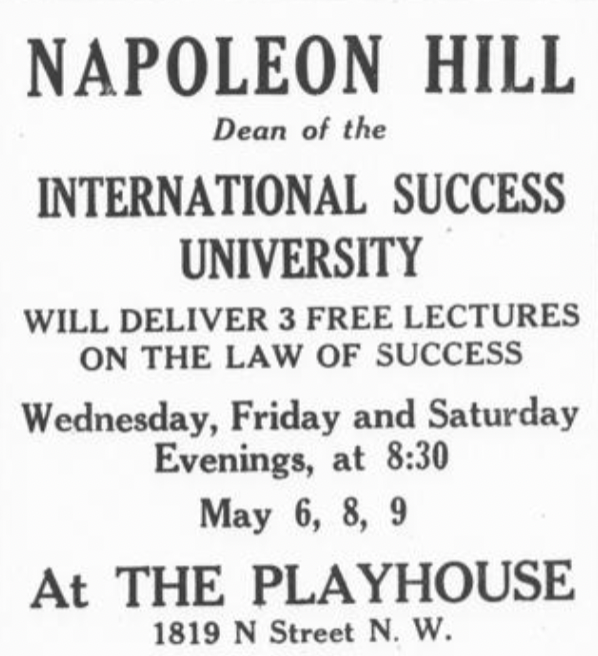
The Washington TimesNapoleon Hill once marketed himself as the dean of the International Success University.
Another scam school, the George Washington Institute, landed Hill in more legal trouble. In 1918, warrants were issued for Hill’s arrest in Illinois. The FTC also charged Hill with false advertising related to his Golden Rule magazine.
By that point in his life, he had also faced many other shocking allegations, including accusations that he had abused his second wife Edith Whitman and their young daughter. Back in 1908, Whitman had claimed that Hill was “a man of violent and ungovernable temper” while filing for divorce. During the divorce proceedings, some of Hill’s own business associates and friends said that he had also cheated on Whitman with numerous prostitutes, or “women of ill-fame.”
Yet even as he outran legal trouble and countless personal scandals, Hill built the myth that would fuel his self-help empire.
Building A Legend
Though he was dodging warrants for his arrest in the 1910s, Napoleon Hill later made the audacious claim that he received a job offer from President Woodrow Wilson during this time, specifically during World War I.
“President Wilson wanted to place me on the government payroll at a rather attractive salary, but for once in my life, I had the privilege of vetoing the president of the United States,” Hill wrote. In Hill’s version, he agreed to create wartime propaganda for the president, but curiously refused pay.
Hill also claimed that he was at the White House with Wilson as the Germans neared surrender and gave Wilson feedback on his response.
Indeed, Hill declared himself the confidant of presidents and powerful businessmen. But was there any proof of Hill’s lofty claims?
The only photographic evidence is a single image of Hill with Thomas Edison.
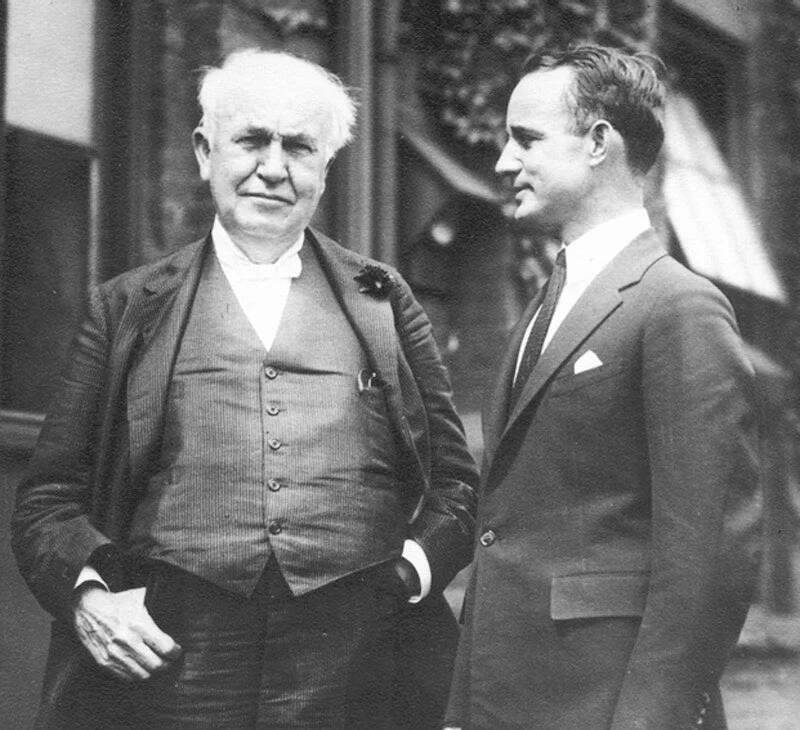
Public DomainAn “audacious stunt” produced the only photographic evidence of Hill’s connection with the rich and famous.
Captured in 1923, the photo was later dubbed an “audacious stunt.” Hill talked himself into attending an Edison convention, where he tried to present Edison with a medal. After the photo was taken, Edison returned the medal.
Still, the picture fueled Hill’s legend, especially when it was paired with the caption describing them as “two of America’s famous men.”
Hill claimed that he’d also collected a number of letters and autographed photos from Woodrow Wilson, Alexander Graham Bell, and other notable men — but all the images and notes were burned in a mysterious fire.
The Success Of Think And Grow Rich
In 1928, Napoleon Hill embarked on publishing an eight-volume book called The Law of Success, which Hill said was based on interviews with 100 millionaires. When the Great Depression made selling books difficult, Hill came up with another scheme: a contest for high schoolers who bought his book.
“We plan to organize a sales force and take the contest to all the high schools all over the country,” Hill wrote to his estranged third wife. “If I get it over it will make me rich in a year. If I do not I might go to jail… The idea is that every contestant would need The Law of Success textbooks in order to get ideas from them for the contest.”
Hill published his most famous book, Think and Grow Rich, in 1937. The book, which declared that thoughts about success and wealth could become reality, eventually sold over 15 million copies.
The book also inspired a quite literal cult following in New York, and the cult was known as the Master Metaphysicians. The group used Hill’s book as a sort of holy text as they embarked on the impossible — by trying to create an “immortal baby.” Not only did Hill become a member of the group, but he was also named the godfather of the supposedly undying infant.
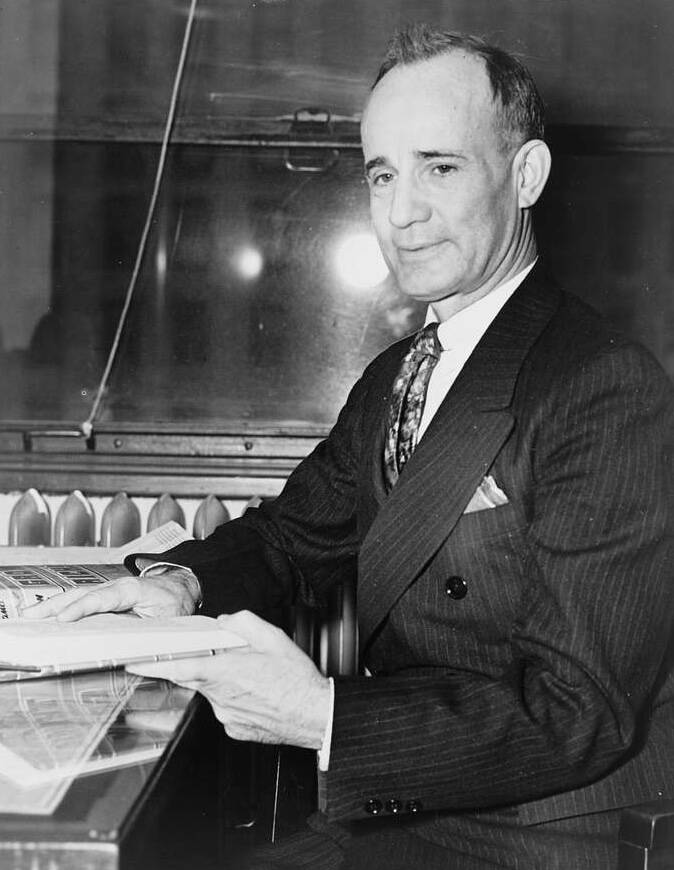
Library of CongressBoom and bust defined Hill’s life, and even when he made millions, he reportedly quickly lost his riches.
But despite his loyal followers and his successful book, none of that could cement Hill’s fortune. The 53-year-old married his fourth wife, 29-year-old Rosa Lee Beeland, after meeting at a lecture in 1936. Beeland, who helped him write Think and Grow Rich, had convinced Hill to sign a prenup that gave her the royalty rights to the book. By the 1940s, she had sold off nearly everything they owned, and went on to marry her divorce lawyer.
Hill and his fifth wife moved to California, where Hill launched a radio show. According to Hill’s biographer, his latest wife “steered him around the con men and charlatans who always found in the guileless Hill an easy mark.”
Selling The Myth Of Success
For years, Napoleon Hill sold a myth of success built on lies about his life.
“I had spent the better portion of my life in chasing a rainbow,” Hill privately admitted. “I had begun to place myself in the category of charlatans who offer others a remedy for failure which they, themselves, cannot successfully apply.”
And yet, many of the stories that Hill spun still pop up in articles and biographies. The Napoleon Hill Institute continues to popularize Hill’s claims.
In the end, Hill proved his theory in a way — he simply declared himself rich and influential, and success followed. Yet Hill’s wealth slipped through his fingers. He died on Nov. 8, 1970, reportedly with very little to his name.
Next, discover the fascinating history of snake oil scams. Then, learn about some of the most infamous con artists in history.