Why Giving Gifts Is A Pagan Christmas Tradition
Another key aspect of Saturnalia was a day of gift-giving. Dec. 19 was known as Sigillaria, named after the small figures called sigillaria that were traditionally exchanged during the festivities. Some depicted mythological heroes like Hercules, while others were made to look like fantastical creatures.
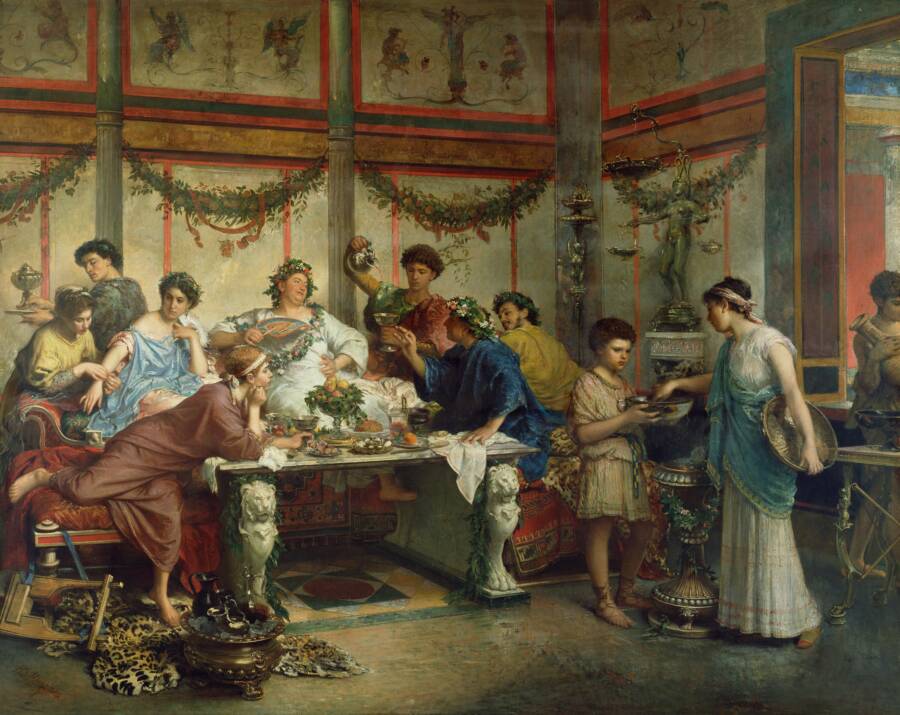
Public DomainIn addition to feasting with friends, family members, and even enslaved workers, Romans exchanged small gifts to celebrate Saturnalia.
Wealthier Romans may have gifted sigillaria made of marble or precious metals, though the majority were crafted from clay or wax. The figures were essentially toys, and they were unique to Saturnalia because the holiday was meant to temporarily erase differences in social status. Enslaved laborers would be given the day off to feast with their masters, and everyone would come together to exchange the sigillaria and other small gifts.
In the first century C.E., the poet Martial wrote of the gifts that were given during Saturnalia in Book 14 of his Epigrams. He listed paper, dice, nuts, stylus cases, golden hair pins, ear picks, combs, a parasol, tools, candles — and even a parrot.
These gifts were sometimes accompanied by short verses, which could be seen as the equivalent of a modern holiday card. Martial included humorous examples of these verses in Epigrams. Under an entry for “a child’s rattle,” he wrote, “If a little boy hangs crying upon your neck, let him shake, with his tender hand, this noisy rattle.” And for cups made of sturdy Saguntine clay, he quipped, “Accept these cups, fashioned of Saguntine clay, which your servant may take and handle without anxiety.”
As Christianity spread through Europe, gift-giving was typically done on New Year’s Day or Epiphany to separate Christmas from the excess of Saturnalia. Over the years, however, this has shifted in many cultures, particularly with the rise of the Santa Claus legend. Today, most American families open their gifts on Christmas morning.