Phil Lynott, the man behind hits like "The Boys Are Back in Town," collapsed after taking a large dose of heroin on Christmas Day 1985 and passed away from heart failure and pneumonia 10 days later at just 36 years old.
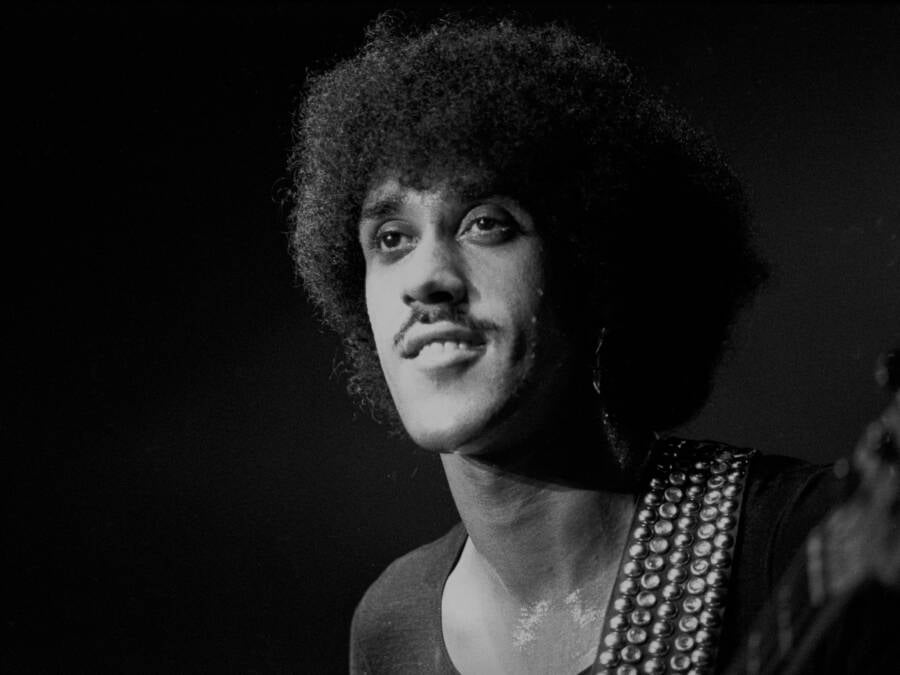
Rolf Adlercreutz / Alamy Stock PhotoPhil Lynott was 36 years old at the time of his death.
The death of Phil Lynott in January 1986 brought an end to his years-long struggle with addiction. On Christmas morning of 1985, the charismatic frontman of Thin Lizzy had suddenly collapsed in his home after taking heroin.
Just over a week later, he succumbed to the ravages of a life lived at full throttle — one that was unfortunately marred by a lengthy battle with drug and alcohol abuse.
At just 36 years old, the singer made famous by anthems like “The Boys Are Back in Town” had lost his lonely fight against heroin addiction.
This is the story of how a lyrical genius — a Dublin icon who broke racial barriers in rock — was ultimately brought down by the very same demons that had fueled his art. It is a stark reminder that, for some, the loud life of a rockstar can end in a silent, desperate struggle.
Growing Up Without A Father
Phil Lynott was born on August 20, 1949, but his story really began two years earlier, when his parents met.
His mother, Philomena Lynott, hailed from Dublin. His father, Cecil Parris, came from Georgetown in what was then British Guiana. He had reportedly stowed away on a ship that he believed was sailing to America in 1947, but he instead found himself in England looking for work.
As his wife, Irene, would later tell the Daily Express, “He landed in Liverpool thinking it was New York.”
Parris settled into a hostel in Liverpool, where he met Philomena Lynott. The two quickly caught feelings for each other and began a relationship. Shortly after, Lynott discovered that she was pregnant, and Parris asked her to marry him. There was one condition, though: He wanted permission from her parents.
She rejected him.
After Philip Parris Lynott was born in August 1949, Philomena Lynott moved with her son into a home in Birmingham for unwed mothers, sleeping in a communal dormitory and working for her bed and board.
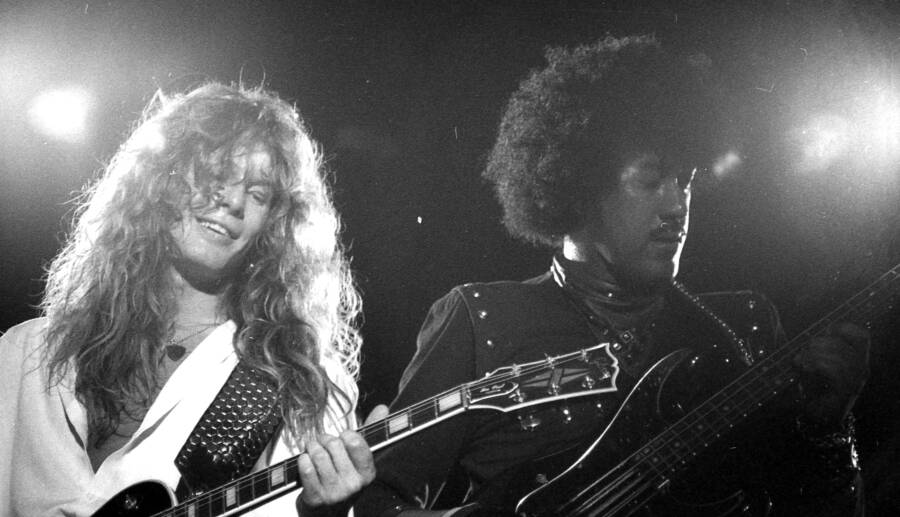
Steve Knight/Wikimedia CommonsJohn Sykes and Phil Lynott performing onstage in 1983.
“Everywhere I turned, I was reminded of the extent to which an unmarried Irish girl with a Black baby was a social outcast,” Philomena Lynott wrote in, My Boy, which was published in 1995, a decade after Phil Lynott’s death. “It was that kind of awful, mean-spirited world back then, where anything unconventional was frowned upon and people were made to feel guilty, even about the most natural and innocent things.”
By 1951, Philomena was living in Liverpool. While she still had occasional contact with Cecil Parris, her life was further complicated by the arrival of a second child, a daughter named Jeanette.
Jeanette Parris Lynott, despite her name, was not Cecil Parris’ daughter. She was purportedly the child of a U.S. serviceman who was, by then, far across the sea.
Meanwhile, Parris settled in London, leaving his son behind. There, he met Irene. “Cecil was always upset about [leaving] because he was a very strong family man,” Irene later explained. “It was taken out of his hands… He wasn’t able to be a father to Philip.”
Philomena Lynott relocated once more, this time to Manchester, where she met a man she called Jimmy Angel. She became pregnant again and gave birth to a son named James Arthur Lynott. Jimmy Angel, who was also a U.S. serviceman, returned to America not long after. Philomena, barely past the age of 21 and a single mother of three, made a difficult decision.
She placed Jeanette and James up for adoption, but she kept her oldest son. Phil Lynott carried the weight of this for the rest of his life.
Phil Lynott’s Entry Into The Dublin Music Scene
Phil Lynott eventually found himself in a more stable environment, living with his grandmother and two uncles in Dublin while his mother remained in Manchester. They were just making ends meet, but it was better for young Phil than constantly relocating and watching men come into his life only to leave shortly after.
From a young age, Lynott felt a connection with music. His uncle Peter listened to bands like the Yardbirds and The Who as well as Black soul music, which resonated with Lynott. He soon began writing his own songs.
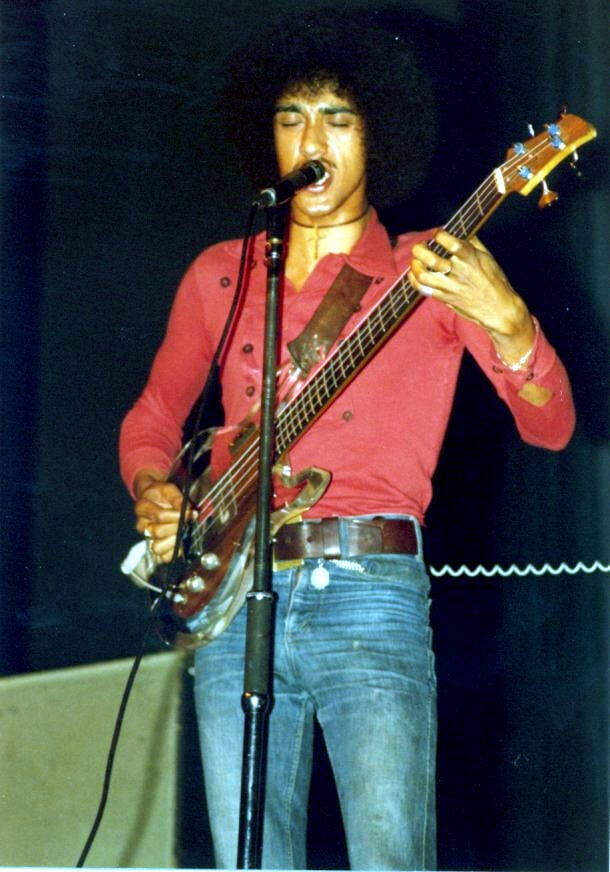
Klaus Hiltscher/Wikimedia CommonsPhil Lynott in 1972.
As he entered his teen years, however, his life seemed to be lacking direction. At 16, he became the lead singer of a band called the Black Eagles. He met a young drummer named Brian Downey at school and convinced him to join the group as well, but the band was ultimately short-lived.
Lynott was then briefly part of a group called Skid Row, but he was effectively kicked out due to his inability to sing on-key. One of his former bandmates did teach him to play the bass, though, which changed the trajectory of his musical career.
Lynott and his old friend Downey went on to form another short-lived band, Orphanage. Then, in 1969, they joined up with guitarist Eric Bell and keyboardist Eric Wrixon — and Thin Lizzy was born.
The Rise And Fall Of Thin Lizzy
In 1973, Thin Lizzy achieved their first top 10 single with “Whiskey in the Jar,” a rock version of a classic Irish song. But it was 1976’s “The Boys Are Back in Town” off the album Jailbreak that cemented them as international stars.
Despite Thin Lizzy’s mainstream success, they were still struggling commercially. Lynott had evolved from a fairly shy bassist and singer to an attention-grabbing frontman, but his personal problems were beginning to impact the band. It started to become clear that Phil Lynott was deep in the throes of a drug addiction.
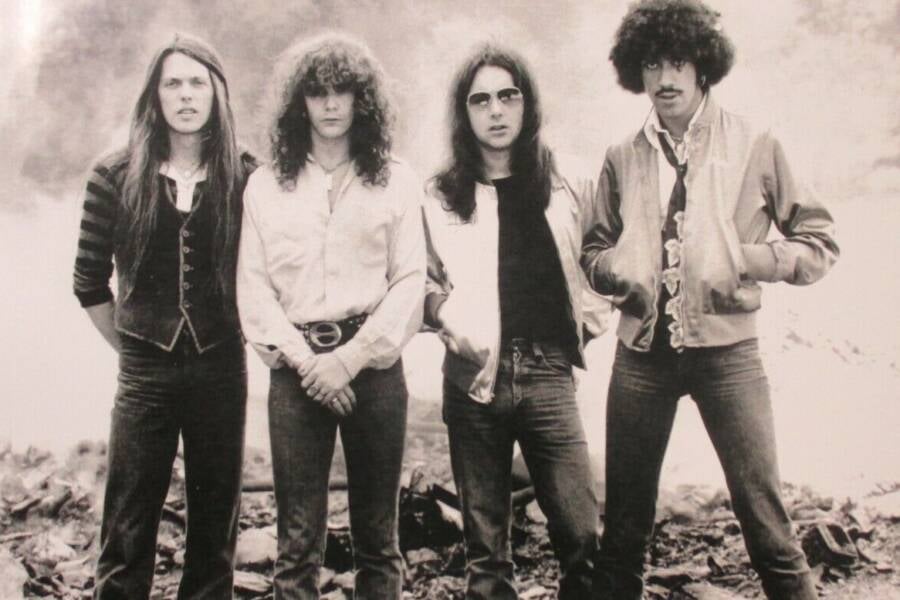
Public DomainScott Gorham, Brian Robertson, Brian Downey, and Phil Lynott in 1977.
Lynott had always embodied the creed of “sex, drugs, and rock and roll.” He frequently slept with female fans and brought his lovers to shows. He had contracted hepatitis in the 1970s, which forced the band to cancel several shows while he recovered. He used both heroin and cocaine, stubbornly believing he would not become addicted.
In 1978, Lynott’s girlfriend, Caroline Crowther, became pregnant. But even the birth of their daughter, Sarah, later that year didn’t inspire Lynott to seek out sobriety. When he and Crowther welcomed another daughter, Cathleen, and got married in 1980, some people were concerned that it wouldn’t last.
Indeed, they separated within a few years, and Lynott’s access to his daughters was limited. He began to spiral. And a year later, he collapsed.
The Death Of Phil Lynott
Thin Lizzy had officially come to an end in 1983. Lynott’s marriage fell apart shortly after. And in 1986, the death of Phil Lynott brought an end to the musician’s struggles.
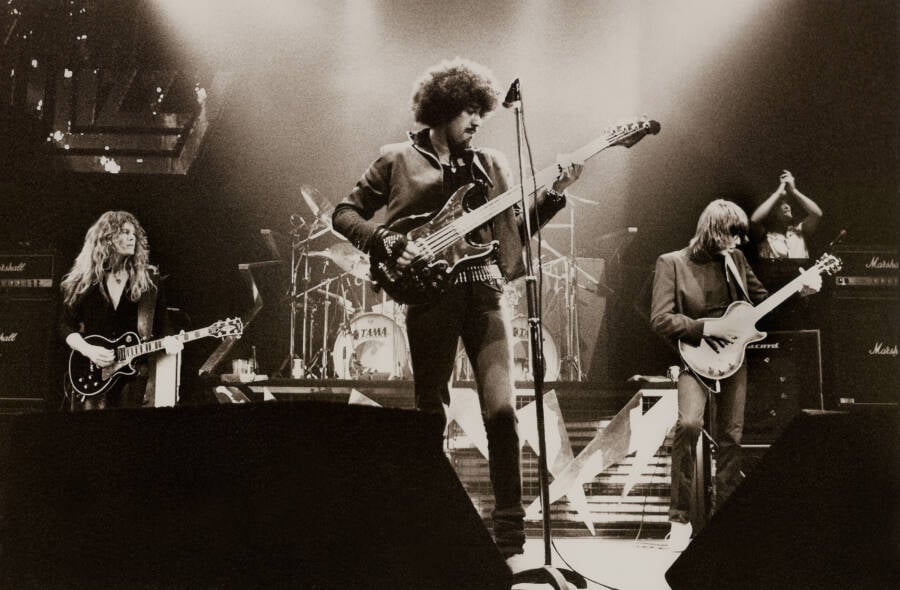
Harry Potts/Wikimedia CommonsThin Lizzy in 1983, shortly before the band split up.
He had hoped to reunite Thin Lizzy. Perhaps, he thought, they could stage a comeback at Live Aid in July 1985. U2 took their spot on the bill instead. Lynott’s other project, Grand Slam, was troubled from the beginning by the same issues that had plagued Thin Lizzy. Even Lynott’s solo gigs fell flat.
Not knowing what else to do, Phil Lynott locked himself away. During an appearance on Good Morning Britain in 1984, he had stated, “The frightening thing about heroin is that… it’s very enjoyable to take it. It cuts off reality.” So, as he was dealing with the harsh reality of losing his band, his wife, and his children, Lynott turned to the drug once more.
On Christmas Day 1985, Lynott took a sizable dose of heroin before unwrapping gifts with his daughters at his London home. He collapsed and needed to be rushed to the hospital — but few people suspected it would be the end. They were sadly mistaken.
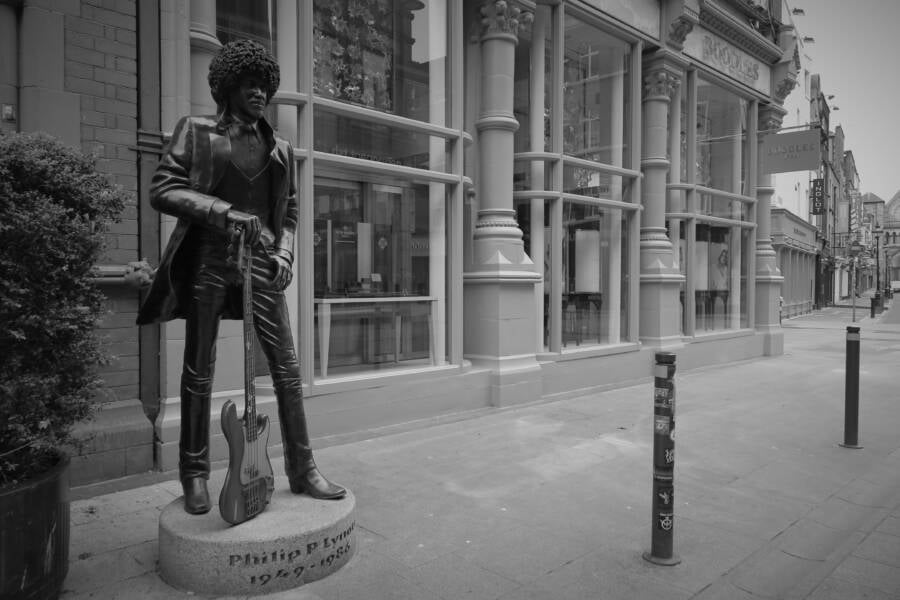
Cityswift/Wikimedia CommonsA statue of Phil Lynott in Dublin.
“I don’t know about anyone else who was there, but I really had no idea how physically broken he was by the drugs,” his mother later recalled, “and I was searching for light — any kind of light — at the end of what only part of me would concede was a tunnel of nightmarish darkness.”
At the hospital, Lynott was diagnosed with septicemia — blood poisoning — which led to a 10-day battle for his life. Tragically, Lynott succumbed to death on Jan. 4, 1986, from heart failure, pneumonia, and kidney and liver damage that was aggravated by his drug use.
A family man at heart, Lynott had grappled with not knowing his father throughout his life. It had left a scar on him that never healed. But when he became a father himself, his lifestyle sadly ensured the same fate for his own children.
After reading about the death of Phil Lynott, go inside the mysterious disappearance of Connie Converse, the original singer-songwriter. Then, learn about the tragic sudden death of Scott Weiland.