Revenge Stories: Marvin Heemeyer And His “Killdozer”
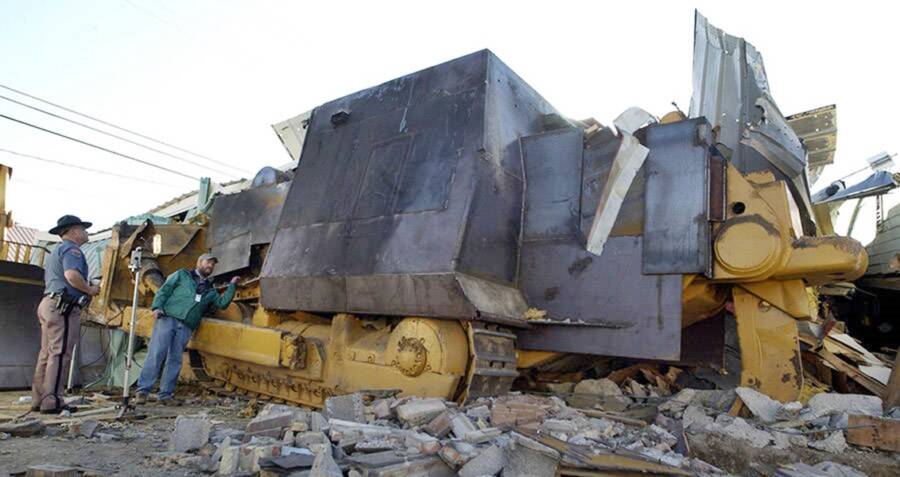
Craig F. Walker/The Denver Post/Getty ImagesInvestigators inspect the fortified bulldozer driven by Marvin Heemeyer at the spot where it came to rest after his revenge rampage through town.
Marvin Heemeyer was a small welding shop owner in Granby, Colorado, who built a makeshift bulldozer-tank in 2004 and plowed through the small town, causing $7 million worth of damage. The reason? A zoning dispute between Heemeyer, the city’s zoning commission, and a concrete company that wanted to build a plant on his land.
In order to build their new facility, the concrete company had purchased a piece of land from Heemeyer where his own shop was also located. When the city’s zoning commission approved the land for construction, Heemeyer argued that the construction blocked him from getting into his shop.
At first, Marvin Heemeyer took the rational course of action and petitioned the commission to prevent the rezoning. But after multiple rejections — as well as multiple fines for various civil violations — Heemeyer decided to take matters into his own hands.
For more than a year, he toiled away in his shop yard building his “killdozer,” a customized Komatsu D355A bulldozer outfitted with thick steel plate armor and a layer of concrete in between, and three-inch bulletproof plastic to protect the cameras he needed to navigate the vehicle. His killdozer was also armed with three makeshift gun ports housing a .50 caliber rifle, a .308 semi-automatic, and a .22 long rifle.
On June 4, 2004, Heemeyer sealed himself inside the killdozer’s cockpit and drove his machine into town. He plowed through the concrete plant next to his shop then made his way toward City Hall, wrecking a newspaper office, the former mayor’s home, a hardware store, and other properties. Once his killdozer was on the loose, the town put out an alert to its residents to warn them to stay away from Heemeyer’s rampage.
After two hours and seven minutes, Heemeyer had bulldozed every business or home that had some connection to his case against the zoning committee. The destruction he caused amounted to $7 million in damages.
The havoc was so great the Colorado governor considered authorizing the National Guard to attack Heemeyer in his killdozer with Apache helicopters and an anti-tank missile. But before they got the green light, Heemeyer rampage ended when he tried to plow through the Gambles hardware store. The store had a small basement that ensnared one of the treads on the vehicle. Unable to free the machine, Heemeyer’s rampage was over. He pulled out a handgun and killed himself with a single shot to the head.
Later, investigators found two lists inside the cab of the bulldozer-tank: one was a list of the 13 properties Heemeyer had destroyed, while another list contained several names, including the town’s mayor and some local business owners.
They also found Heemeyer had no way of getting out of the sealed cockpit on his own which suggests that he wasn’t planning on making it out of his rampage alive. Nobody was hurt during his bulldozing spree except for Heemeyer himself, but the memory of the incident still haunts the city’s residents.
“It’s not that I don’t feel safe, but it’s changed the way that you look at people, at stuff,” the Gambles store owner said. “I don’t know how to put it into words, really.”
The Mass Execution Of Nazis By American Soldiers At The Dachau Concentration Camp
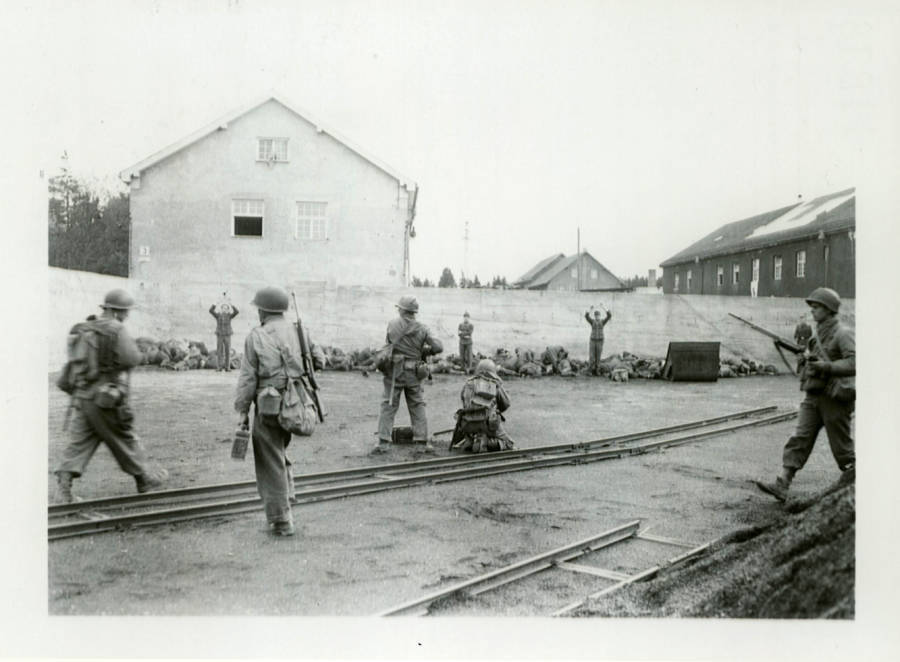
Wikimedia CommonsU.S. troops executed Nazi personnel at Dachau following the camp’s liberation on April 29, 1945.
The revenge story of Dachau — the first concentration camp built by the Nazis to enslave, torture, and murder Jews and other victims — is reminiscent of Quentin Tarantino’s Nazi revenge fantasy, Inglorious Bastards, only even more grisly.
Between 1933 and 1945, there were more than 67,665 registered prisoners, in addition to others who were unregistered, held at the main Dachau concentration camp and its sub camps.
When American soldiers descended on Dachau and liberated the camp on April 29, 1945, the horrors perpetrated by the Nazis were ghastly: mounds of corpse littered the camp’s grounds while the bodies of others rotted away in stacks piled up in the railway wagons nearby.
The sudden and extreme horror of Dachau triggered something in the newly-arrived Allied troops, who threw the formalities of surrender out the window. According to an account by survivor Abram Sachar, the execution was swift:
“Some of the Nazis were rounded up and summarily executed along with the guard dogs. Two of the most notorious prison guards had been stripped naked before the Americans arrived to prevent them from slipping away unnoticed. They, too, were cut down.”
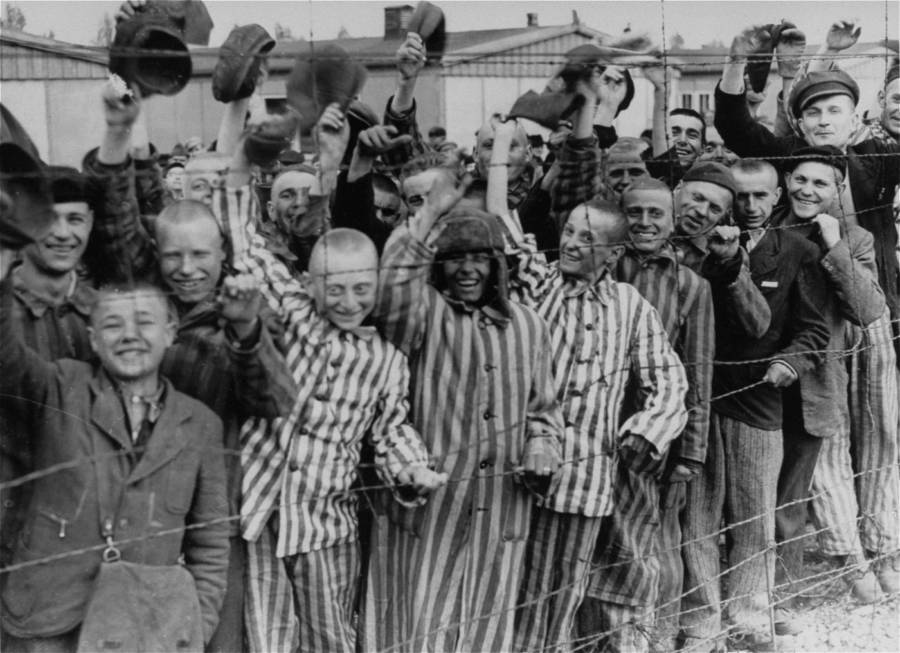
Wikimedia CommonsSome of the young prisoners of Dachau, newly freed by the American troops.
The execution of the Nazi guards was a direct violation of the Geneva Convention, and so an inquiry was opened once word spread about the executions conducted by American soldiers at Dachau.
In his book Dachau: The Hour of the Avenger, medical officer Col. Howard A. Buechner recounted the “deliberate killing of 520 Prisoners of War by American soldiers,” and claimed 19 American soldiers were present or involved in the incident.
This is where accounts of the event from different sources begin to contradict one another. While Buechner had described the execution of more than 500 Nazis, General Felix L. Sparks wrote that, “the total number of German guards killed at Dachau during that day most certainly not exceed fifty, with thirty probably being a more accurate figure.”
Nevertheless, accounts of the Dachau massacre also spoke of acts of revenge against the Nazi guards by the liberated prisoners themselves.
“I knew men in camp who had sworn by everything that was holy to them that if they ever got out that they would kill every German in sight,” said Jack Goldman, who was among the liberated prisoners at Dachau. “They had to watch their wives mutilated. They had to watch their babies tossed in the air and shot.”
One prisoner, Walenty Lenarczyk, said that at the moment of liberation, prisoners were consumed by the desire for revenge against their captors. They captured some SS men “and knocked them down and nobody could see whether they were stomped or what, but they were killed… We were, all these years, animals to them and it was our birthday.”
While the unsanctioned killing of the Nazis at Dachau went against protocol, the swift and brutal vengeance visited on the prison guard is viewed by many as the justifiable comeuppance for their atrocities.