Members of the ancient Pazyryk culture of Central Asia drilled two holes in a woman's injured jawbone and threaded it together with hair or tendon to create a "primitive prosthetic" circa 500 B.C.E.
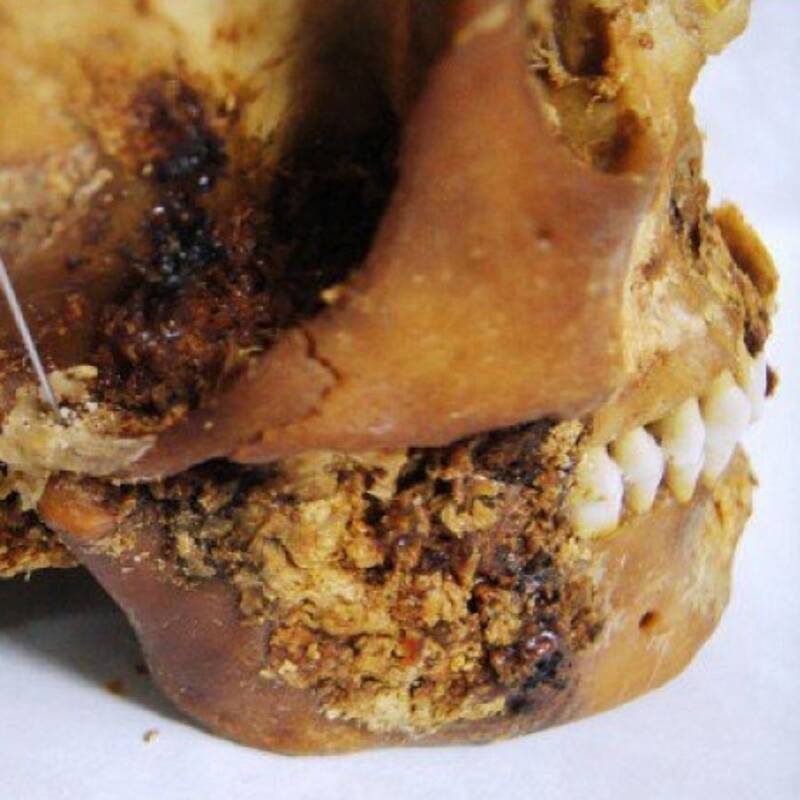
Novosibirsk State University Press ServiceIt’s unknown what caused this Pazyryk woman’s jaw injury 2,500 years ago, but the surgery performed to repair it may be the first example of such an operation in history.
In 1994, archaeologists excavated a small burial site on the Ukok Plateau, a grassland located at the border of Russia, China, Kazakhstan, and Mongolia. There, they unearthed several bodies, including the partially mummified corpse of a woman from the ancient Pazyryk culture who was between the ages of 25 and 30 when she died roughly 2,500 years ago.
At the time, scientists didn’t notice anything remarkable about the young woman. Now, however, they’ve taken CT scans of her skull — and found a “primitive prosthetic” within her mandible that may represent the earliest example of jaw surgery in history.
The Unexpected Discovery Of An Ancient Pazyryk Burial In The Siberian Permafrost
The Pazyryk culture thrived in Siberia, the Altai Mountains, Kazakhstan, and Mongolia between the sixth and third centuries B.C.E. These nomadic people traveled through the region’s grasslands, and their practice of burying their dead in the permafrost has preserved many of their artifacts — and their bodies, including that of the famous “Siberian Ice Maiden.”
But when another Pazyryk woman’s remains were uncovered in the same area roughly three decades ago, archaeologists didn’t expect to learn much from them at first. She’d been buried on a wooden bed in a sleeping position, but there were no grave goods found alongside her except for a wig, which was typical of the Pazyryk culture.
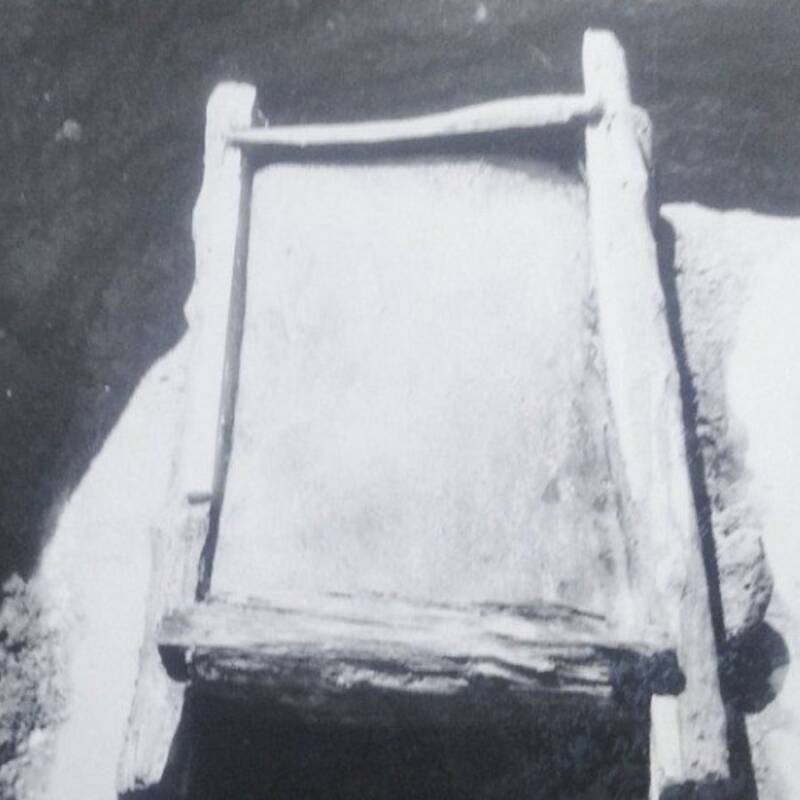
Novosibirsk State University Press ServiceThe Pazyryk woman was found buried on this wooden bed in 1994.
The permafrost had preserved part of the woman’s head, but scientists didn’t initially notice her injured jaw. As Natalia Polosmak, the chief researcher at the Institute of Archaeology and Ethnography of the Siberian Branch of the Russian Academy of Sciences, noted in a statement released by Russia’s Novosibirsk State University, “This mummified patch of skin on the deceased’s skull made anthropological research impossible, but we wanted to learn as much as possible about the woman, and her skull was all we had left.”
So, scientists recently decided to perform a CT scan on the remains to see what was beneath the mummified skin. Vladimir Kanygin, the head of the laboratory where the analysis was performed, said in the university’s statement, “The CT scanner allowed us to virtually ‘remove’ these coverings and create an accurate digital and then physical 3D model of the skull, making it accessible for detailed anthropological analysis.”
What the researchers found shocked them.
Uncovering Astonishing Evidence Of 2,500-Year-Old Jaw Surgery
Scientists first noticed that the Pazyryk woman’s right mandible had been displaced, with her temporomandibular joint destroyed and her lateral ligament torn. She may have been thrown from a horse or fallen from a significant height, and the injury would have left her unable to chew or speak.
Such significant trauma would seemingly have meant certain death 2,500 years ago, but the Pazyryk people were fairly advanced for their time in terms of medicine. Scientists have long known that they practiced cranial trepanation, or drilling holes in the skull to release pressure or treat injuries. However, the evidence of surgical intervention that researchers discovered in the woman’s skull was groundbreaking.
Two thin canals were drilled into her mandible and converged at a right angle. An elastic material, likely horse hair or an animal tendon, was then strung through the holes, connecting her damaged jawbone.
“It is possible that we have discovered evidence of such a surgical procedure for the first time,” said Andrey Letyagin, a professor and physician with the Russian Academy of Sciences. “This primitive prosthetic held the articular surfaces together and allowed the patient to move her jaw. The joint functioned, but she still couldn’t chew food on the injured side due to severe pain.”
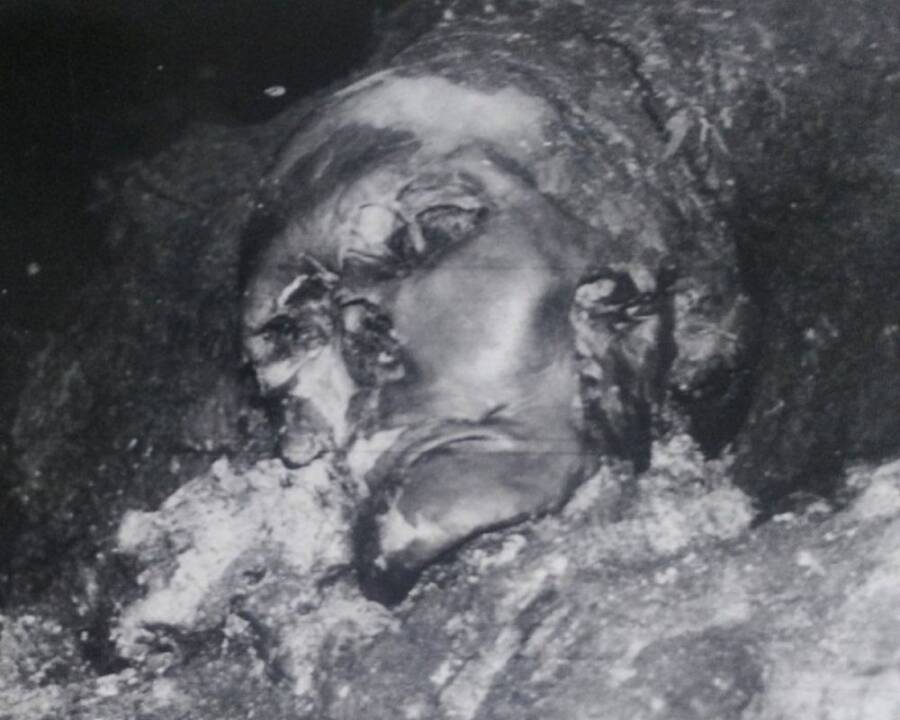
Novosibirsk State University Press ServiceThe mummified skin covering the woman’s skull initially concealed her jaw injury.
Indeed, evidence of extensive wear on the molars of the uninjured side of the woman’s face, in addition to healing bone within the drilled canals, indicate that she survived the surgery and lived for at least several months afterward.
But why did the Pazyryk people go to such lengths to save this woman’s life? Aside from the wooden bed she was buried on — which would have been expensive to make due to the lack of trees on the Ukok Plateau — there were no elaborate grave goods interred alongside her that would suggest she was an elite member of society.
However, as Polosmak noted, “Every Pazyryk resident possessed certain essential, and perhaps even unique, qualities and talents… In this society, everyone was valued in life simply for their existence, and honored after death.”
Scientists are now hoping that CT scans can reveal even more about both the Pazyryk culture and other ancient civilizations. Kanygin lauded the technology, saying, “It allowed us not only to diagnose the injury but also to reconstruct the results of a complex surgical intervention performed in ancient times, transforming a single find into detailed evidence of the high level of medical knowledge of the Pazyryk culture.”
After reading about the evidence of jaw surgery discovered on a 2,500-year-old skull found in Russia, look through these before-and-after photos from the early days of plastic surgery. Then, go inside the grisly history of “phossy jaw,” the deadly condition that plagued “matchstick girls” in the 19th century.