Found completely intact just three feet below ground, this four-pound bronze ball is believed to have been used by the Mexican Army in the course of either the battle or the 13-day siege that preceded it.
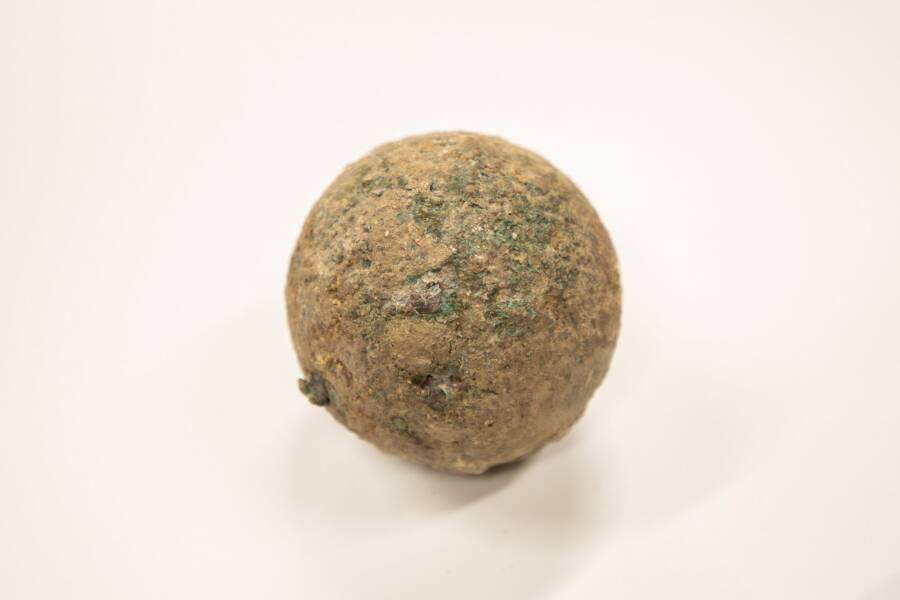
Alamo TrustThe four-pound cannonball that was recently found at the Alamo.
During excavations at the Alamo — the location of the historic 1836 battle that inspired the famous cry “Remember the Alamo!” — archaeologists turned up a relic from the site’s storied past. While digging just outside the Alamo Church in San Antonio, Texas, researchers uncovered a well-preserved 190-year-old cannonball.
Archaeologists believe that the cannonball was used during the Battle of the Alamo, or perhaps during the 12-day siege that preceded it. As such, it’s a remarkable artifact from one of American history’s most famous battles.
The 190-Year-Old Cannonball Found At The Alamo
According to a statement from the Alamo Trust, the cannonball was discovered on March 5, 2026, one day before the 190th anniversary of the Battle of the Alamo, which took place on March 6, 1836. Archaeologists found the relic three feet below ground while excavating an area near the Alamo Church.
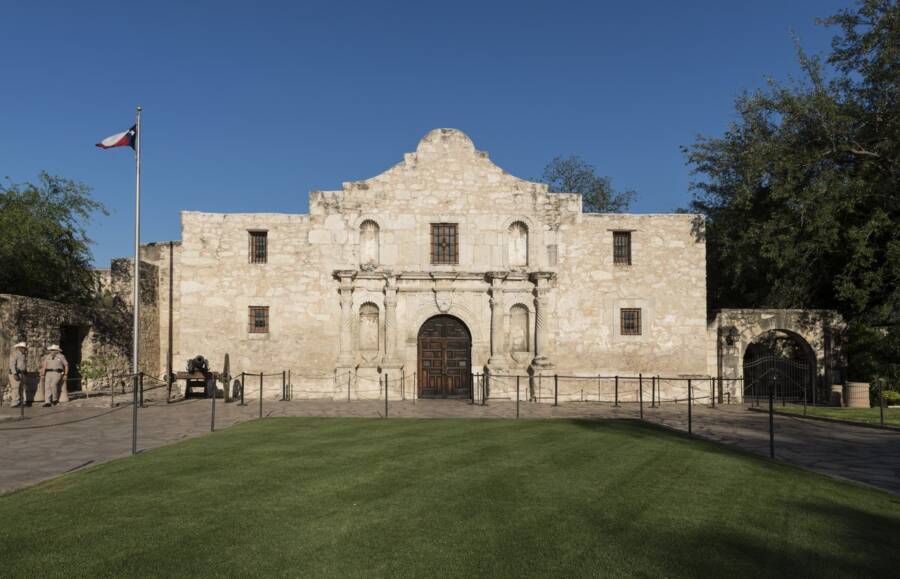
Library of CongressThe Alamo Church, one of the only structures from the original Alamo that’s still standing today.
“I have chills now, just thinking about it,” the Alamo’s Director of Archaeology Dr. Tiffany Lindley told the Alamo’s official podcast, Stories Bigger Than Texas: The Alamo Podcast. “March 5th is when we pulled it out of the ground. I don’t think words can express the feelings that we all felt.”
The cannonball was found in a “clean deposit,” meaning that archaeologists could document the layers of soil that covered it. By studying these, they were able determine that the ball dated to 1836, the year of the Battle of the Alamo.
What’s more, archaeologists even have a good idea of who fired this four-pound cannonball. Because it’s made of bronze, experts suspect that it was originally used by the Mexican Army.
“We can’t say with 100 percent certainty that it came from the Mexican Army, but I would say 99 percent because largely the Mexican Army is using bronze cannonballs and largely the Texans are using iron cannonballs,” Alamo Senior Researcher and Historian Kolby Lanham explained on the podcast. “Doesn’t mean they didn’t capture each other’s stuff and use it, but I would say with a fair amount of certainty that this is a Mexican Army cannonball.”
Lanham further explained that the cannonball was likely fired during the Battle of the Alamo, or possibly during the 13-day siege that took place in the lead-up the battle.
Furthermore, the cannonball was not the only relic from the Alamo’s violent past that archaeologists uncovered. They also found four exploding shot fragments — three made from bronze, and one made from iron.
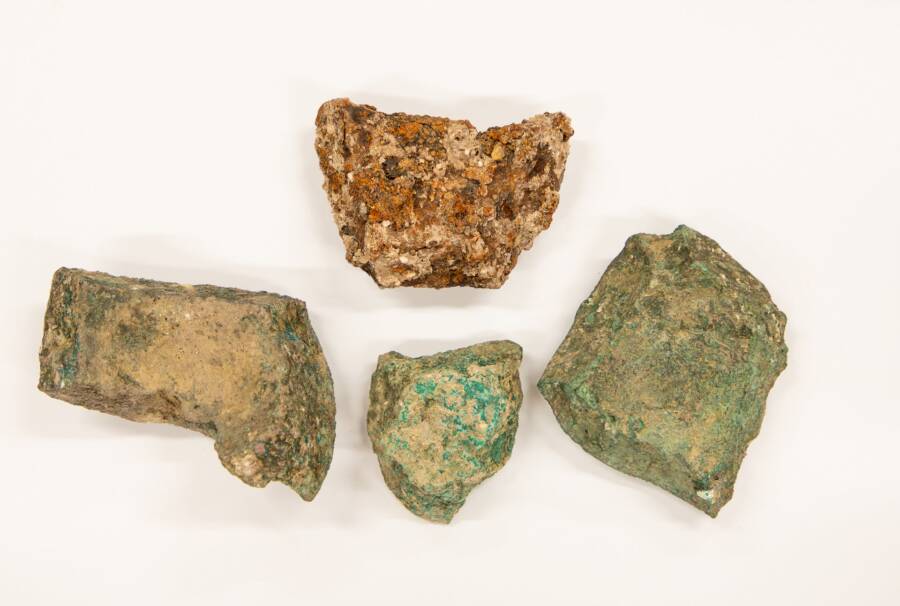
Alamo TrustThe four shot fragments are made from both bronze and iron, suggesting that they came from both the Mexican and the American sides.
Artifacts like these provide a fascinating window into the dramatic history of the Alamo.
The History Behind The Battle Of The Alamo
Though it’s a quiet historical site today, the Alamo was once at the heart of a revolutionary struggle. Held by the Spanish, then by Mexicans rebelling against Spanish rule, the former Franciscan mission eventually fell into the hands of a group of white Texans in the 1830s. The Texans sought independence from Mexico, and roughly 200 of them — including the famous frontiersman Davy Crockett — dug in at the Alamo in December 1835.
In February 1836, however, roughly 2,000 Mexican troops under the command of General Antonio López de Santa Anna arrived at the Alamo, and laid siege to the fort. The siege lasted almost two weeks, but on March 6, the Mexicans overpowered the Texans and took the fort. Almost all the men defending the Alamo, including Crockett, were killed.
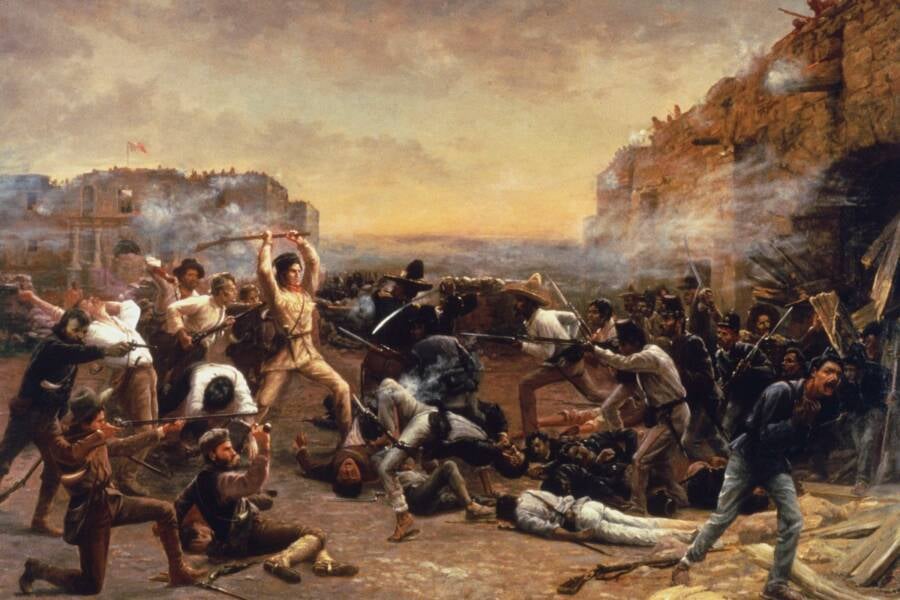
Public DomainA depiction of the Battle of the Alamo. Davy Crockett is shown here holding up his rifle.
But the story of the Alamo didn’t end there. The Battle of the Alamo inspired other Texans seeking independence, and Sam Houston, the commander-in-chief of the Texan forces, rallied his men with the cry, “Remember the Alamo!” The Texans soon defeated the Mexicans at the Battle of San Jacinto that April, securing Texan independence. The state would then be annexed by the United States in 1845, bringing an end to this dramatic chapter in American history.
After reading about the cannonball found at the Alamo, discover the thrilling stories behind some of the most legendary lawmen of the Wild West. Then, look through these stunningly colorized Wild West photos.