Made of bronze and dating back 1,800 years, this pendant measures just 1.2 inches long and is believed to be a talisman that was held onto for good luck.

Uncovering Roman CarlisleThe newly-unearthed penis charm is just one of many Roman-era relics found in Carlisle.
Archaeologists in Carlisle, England recently uncovered a small bronze penis pendant while excavating the ruins of an ancient Roman bathhouse. Experts believe that this striking relic was a charm worn to ward off evil and bring good luck some 1,800 years ago.
The phallus is just one of thousands of artifacts that have been discovered at the site since 2017, when workers stumbled upon ancient Roman ruins while constructing a new pavilion. This site has since been determined to be the largest known building along Hadrian’s Wall — and it may have a connection to a renowned emperor.
The “Beautiful” Roman Phallus Charm Found In Carlisle, England
This bronze phallus was unearthed during recent excavations at Carlisle Cricket Club in the English county of Cumbria. While archaeologists have discovered a trove of artifacts at the site over the last decade, this is the only penis relic that they’ve come across so far.
“It’s our first little phallus,” site director Frank Giecco told the BBC. “[I]t’s tiny… but beautifully made in bronze.”
The ornament is roughly 1.2 inches long, and it was likely once attached to a belt or worn as jewelry. During Roman times, the phallus represented fertility and power. Romans were “extremely superstitious,” Giecco noted, and such charms were thought to bring good luck and repel the “evil eye.”

Uncovering Roman Carlisle/FacebookThe ancient Roman site in Carlisle has been undergoing excavations since 2017.
While this is the first penis charm found at the Carlisle site, countless others have been uncovered elsewhere across the former Roman world. In 2022, archaeologists unearthed a massive phallus carved into the base of a building in Spain. The following year, excavations in Serbia revealed a penis wind chime among the ruins of the ancient Roman city of Viminacium.
Giecco noted that the bronze phallus “gives a fantastic insight into the minds of people who lived in Carlisle 1,800 years ago.” But it’s not the only relic that’s revealing what life was like back when the city was known as Luguvalium.
Further Discoveries From The “Uncovering Roman Carlisle” Project
The Uncovering Roman Carlisle project began back in 2017, when construction work at Carlisle Cricket Club revealed the remnants of an ancient building. Archaeologists soon discovered structural elements that suggested the site had once held a massive bathhouse, such as vaulted roof tiles, underfloor heating, fragments from stone pillars, and shards of pottery.
In fact, historians now believe that the bathhouse was the largest building along Hadrian’s Wall, which marked the northernmost boundary of the Roman Empire. At the time, Carlisle was a key settlement at the intersection of two major highways. The city played a vital role in the movement of troops and supplies to various forts along the border.
Since 2017, archaeologists have uncovered thousands of other artifacts at the site, from statue heads and gemstones to metal objects and even a chunk of rare Tyrian Purple dye.
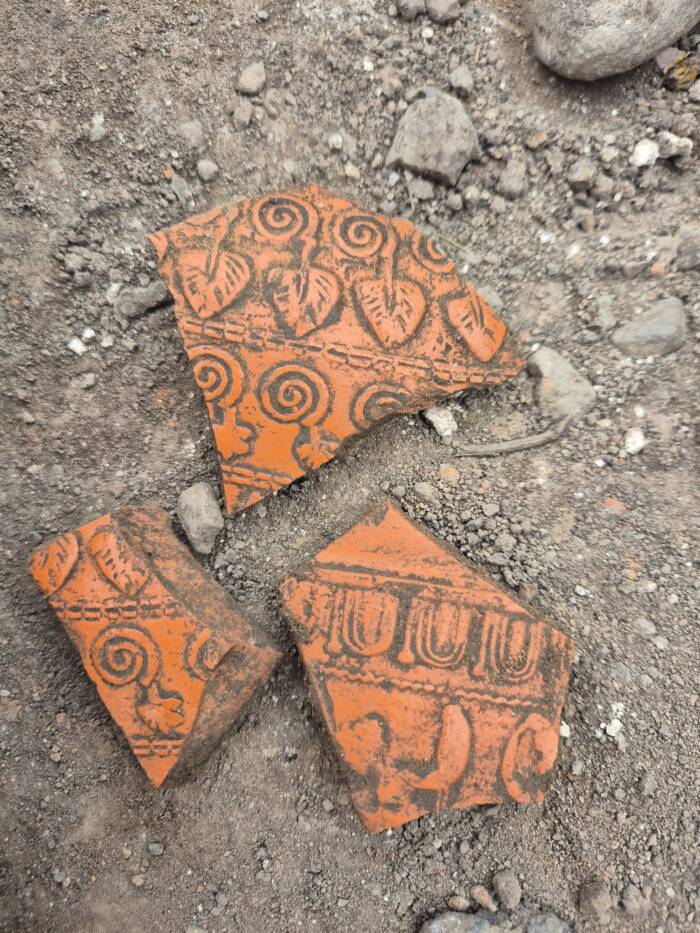
Frank Giecco/FacebookShards of Roman pottery uncovered at the Carlisle excavation site.
Indeed, this dye may be evidence that Luguvalium — and perhaps even the bathhouse itself — once hosted Emperor Septimius Severus. He ruled from 193 C.E. to 211 C.E., and was known for expanding parts of the empire, strengthening Hadrian’s Wall, and trying to invade Scotland.
As Giecco noted in a statement released by the Cumberland Council in 2024, “For millennia, Tyrian Purple was the world’s most expensive and sought after color. Its presence in Carlisle combined with other evidence from the excavation all strengthens the hypothesis that the building was in some way associated with the Imperial Court of the Emperor Septimius Severus which… possibly relates to an Imperial visit to Carlisle.”
As such, the newly-uncovered bronze penis pendant adds one more piece to the unique history of these grand ruins. “It’s unusual we haven’t found a phallus shaped object on the site before,” Giecco told the BBC, “it’s so rich in other types of objects… The joy of pulling a pot out of the ground that hasn’t been touched for years is incredible.”
Many of the artifacts have been put on display at Tullie Museum and Gallery in Carlisle, where the public can get a glimpse of the ancient history that’s sitting just beneath their feet.
After reading about the Roman-era bronze phallus found in England, discover how big the Roman Empire was at its peak. Then, learn about 14 of history’s most important archaeological discoveries.