The Sultana Explosion Shocks Post-Civil War America
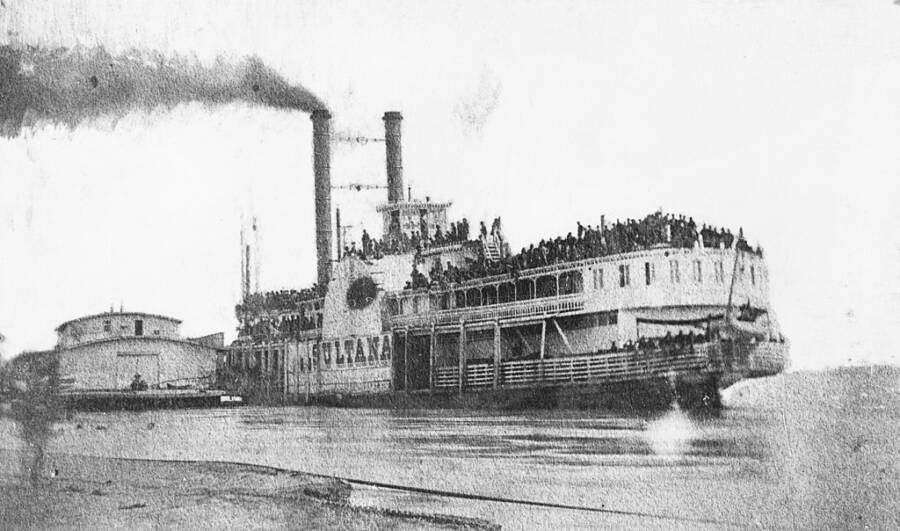
Public DomainThe Ill-fated Sultana before her boilers exploded and she sank on April 27th.
On April 27, 1865, the United States experienced the worst maritime disaster in its history.
A steamboat, traveling up the Mississippi River bound for St. Louis, exploded, killing roughly 1,800 of the almost 2,500 people on board.
The steamboat started its journey in Vicksburg, Mississippi. The Sultana’s captain, J. Cass Mason, had agreed to transport recently freed Union prisoners of war back to the North in exchange for a per-passenger fee.
Hungry for money, Mason overloaded the 376 passenger Sultana with over 2,500 passengers, trusting that the waters of the Mississippi would be smooth for their journey.
They were not.
The river was at a flood stage, a time of the year when the waters hover dangerously close to overflowing levels. Trees and other debris often get pulled into the river by the high waters, creating a treacherous trip upriver. Not to mention that in April, temperatures can drop close to freezing.
The Sultana made it a few miles north of Memphis before disaster struck.
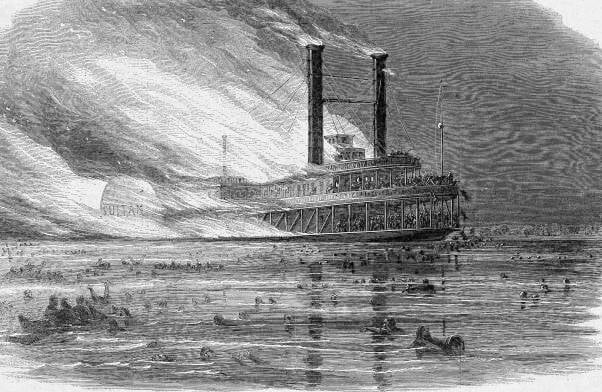
Public DomainAn illustration of the disaster in Harper’s Weekly.
At two in the morning, one of the steamboats boilers exploded. The explosion caused a domino effect, in turn rupturing the two boilers next to it.
A fire broke out, immediately engulfing the rear of the ship. The two paddle wheels fell off, causing the boat to turn backward into the wind, which blew the flames up the entirety of the ship.
Within minutes the entire steamboat was ablaze.
However, there were some survivors.
Despite the Civil War ending just a few days prior, the steamboat’s Union veteran passengers were rescued by Confederate veterans. The boat had still been passing through Confederate territory when it burst into flames. Though they had been on different sides of the war just days before, they risked their lives to help their fellow soldiers.
Though the sinking of the Sultana is still the worst maritime disaster in U.S. history (resulting in roughly 300 more deaths than the sinking of the Titanic) there was hardly any news spread about it, due to the fact that an even larger tragedy had occurred just days before: the assassination of President Abraham Lincoln. Indeed, one interesting historical event is sometimes swallowed up in the shadow of another.
Ironically, the reason the Sultana had even been in Mississippi was to deliver newspapers to the south, reporting the president’s death.
Interesting Events In History: Exercise Tiger, The World War II Disaster At Slapton Sands
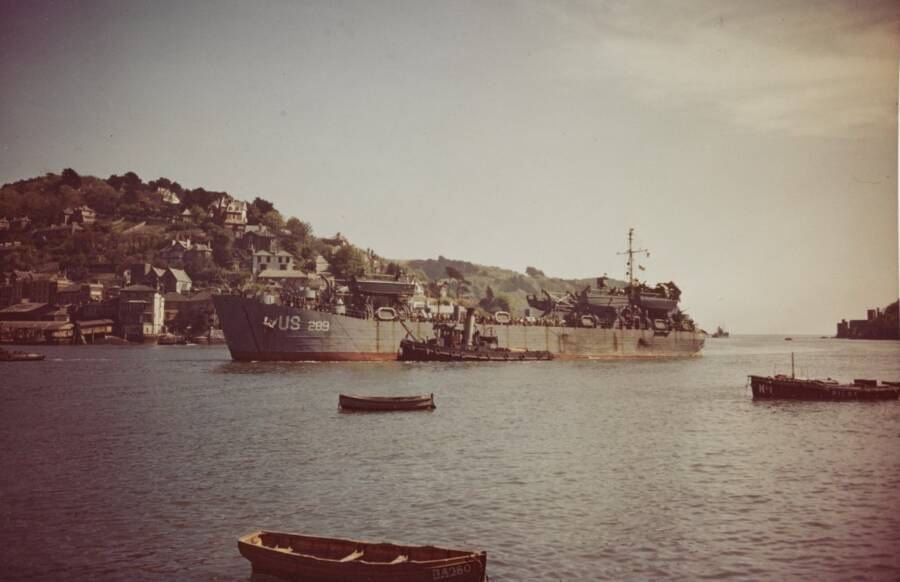
Naval History and Heritage CommandUSS LST-289 arrives in Dartmouth Harbor, England, after being torpedoed by German torpedo boats during an invasion rehearsal off Slapton Sands, England, on 28 April 1944.
Everyone knows the story of D-Day. The Allies landed on the shores of Normandy to invade German-occupied Europe and liberate the continent from Nazi control.
Operations like D-Day need to be practiced to be successful. Nobody just invades a country and wins without a run through or two.
However, even though these run-through’s are practice rounds for the real thing, it doesn’t mean they always go as planned. One such unsuccessful run-through of D-Day was known as “Exercise Tiger,” and it actually resulted in the deaths of 749 American soldiers.
To prepare for the invasion of Normandy, the British government set up training camps along the shores of Slapton Sands, Devon. To keep the operations secret, the British Royal Navy patrolled the area and kept a close watch on the bay that leads to the beach.
The first casualty took place on the morning of April 27.
A practice assault was scheduled to take place, involving real ammunition so the soldiers could become accustomed to the sights and sounds of battle. They originally had scheduled the exercise for 7:30 a.m., however one of the boats that was supposed to be simulating a naval approach was held up at sea for repairs. The generals decided to move the exercise to 8:30, though the communication did not make it to the landing craft in time.
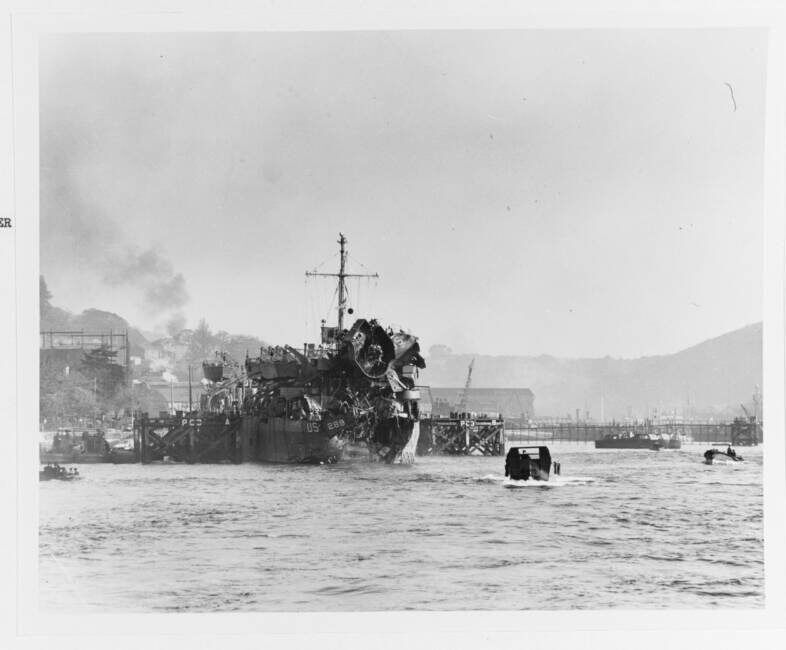
Naval History and Heritage CommandDartmouth Harbor after being torpedoed by German MTBs.
When they landed on the beach at 7:30, they were attacked, as the crew believed they were actually being attacked. In an exchange of friendly fire, roughly 450 men were killed before anyone realized they were shooting at their own men.
Then, the day after that, an actual attack happened, though this time they were not prepared. Two of the ships that were patrolling the bay that lead to Slapton Sands beach were attacked by German E-boats.
Though the Allied ships ended up fighting back, four of their ships were lost in the attack. In the end, the E-boats retreated from the battle, leaving the Allies to tend to their losses.
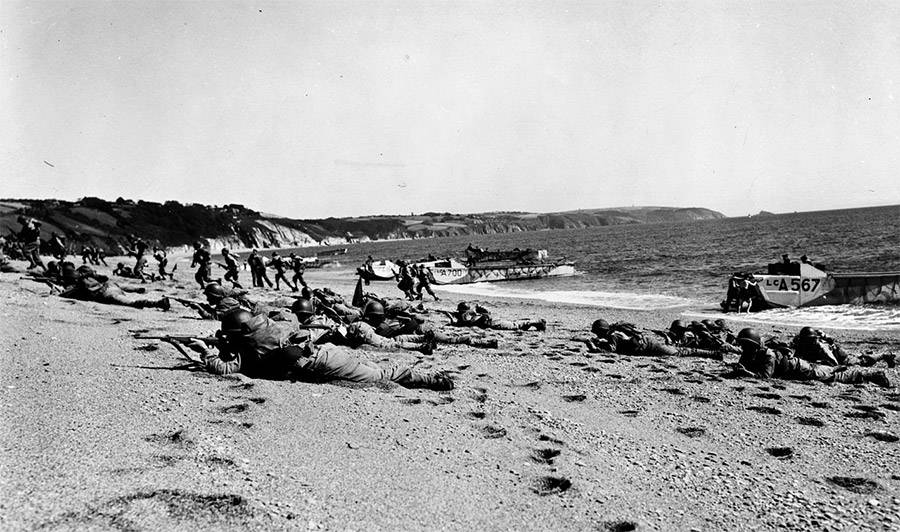
Wikimedia CommonsAmerican troops land on Slapton Sands in England during rehearsals for the invasion of Normandy. April 1944.
Out of fear that word would get out about their failed practice missions, the Allied generals swore their surviving soldiers to secrecy, keeping this interesting historical event below the radar for years. Ten of the officers who had gone missing during the two attacks had high levels of clearance regarding actual D-Day, and because of that, the entire operation was almost called off.
In the end, the generals decided to go ahead with the mission, which ultimately resulted in a victory for the Allied powers.