Pagans Decked The Halls With Boughs Of Holly
Today, holly commonly appears in wreaths and on holiday cards, but this pagan Christmas tradition goes back thousands of years.
Like mistletoe, holly is an evergreen plant that remains vibrant throughout the cold, snowy winter months. Druids believed it was sacred, but rather than connecting it to fertility, they viewed its spiky leaves as a symbol of protection.
One Celtic myth claimed that the Holly King and the Oak King fought twice each year. In the summer, the Holly King won, which caused the days to grow shorter and the leaves to fall. In the winter, the Oak King won, which brought longer days and blooming plants.
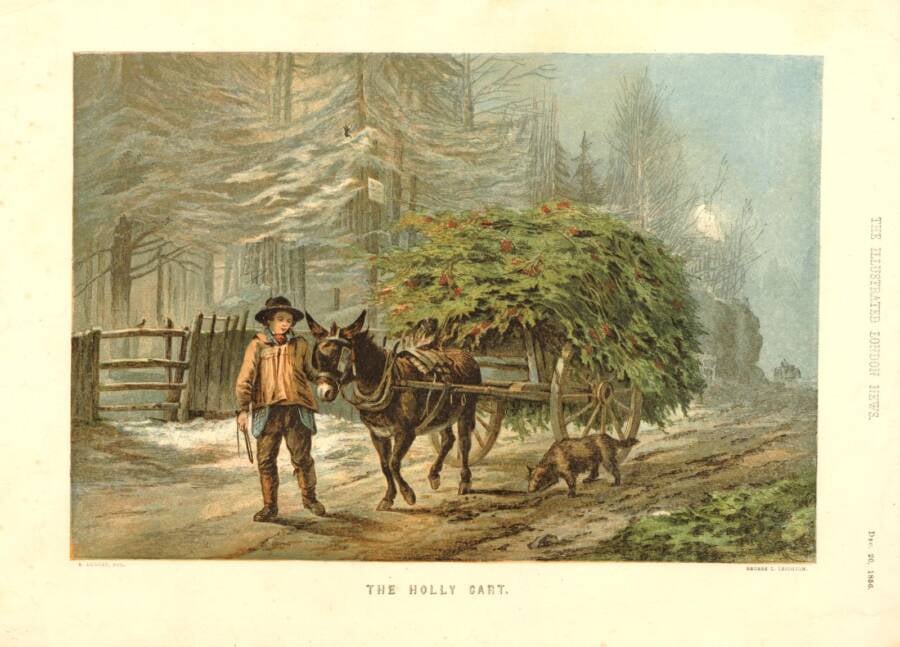
Public DomainA boy leads a donkey hauling a cart full of holly boughs in this illustration from an 1856 edition of the Illustrated London News.
Ancient pagans also used the plant in celebrations of the winter solstice to ward off evil spirits. This belief continued even into the Middle Ages, when Europeans would wear sprigs of holly on their clothes to protect themselves from witchcraft.
The Romans decorated their homes and temples with holly during Saturnalia, since it was one of the few plants that was still green at the time of the celebration. Holly was also associated with Saturn himself.
However, as Christianity spread throughout Europe, holly’s symbolism changed. The prickly leaves came to represent the crown of thorns Jesus wore on his head as he was crucified, and the red berries were seen as the drops of blood that fell from Christ while he was tortured.