In 68 C.E., Emperor Nero stabbed himself in the throat with a dagger as he heard the hoofbeats of the approaching centurions who were sent to arrest him for his extravagant spending and tyrannical behavior.
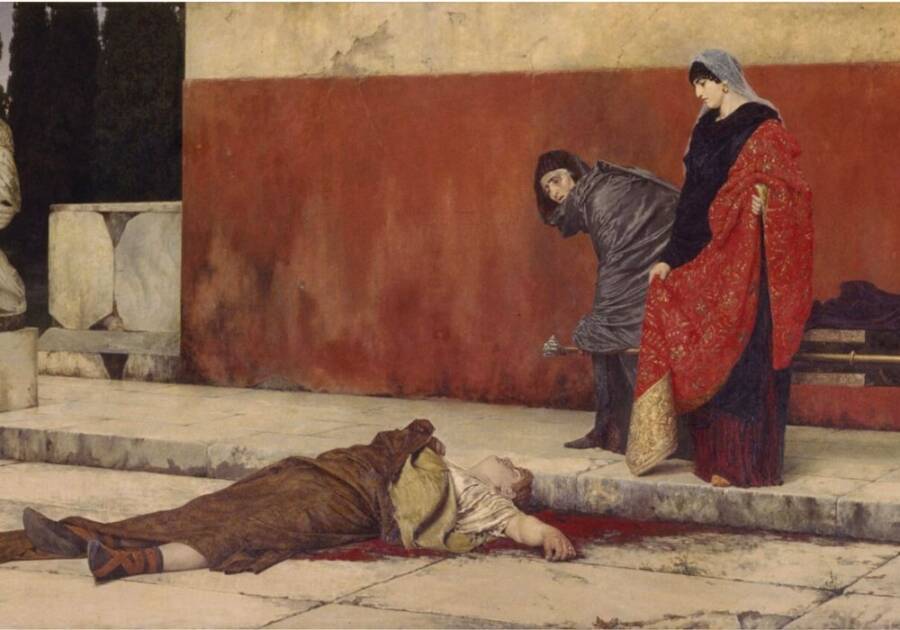
Public DomainA painting of Emperor Nero’s corpse by 19th-century Russian painter Vassily Sergeyevich Smirnov.
History is riddled with seismic events that mark the end of an era and herald unprecedented change, and the death of Emperor Nero was no different. His demise confirmed the unthinkable: The Roman Empire could fall.
Nero’s reign had been controversial from the beginning. He spent extravagantly, acted tyrannically, and debased himself in the eyes of the elite by singing and acting in public. The empire began to rally behind a different ruler, and the Senate declared Nero an enemy.
Rather than face public execution, Nero decided to take his own life. He fled to a villa outside of Rome on June 9, 68 C.E., and stabbed himself in the throat with the help of his personal secretary, Epaphroditus. He was just 30 years old at the time.
Rome would ultimately survive without him, but Emperor Nero’s death in 68 C.E. brought a permanent end to the first imperial bloodline, a dynasty that had ruled the empire since its inception. And without an heir to take his place or codified rules of succession, dangerous and wholly unprecedented uncertainty swept the corridors of power.
The Early Life Of A Future Leader
Nero was a direct descendant of Augustus, the founder of the Roman Empire, making his place on the imperial throne his arguable birthright. Born Lucius Domitius Ahenobarbus in the coastal town of Antium in 37 C.E., he was the only child of politician Gnaeus Domitius Ahenobarbus and Agrippina the Younger, the great-granddaughter of Augustus and the sister of Caligula.
Gnaeus died when Nero was three, leaving Agrippina alone to fend for their son’s future. She wasted no time in romantically approaching her uncle, Emperor Claudius, whose third wife had recently died.
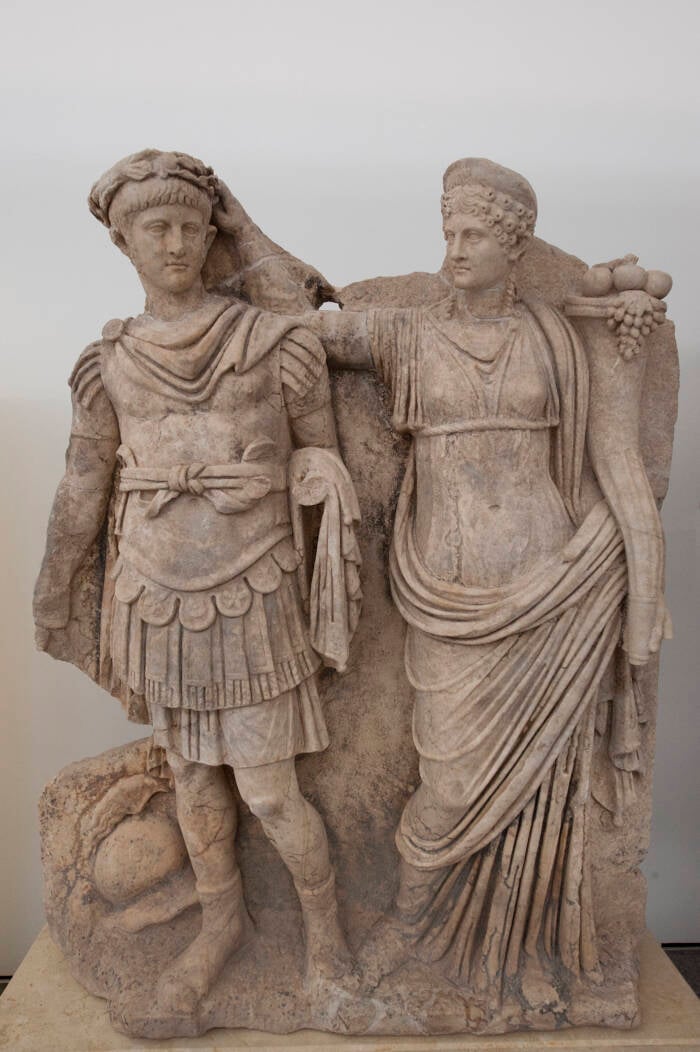
Dosseman/Wikimedia CommonsA relief of Nero and Agrippina from the first century C.E.
Agrippina was apparently unbothered by the fact that Claudius had his late wife executed on charges of supposed treason and adultery, and after a brief courtship, the two were formally wed in 49 C.E. Nero was adopted by the emperor the following year — at his mother’s politically savvy and relentless insistence.
Then, in 54 C.E., Claudius died suddenly, purportedly after eating mushrooms. Whether he was poisoned by his wife remains a subject of debate, though she certainly knew that Claudius’ son Britannicus was his legitimate heir. However, Britannicus also mysteriously perished the following year — seemingly poisoned by Nero himself — allowing for Nero’s ascension without objection.
The Rise Of Emperor Nero
Nero came to power at the age of 16 as the fifth and final emperor of the Julio-Claudian dynasty. He succeeded emperors Claudius, Caligula, Tiberius, and Augustus — the great-nephew and adopted son of Julius Caesar who famously transformed the Roman Republic into the Roman Empire after defeating Mark Antony and Cleopatra in 31 B.C.E.
The Roman Empire that Nero inherited was vast, spanning from Britain to Egypt and from Spain to Syria. While the emperor would eventually grow cruel and sadistic, he seemingly began his reign with careful consideration of how to rule over this ever-growing expanse.
The Romans were initially pleased by their newly-crowned ruler, as Nero began holding lavish spectacles for his empire’s plebeian citizens. He also reduced taxes, eliminated secret trials, and gave the Senate more freedom. His subjects saw him as a kind and generous emperor — but that wouldn’t last.
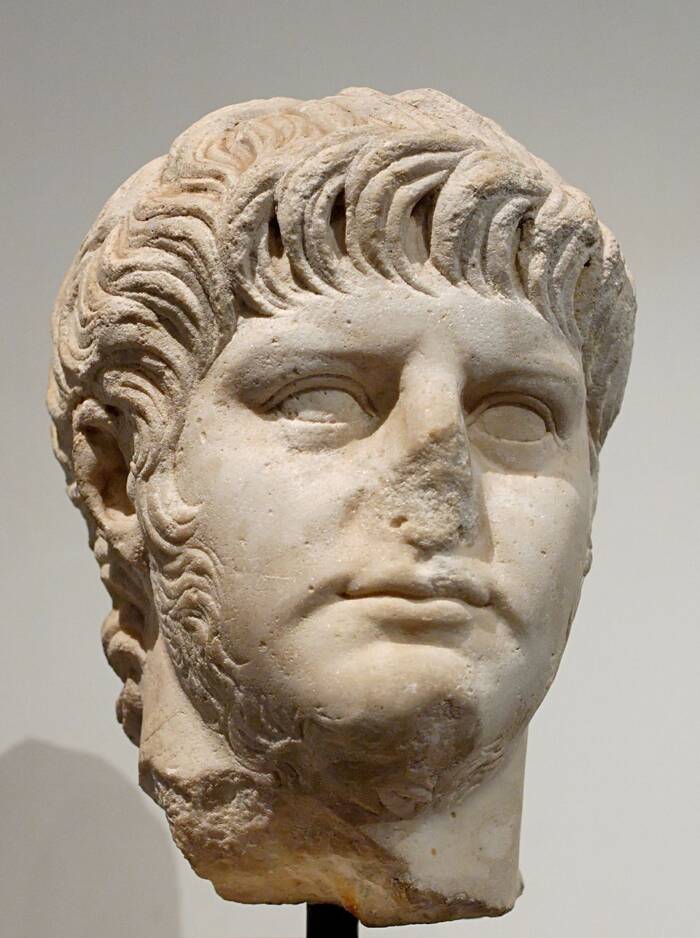
Public DomainA bust of Emperor Nero dating to the first century C.E.
He first lost the support of the wealthy elite by appearing in public to play the lyre, act in theatrical performances, and recite poetry. These actions were seen as degrading to the role of an emperor, but they increased Nero’s popularity among Rome’s lower classes.
However, this approval was fleeting. Nero would soon reveal himself as one of the cruelest and most violent rulers of the early Roman Empire.
The Fall Of Rome’s Tyrannical Ruler
Nero’s descent into cruelty was gradual at first, but it grew in lockstep with the emperor’s ego and increasing sense of invulnerability. He began accusing various senators and generals of treason and ordering their execution. As the Roman historian Suetonius wrote in The Lives of the Twelve Caesars, Nero “showed neither discrimination nor moderation in putting to death whomsoever he pleased on any pretext whatever.”
Meanwhile, Nero grew ever more paranoid — and his delusions soon honed in on his mother.
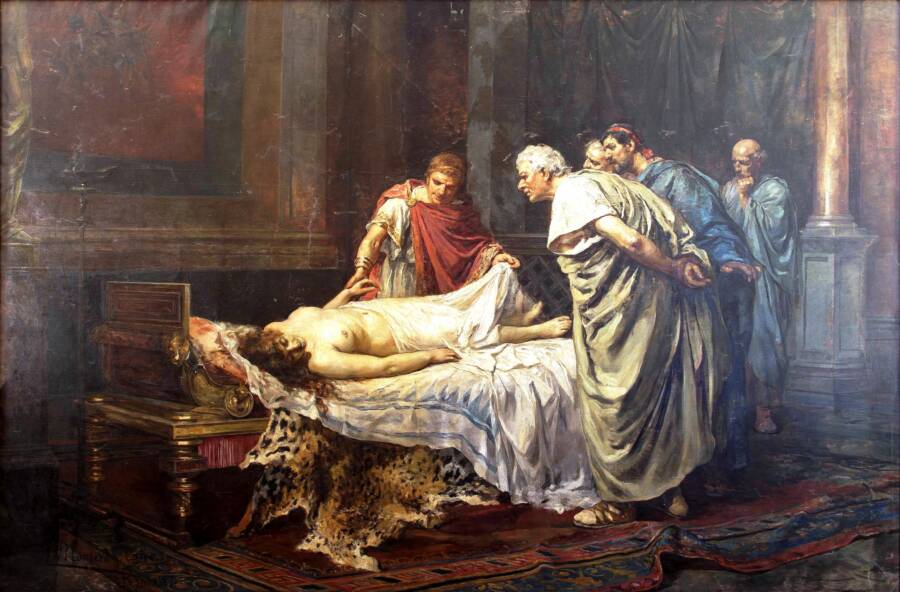
Public DomainThis painting by Arturo Montero y Calvo depicts Nero standing over the corpse of his mother, Agrippina the Younger.
By the age of 22, Nero was determined to murder Agrippina, not despite her integral role in bringing him to power, but because of it. Agrippina was highly motivated and ambitious, wielding enormous power in Rome’s political affairs. She also opposed Nero’s relationship with Poppaea Sabina, whom he would later marry.
Nero’s initial scheme on Agrippina’s life failed. He staged a shipwreck, but she survived by swimming to shore. When the emperor learned that his plot had gone awry, he instead accused his mother of conspiring against him, had her put to death, and then claimed that she’d taken her own life.
The emperor reportedly grew even more cruel following this matricide, and by the time the Great Fire of Rome devastated the city in 64 C.E., even his loyal subjects had started to turn on him. While Nero never actually fiddled while Rome burned, rumors quickly spread that he had started the blaze so that he could redesign the city.
In reality, he had organized and personally funded relief efforts, opened his palaces to provide shelter, and fed the survivors. But none of this mattered due to his past behavior. So, seeing that public opinion had hardened against him, Emperor Nero tried another tactic.
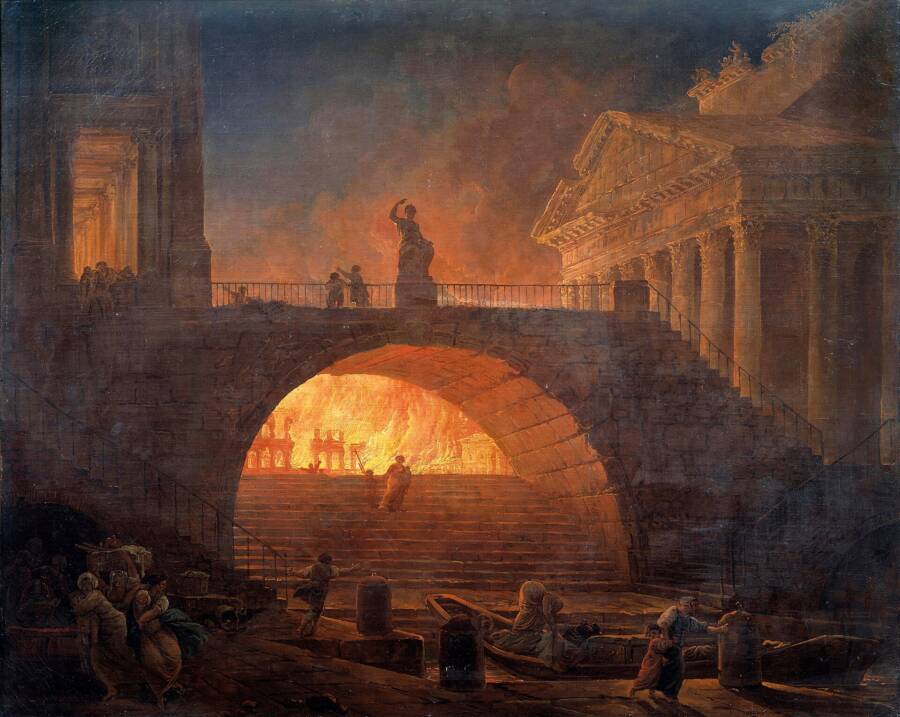
Public DomainThe Fire of Rome (1785) by Hubert Robert.
According to the Roman historian Tacitus, Nero blamed the fire on Christians. “First, then,” Tacitus wrote, “the confessed members of the sect were arrested; next, on their disclosures, vast numbers were convicted… And derision accompanied their end: they were covered with wild beasts’ skins and torn to death by dogs; or they were fastened on crosses, and, when daylight failed were burned to serve as lamps by night.”
By 68 C.E., officials were rebelling against Nero’s rising taxes. Support began to rise for Servius Sulpicius Galba, a governor in what’s now Spain. The empire had fallen into discontent — and the Senate declared Nero a public enemy.
Inside Emperor Nero’s Death By Suicide
On June 9, 68 C.E., Nero awoke in his palace in Rome to discover that his guards had abandoned him. The prefect of the Praetorian Guard had already declared his allegiance to Galba. With just a handful of freedmen left on his side, Nero fled Rome in disguise, rushing to a villa outside of the city.
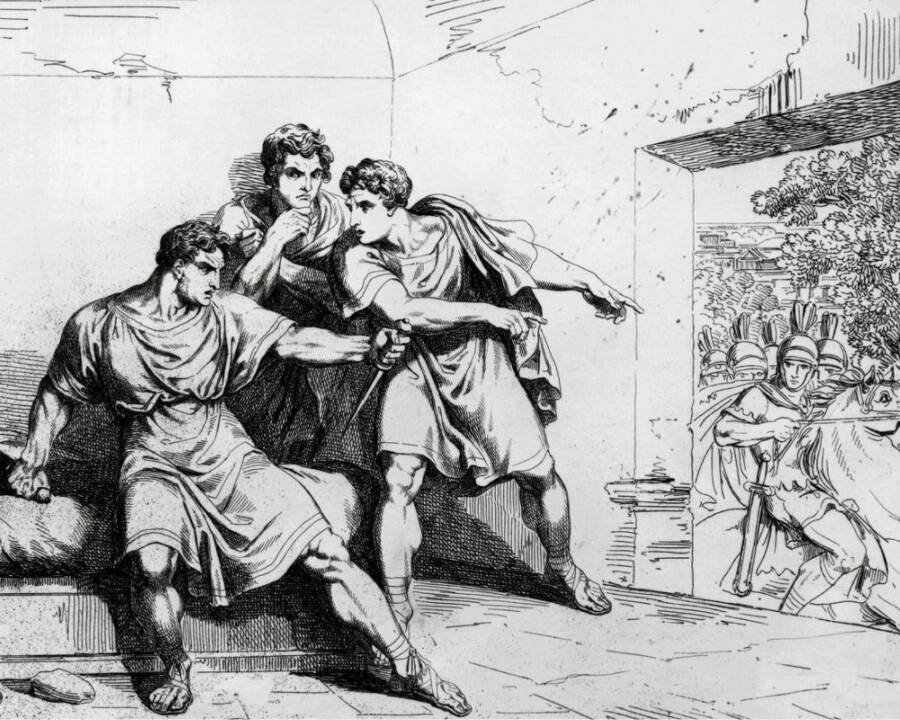
Public DomainA 19th-century engraving by Italian artist Bartolomeo Pinelli depicting the moments before Emperor Nero’s suicide.
According to Suetonius, Nero had his men dig him a grave as he wept, “What an artist the world is losing!” Then, he noticed the approaching hoofbeats of soldiers coming to detain him for his public execution. Suetonius wrote:
“When he heard them, he quavered: ‘Hark, now strikes on my ear the trampling of swift-footed coursers!’ and drove a dagger into his throat, aided by Epaphroditus, his private secretary. He was all but dead when a centurion rushed in, and as he placed a cloak to the wound, pretending that he had come to aid him, Nero merely gasped: ‘Too late!’ and ‘This is fidelity!’ With these words he was gone, with eyes so set and starting from their sockets that all who saw him shuddered with horror.”
Although the Romans had pushed their ruler to suicide, Emperor Nero’s death threw the empire into chaos that threatened to ruin it.
The Aftermath Of Emperor Nero’s Death
The death of Emperor Nero brought about the Year of the Four Emperors. Galba, Otho, and Vitellius rose to power as quickly as they fell before Vespasian finally took the throne and ruled for the next decade.
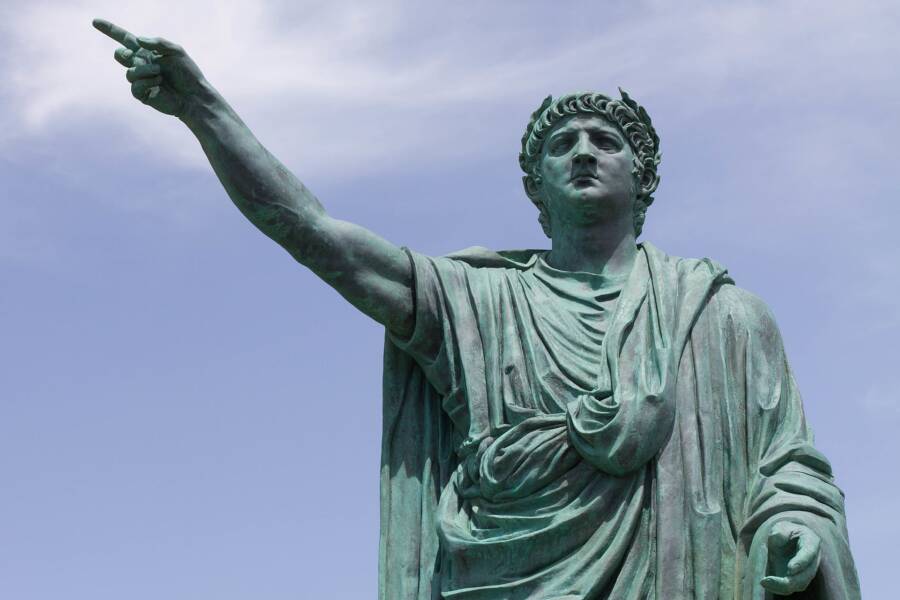
Helen Cook/Wikimedia CommonsA statue of Nero in his birthplace of Antium, modern-day Anzio, Italy.
Roman writers would portray Nero as the image of excess, violence, and utter egomania. He became a cautionary tale whose statues were dismantled and memory was condemned.
Some historians have painted a different picture, however, alleging that Rome’s lower classes would whisper that Nero wasn’t actually dead but in hiding, just waiting to return to power. There are even accounts of impostors claiming to be the late emperor.
In the end, however, there was one defining lesson in Emperor Nero’s death: Rome had told itself a story that hereditary rule ensured stability and order. But the calamitous end of the Julio-Claudian dynasty, with all its suicides, rebellions, and chaos, was a reminder of the most undying truth for all empires: Power rests on force, not tradition.
After reading about Emperor Nero’s death, learn when exactly Rome fell. Then, go inside the story of Locusta of Gaul, Nero’s personal assassin.