The father of John F. Kennedy, Joseph P. Kennedy Sr. demanded that his son run for president and funded his campaign — using a fortune that some believe came from bootlegging.
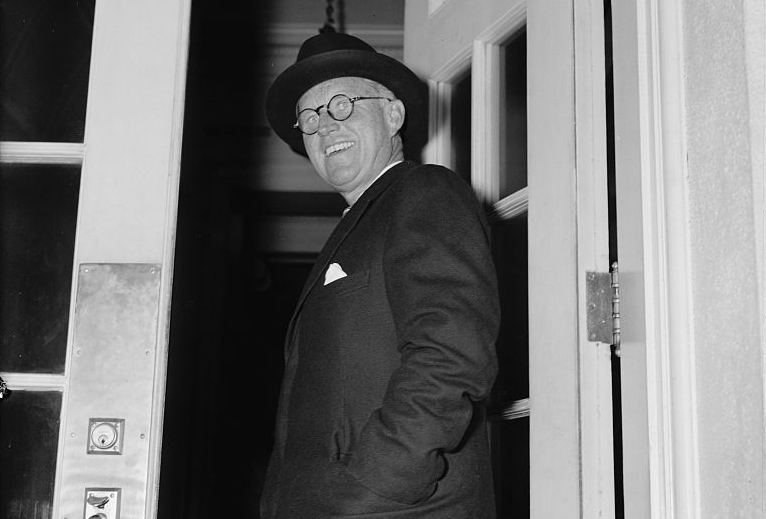
Library of CongressJoseph Kennedy Sr. in Washington, D.C., circa 1940.
In 1960, John F. Kennedy was elected president of the United States. At 43 years old, he was the youngest elected president in American history, and the country’s first Irish Catholic president. And he wouldn’t have gotten there without the encouragement of his father, Joseph P. Kennedy Sr.
Highly ambitious, and one of the wealthiest men in the United States, Joseph not only urged his son to run for president, but he funded his campaign. Joseph had long desired for his sons to rise to the highest office in the land, and the election of Jack seemed like a fulfillment of his dream.
But the dream had a dark side. Not only would Joseph lose Jack to an assassin’s bullet in 1963, but he would also live to see the assassination of another son, Robert F. Kennedy, during his own presidential campaign in 1968. The death of his son Joe Jr. in 1944, and his daughter Kick in 1948, have thus led to rumors of the “Kennedy Curse.”
Indeed, Joseph P. Kennedy Sr. saw both great highs and great lows during his life. This is his story, from the allegedly unscrupulous ways he earned his fortune, to how he urged his sons to run for president, to the debilitating stroke that stole his ability to speak at the end of his life.
The Glittering Rise Of Joseph P. Kennedy
Born on Sept. 6, 1888 to Patrick Joseph “P.J.” Kennedy and Mary Augusta Hickey, Joseph Patrick Kennedy grew up in East Boston. His father P.J. was an important figure in the community, a liquor importer who entered politics as a ward boss and then a Massachusetts state senator.
P.J. saw big things for his son, and enrolled him in the predominantly-Protestant Boston Latin School, which the National Park Service reports was the top choice of Boston’s elites. From there, Joseph further ascended the social ladder by attending Harvard University, graduating in 1912.
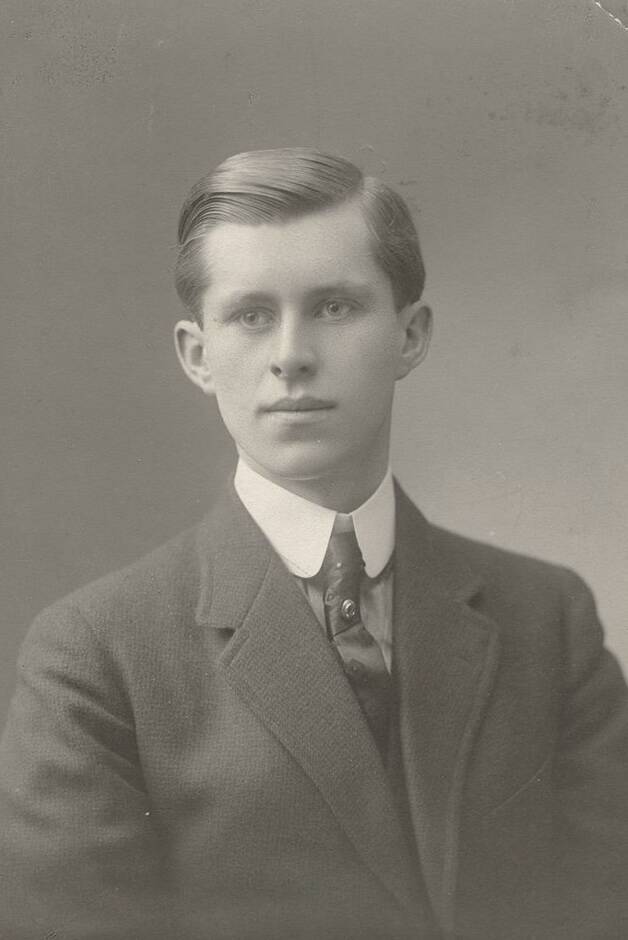
John F. Kennedy Presidential Library and Museum, BostonJoseph P. Kennedy circa 1913.
He had big dreams of his own. As The New York Times reported, Joseph told his friends that he planned to be a millionaire before he turned 35.
But despite his advances, Joseph was still Irish Catholic in a time of great prejudice, and he had to be creative to further himself in his career. After securing a job as state bank examiner, he raised the alarm about an attempt to take over the Columbia Trust, Boston’s only Irish-owned bank. The bank owners rewarded him by making him president and Joseph, just 25, became one of the youngest bank presidents in the country.
He further ascended in the social ranks in 1914, when he married Rose Fitzgerald, the eldest daughter of Boston mayor John Fitzgerald. The couple would eventually have nine children — Joe Jr., John, Rosemary, Kathleen, Eunice, Patricia, Robert, Jean Ann, and Edward — who they raised in the affluent and fashionable Boston neighborhood of Brookline.
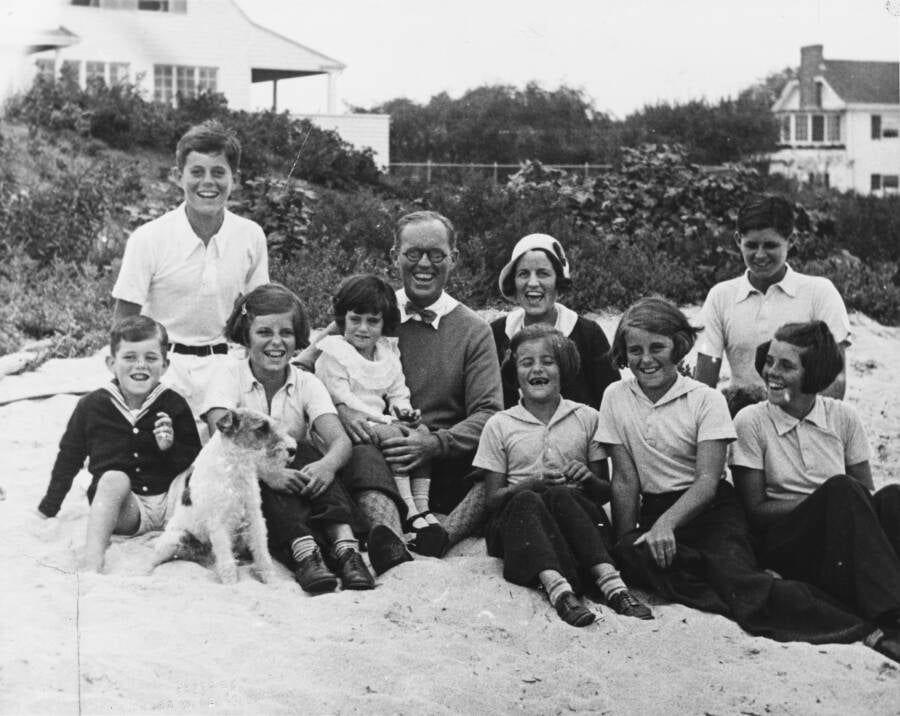
John F. Kennedy Presidential Library and MuseumJoseph P. Kennedy, his wife, Rose, and eight of their nine children. Rose is pregnant with their youngest child, Ted.
Then, Joseph P. Kennedy set out to make his fortune.
How Joseph P. Kennedy Built His Fortune
For decades, rumors have spread that Joseph P. Kennedy made his millions as a bootlegger who worked with the mob. Frank Costello even claimed that he and Joseph were “partners” in the liquor businesses, according to The New York Times. But these rumors have not been substantiated, and while Joseph sometimes engaged in unscrupulous business practices, he was seemingly careful to stay within the bounds of the law.
In The Patriarch: The Remarkable Life and Turbulent Times of Joseph P. Kennedy, historian David Nasaw chased down rumors of Joseph’s bootlegging and came up empty. According to Nasaw, the closest Joseph got to bootlegging was supplying free Scotch he’d gotten from his his father at his Harvard class reunion. However, Joseph was an early importer of liquor at the end of Prohibition, and Nasaw admits that Joseph might have worked with “former gangsters” to get his importation business off the ground.
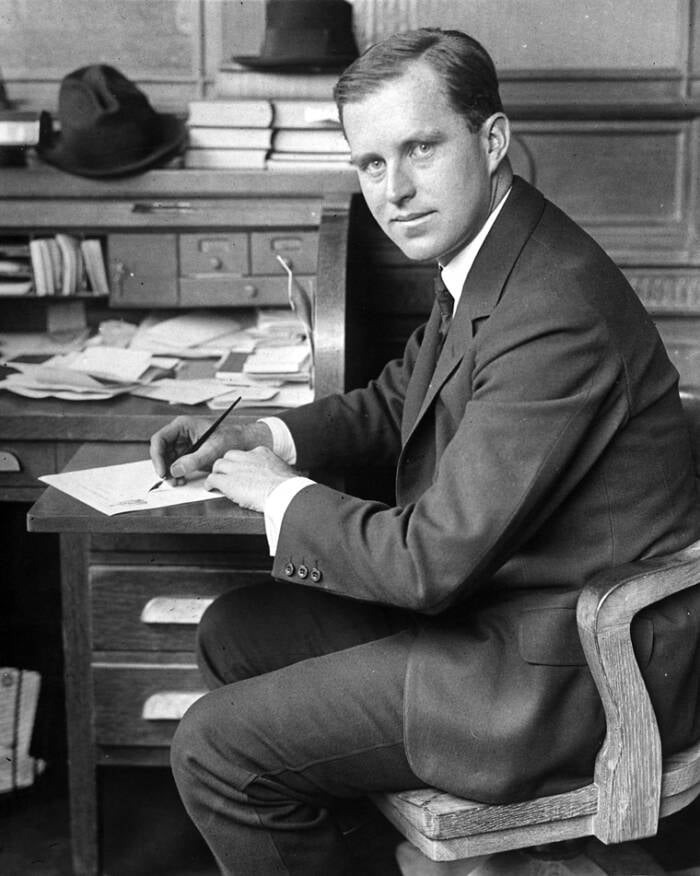
John F. Kennedy Presidential Library and MuseumJoseph Kennedy in 1914, at the age of 25.
Otherwise, Joseph Kennedy built his wealth through other means.
In the 1920s, he made a fortune after buying a film studio and producing a number of inexpensive B-movies, becoming a multimillionaire before the age of 40. And in 1929, Joseph predicted the looming economic crash. He sold his stock holdings and started shorting stocks, which increased his fortune as most of the country lost theirs in the Great Depression.
Joseph P. Kennedy Sr. was well on his way to becoming one of the wealthiest men in the country. And in the 1930s, his political star rose as well when he supported Franklin Roosevelt in the presidential election of 1932.
The Kennedy Patriarch’s Political Rise — And Fall
As a reward for his loyalty during the presidential campaign, Roosevelt appointed Joseph P. Kennedy as the first chairman of the Securities and Exchange Commision. Joseph lead the SEC for 14 months before becoming chairman of the Maritime Commission. But as Nasaw wrote, what Joseph really wanted was to become Secretary of the Treasury.
However, Roosevelt was happy with his current pick, Henry Morgenthau. The president sent his son to find out what else Joseph might want, and Joseph Kennedy stated that he wanted to be ambassador to the United Kingdom.
Upon hearing the news, Roosevelt laughed so hard he almost fell out of his wheelchair. Joseph Kennedy was intelligent and capable, but had a fierce temper and a foul mouth. He was “among the least diplomatic men in Washington,” according to Nasaw, but Roosevelt did need an ambassador, and Joseph was a superb analyst — and loyal to the president.
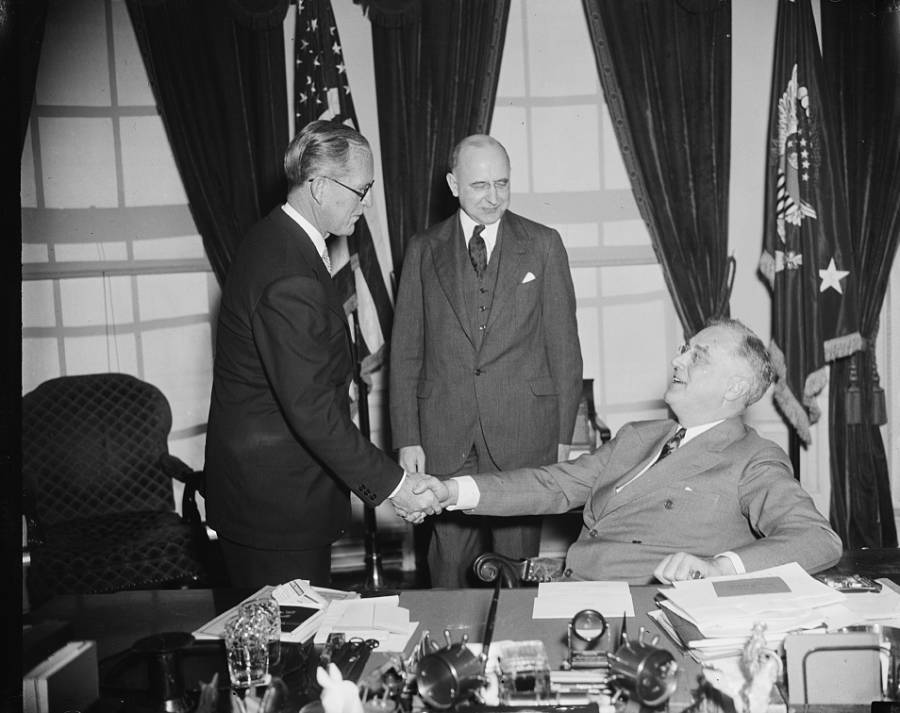
Library of CongressPresident Franklin Roosevelt (right) congratulates Joseph Kennedy Sr. (left) just after Kennedy took the oath as U.S. ambassador to the United Kingdom at the White House on February 18, 1938.
But though he had higher political ambitions, Joseph Kennedy’s ambassadorship would prove to be the undoing of his career. Shortly after he arrived in London in 1938, World War II began in Europe.
Not only did Joseph Kennedy advocate for appeasement with Nazi Germany and express support for isolationism, but he left London for the countryside during the Blitz. He was seen as cowardly and defeatist, and his public statements were increasingly at odds with Roosevelt’s.
What’s more, Joseph P. Kennedy held deeply antisemitic views. Though Nasaw notes that he made a concerted effort to save German Jews in 1938-1939, Joseph also “succumb[ed] to anti-Semitic scapegoating” and claimed the media and even Roosevelt was controlled by the Jews.
With both the British and the Americans turning against him, Joseph Kennedy resigned his ambassadorship in 1940. His political career was over. But the decade would bring further tragedy: in 1944, his eldest son, Joe, was killed in action. In 1948, his daughter “Kick” Kennedy died in a plane crash.
Joseph then passed his political ambitions to his son, John “Jack” Kennedy. But though Joseph would watch his son reach the White House, he’d also suffer terrible tragedies before his death in 1969.
The Many Tragedies Of Joseph P. Kennedy Sr.
After World War II, John F. Kennedy considered a career in journalism. But after Joe Jr.’s death, their father pushed him to pursue a political career instead. By the 1950s, Joseph was one of the 16 wealthiest Americans in the country, with a net worth of between $200 million and $400 million, and he used his fortune to fund Jack’s political campaigns.
In 1946, Jack Kennedy won a seat in Congress. In 1956, he won a seat in the Senate. And in 1960, he ran for president — and became the youngest elected president in U.S. history when he won at the age of 43.
“I got Jack into politics, I was the one,” Joseph P. Kennedy stated, according to The New York Times. “I told him Joe was dead and that it was his responsibility to run for Congress. He didn’t want to. He felt he didn’t have the ability and he still feels that way. But I told him he had to.”
“It was like being drafted,” John F. Kennedy remarked. “My father wanted his eldest son in politics. ‘Wanted’ isn’t the right word. He demanded it.”
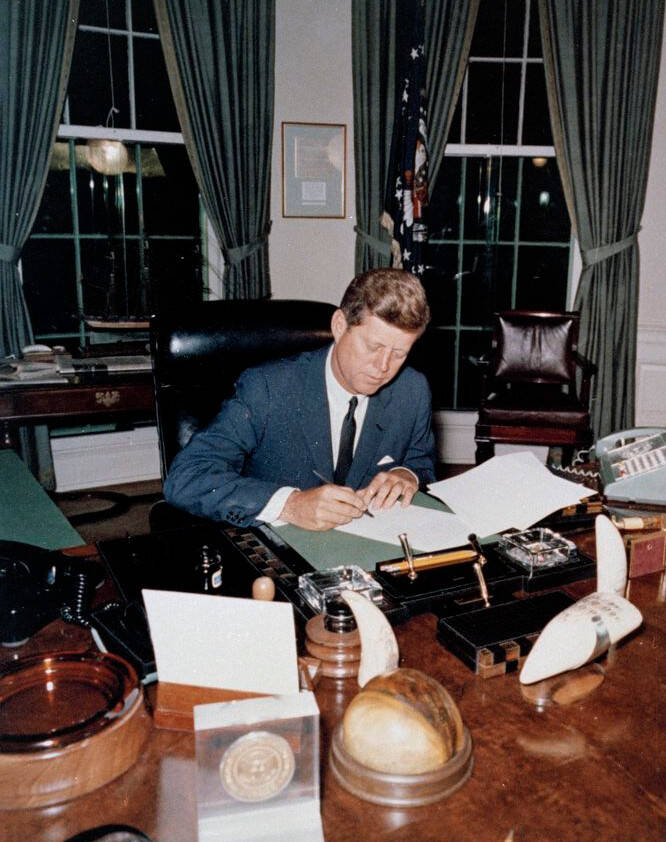
Public DomainJohn F. Kennedy in the White House. After winning the election of 1960, he was sadly assassinated in 1963.
But John F. Kennedy’s glamorous presidency ended in tragedy on Nov. 22, 1963, when he was assassinated in Dallas by Lee Harvey Oswald. A few years later, Joseph’s next eldest son, Bobby Kennedy, also ran for president — but he too was struck down by an assassin in 1968.
These events — and a number of other tragedies that the Kennedy family has suffered over the years — have led to rumors of a Kennedy curse.
However, Joseph P. Kennedy’s feelings about the loss of his sons are unknown. On Dec. 19, 1961, he suffered a debilitating stroke that left him partially paralyzed and unable to speak. He died almost eight years later, on Nov. 18, 1969, at the age of 81.
Today, Joseph P. Kennedy Sr. leaves behind a mixed legacy. On the one hand, Joseph’s political and financial acumen made him the patriarch of the wealthy Kennedy dynasty, a force in American politics even to this day. But Joseph’s possible mob connections, his antisemitism, and his appeasement of Nazi Germany have cast a dark shadow on the story of his life.
After this look at Joseph Kennedy Sr., the father of John F. Kennedy, go inside these surprising facts about George Washington. Then, discover some of Thomas Jefferson’s dark secrets.